Private Pilot · Unit 6 · 30 min
Communicating with Air Traffic Control
By the end of this lesson you will know:
- which three frequencies an arrival at a towered airport uses, and when two-way radio communications must be established
- which tower transmissions are advisory aids you may decline, and which are air traffic control (ATC) instructions that bind you under 14 CFR 91.123
- who has the final authority to accept or decline a land and hold short operations (LAHSO) clearance, and who should not participate
- which items in a taxi instruction are read back, and why a taxi route to the runway is not a clearance onto it
- what the radar traffic information service gives a VFR flight, and what it does not relieve you of
- what the six light gun signals mean in flight and on the surface, and how you acknowledge one
Calling a towered airport
When operating at an airport where traffic control is being exercised by a control tower, pilots are required to maintain two-way radio contact with the tower while operating within the Class B, Class C, and Class D surface area, unless the tower authorizes otherwise. Initial callup should be made about 15 miles from the airport (AIM 4-3-2). Unless there is a good reason to leave the tower frequency before exiting the surface area, it is a good operating practice to remain on the tower frequency for the purpose of receiving traffic information. It is not necessary to request permission to leave the tower frequency once outside those surface areas (AIM 4-3-2).
That callup uses the initial contact format the radio communications lesson gave. That format opens with the name of the facility being called and your full aircraft identification (AIM 4-2-3). Listen to the automatic terminal information service (ATIS) and note its letter before you call the tower, as the previous lesson covered.
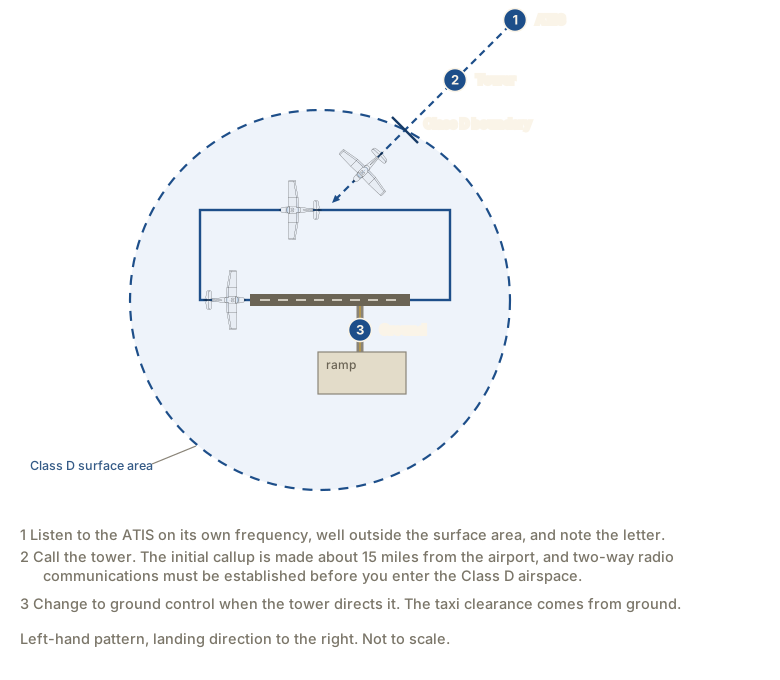
The regulation behind the second stage is 14 CFR 91.129(c)(1): each person arriving or operating through Class D airspace must establish two-way radio communications with the ATC facility providing air traffic services prior to entering that airspace, and thereafter maintain those communications while within that airspace. A person departing from the primary airport, or from a satellite airport with an operating control tower, must establish and maintain two-way radio communications with the control tower, and thereafter as instructed by ATC while operating in the Class D airspace area (14 CFR 91.129(c)(2)(i)). The airspace lesson gave the test for what "established" means: communications are established when the controller answers you using your aircraft call sign. The same test applies to Class C under 14 CFR 91.130(c)(1).
When necessary, the tower controller will issue clearances or other information for aircraft to generally follow the desired flight path when flying in the surface areas, and the proper taxi routes when operating on the ground (AIM 4-3-2). A local controller may give a VFR pilot a generalized instruction such as "proceed southwestbound, enter a right downwind runway three zero," and may provide a suggested heading such as "suggested heading two two zero, for radar identification." In both cases the instructions are advisory aids to the pilot flying VFR and are not radar vectors. You have complete discretion regarding acceptance of the suggested headings or directions, and sole responsibility for seeing and avoiding other aircraft (AIM 4-3-2). An ATC instruction otherwise binds you except in an emergency, under 14 CFR 91.123(b).
No person may, at any airport with an operating control tower, operate an aircraft on a runway or taxiway, or take off or land an aircraft, unless an appropriate clearance is received from ATC (14 CFR 91.129(i)).
After landing, exit the runway without delay at the first available taxiway or on a taxiway as instructed by ATC. Do not exit the landing runway onto another runway unless authorized by ATC. In the absence of ATC instructions, you are expected to taxi clear of the landing runway by taxiing beyond the runway holding position markings associated with that runway, even if that requires the aircraft to protrude into or cross another taxiway or ramp area. Once all parts of the aircraft have crossed those markings, hold unless further instructions have been issued by ATC. Immediately change to ground control frequency when advised by the tower, and obtain a taxi clearance (AIM 4-3-21).
AIM 4-3-2, 4-3-21; 14 CFR 91.126(d), 91.127(c), 91.129(c), 91.129(i), 91.130(c)(1)
Accepting or declining a LAHSO clearance
Land and hold short operations (LAHSO) include landing and holding short of an intersecting runway, an intersecting taxiway, or some other designated point on a runway other than an intersecting runway or taxiway (AIM 4-3-11). The markings lesson showed the yellow holding position markings and the red sign that mark the LAHSO point on the pavement.
At controlled airports, air traffic may clear a pilot to land and hold short. Pilots may accept such a clearance provided that the pilot in command determines that the aircraft can safely land and stop within the available landing distance (ALD). ALD data are published in the Chart Supplement and in the U.S. Terminal Procedures Publications. Controllers will also provide ALD data upon request (AIM 4-3-11).
If for any reason, such as difficulty in discerning the location of a LAHSO intersection, wind conditions, or aircraft condition, you elect to request to land on the full length of the runway, to land on another runway, or to decline LAHSO, you are expected to promptly inform air traffic, ideally even before the clearance is issued (AIM 4-3-11). A LAHSO clearance, once accepted, must be adhered to, just as any other ATC clearance, unless an amended clearance is obtained or an emergency occurs. A pilot who accepts a LAHSO clearance should land and exit the runway at the first convenient taxiway (unless directed otherwise) before reaching the hold short point. Otherwise, the pilot must stop and hold at the hold short point. A LAHSO clearance does not preclude a rejected landing. If a rejected landing becomes necessary after accepting one, maintain safe separation from other aircraft or vehicles and promptly notify the controller (AIM 4-3-11).
Controllers need a full read back of all LAHSO clearances. Include the words "hold short of" followed by the runway, taxiway, or point in your acknowledgment. Read the clearance back without prompting to reduce frequency congestion (AIM 4-3-11). The AIM's example runs: the controller says "cleared to land runway six right, hold short of taxiway bravo for crossing traffic," and the pilot answers "wilco, cleared to land runway six right to hold short of taxiway bravo" with the aircraft identification (AIM 4-3-11).
Pilots should only receive a LAHSO clearance when there is a minimum ceiling of 1,000 feet and 3 statute miles visibility. The intent of having basic VFR weather conditions is to allow pilots to maintain visual contact with other aircraft and ground vehicle operations (AIM 4-3-11).
AIM 4-3-11; PHAK Ch 14, "Land and Hold Short Operations (LAHSO)"; Pilot/Controller Glossary, "Land and Hold Short Operations"
The taxi clearance and its readback
Approval must be obtained prior to moving an aircraft or vehicle onto the movement area during the hours an airport traffic control tower is in operation. Always state your position on the airport when calling the tower for taxi instructions (AIM 4-3-18). Pilots of departing aircraft should communicate with the control tower on the appropriate ground control or clearance delivery frequency prior to starting engines. Unless otherwise advised by the tower, remain on that frequency during taxiing and runup, then change to the local control frequency when ready to request takeoff clearance (AIM 4-3-14). The majority of ground control frequencies are in the 121.6 to 121.9 megahertz (MHz) band. A controller may abbreviate one as, for example, "contact ground point seven." If any doubt exists as to what frequency is in use, promptly request the controller to provide that information (AIM 4-3-14).
Taxiing out at a towered airport involves separate clearances (AIM 4-3-18):
- A clearance must be obtained prior to crossing any runway. ATC will issue an explicit clearance for all runway crossings.
- When you are assigned a takeoff runway, ATC will first specify the runway, issue taxi instructions, and state any hold short instructions or runway crossing clearances if the taxi route will cross a runway. This does not authorize the aircraft to enter or cross the assigned departure runway at any point.
To preclude misunderstandings in radio communications, ATC will not use the word "cleared" in conjunction with authorization for aircraft to taxi (AIM 4-3-18). A taxi instruction that routes you to the runway is therefore not a clearance onto it.
Three items are read back when taxi instructions are received from the controller (AIM 4-3-18):
- the runway assignment;
- any clearance to enter a specific runway;
- any instruction to hold short of a specific runway, or to line up and wait.
Air traffic controllers are required to obtain from the pilot a readback of all runway hold short instructions (AIM 4-3-18). In the AIM's example, ground says "Beechcraft One Three One Five Niner, Washington ground, runway two seven, taxi via taxiways Charlie and Delta, hold short of runway three three left," and the pilot answers "Beechcraft One Three One Five Niner, runway two seven, hold short of runway three three left" (AIM 4-3-18).
Although an ATC clearance is issued for taxiing purposes, when operating in accordance with the CFRs it is the responsibility of the pilot to avoid collision with other aircraft. Since the pilot in command of an aircraft is directly responsible for, and is the final authority as to, the operation of that aircraft, obtain clarification of any clearance or instruction which is not understood (AIM 4-3-18). If you are unfamiliar with the airport, or for any reason confusion exists as to the correct taxi routing, you may request progressive taxi instructions, which include step-by-step routing directions (AIM 4-3-18).
The markings lesson covered the runway holding position marking, four yellow lines with the solid pair on the side where the aircraft must hold, and the rule that when instructed by ATC to hold short of a runway you must stop so that no part of the aircraft extends beyond that marking.
AIM 4-3-14, 4-3-18; PHAK Ch 14, "Taxiing"; 14 CFR 91.129(i)
Compliance with ATC instructions: 14 CFR 91.123
A clearance is an authorization to proceed under stated conditions. An instruction is a directive issued for a specific action. 14 CFR 91.123 governs both, in five paragraphs.
- Deviating from a clearance. When an ATC clearance has been obtained, no pilot in command may deviate from that clearance unless an amended clearance is obtained, an emergency exists, or the deviation is in response to a traffic alert and collision avoidance system resolution advisory (14 CFR 91.123(a)).
- Uncertainty about a clearance. When a pilot is uncertain of an ATC clearance, that pilot shall immediately request clarification from ATC (14 CFR 91.123(a)).
- Operating contrary to an instruction. Except in an emergency, no person may operate an aircraft contrary to an ATC instruction in an area in which air traffic control is exercised (14 CFR 91.123(b)).
- Reporting a deviation. Each pilot in command who, in an emergency or in response to a resolution advisory, deviates from an ATC clearance or instruction shall notify ATC of that deviation as soon as possible (14 CFR 91.123(c)). Each pilot in command who is given priority by ATC in an emergency shall submit a detailed report of that emergency within 48 hours to the manager of that ATC facility, if requested by ATC (14 CFR 91.123(d)).
- Another aircraft's clearance. Unless otherwise authorized by ATC, no person operating an aircraft may operate that aircraft according to any clearance or instruction that has been issued to the pilot of another aircraft for radar air traffic control purposes (14 CFR 91.123(e)). An instruction to follow a preceding aircraft does not authorize you to comply with any ATC clearance or instruction issued to that aircraft (AIM 4-1-18).
The emergency exception in 91.123 is the same authority the operating rules lesson gave you under 14 CFR 91.3(b): in an in-flight emergency requiring immediate action, the pilot in command may deviate from any rule of Part 91 to the extent required to meet that emergency. Pilots must advise ATC if they cannot comply with the instructions issued, and request amended instructions (PHAK Chapter 14).
14 CFR 91.3(b), 91.123; PHAK Ch 14, "Towered Airport"; AIM 4-1-18
Radar traffic advisories for a VFR flight
The radar traffic information service advises pilots of any radar target observed on the radar display which may be in such proximity to the position of their aircraft or its intended route of flight that it warrants their attention. This service is not intended to relieve the pilot of the responsibility for continual vigilance to see and avoid other aircraft (AIM 4-1-15).
All commissioned radar facilities provide four basic radar services for VFR aircraft (AIM 4-1-18):
- safety alerts;
- traffic advisories;
- limited radar vectoring on a workload permitting basis;
- sequencing at locations where procedures have been established for this purpose.
Traffic information is routinely provided to aircraft on IFR flight plans, and it may be provided to flights not operating on IFR flight plans when requested by pilots of such flights (AIM 4-1-15).
Many factors, such as limitations of the radar, volume of traffic, controller workload, and communications frequency congestion, could prevent the controller from providing this service. Controllers possess complete discretion for determining whether they are able to provide or continue to provide this service in a specific case. The controller's reason against providing it is not subject to question, nor need it be communicated to the pilot (AIM 4-1-15).
Pilots of arriving aircraft should contact approach control on the publicized frequency and give their position, altitude, aircraft call sign, type of aircraft, radar beacon code if transponder equipped, destination, and request traffic information (AIM 4-1-18). En route, the request is shorter: "Miami Center, Baron Five Six Three Hotel, request V-F-R traffic advisories" (AIM 4-2-3). Pilots of departing VFR aircraft are encouraged to request radar traffic information by notifying ground control, or where applicable clearance delivery, on initial contact with their request and proposed direction of flight (AIM 4-1-18).
The controller calls traffic by azimuth from your aircraft in terms of the 12 hour clock, then distance in nautical miles, then the direction in which the target is proceeding, then the type of aircraft and its altitude if known: "traffic 10 o'clock, 3 miles, westbound" (AIM 4-1-15). The clock position is measured from your track rather than your heading (PHAK Figure 14-44). The radar controller can only observe aircraft track on the radar display. When your heading is left of your track, traffic issued as 12 o'clock appears to the right of your nose. In the AIM's example the pilot sees it at 2 o'clock (AIM 4-1-15).
Monitor the assigned frequency at all times. VFR radar advisory service does not include vectors away from conflicting traffic unless requested by the pilot. When the service is no longer desired, advise the controller before changing frequencies, then change your transponder code to 1200, if applicable (AIM 4-1-15).
When a controller requests a code or function on the transponder, the word squawk may be used (PHAK Chapter 14). "Squawk five seven zero seven" means operate the transponder on that code. "Squawk altitude" means activate Mode C with automatic altitude reporting. "Ident" means engage the ident feature of the transponder, which helps the controller confirm an aircraft identity or identify an aircraft (PHAK Figure 14-43; Pilot/Controller Glossary, "Ident"). "Squawk VFR" means operate the transponder on code 1200 in Mode A/3, or other appropriate VFR code (PHAK Figure 14-43).
Inside a terminal radar service area (TRSA), which the airspace lesson described, the service is radar sequencing and separation for VFR aircraft. Pilot participation is urged but is not mandatory. Participating VFR aircraft are separated from IFR and other participating VFR aircraft by 500 feet of vertical separation, by visual separation, or by target resolution. If you do not want the service, state "negative TRSA service" on initial contact with approach control or ground control, as appropriate (AIM 4-1-18).
AIM 4-1-15, 4-1-18, 4-2-3; PHAK Ch 14, "Radar Traffic Advisories," Figure 14-43 and Figure 14-44; 14 CFR 91.155
When the radio fails: light gun signals
ATC personnel use a directive traffic control signal which emits an intense narrow light beam of a selected color, either red, white, or green, when controlling traffic by light signals (AIM 4-3-13). ATC light signals have the meanings fixed by regulation in 14 CFR 91.125.
| Color and type of signal | Meaning with respect to aircraft on the surface | Meaning with respect to aircraft in flight |
|---|---|---|
| Steady green | Cleared for takeoff | Cleared to land |
| Flashing green | Cleared to taxi | Return for landing (to be followed by steady green at proper time) |
| Steady red | Stop | Give way to other aircraft and continue circling |
| Flashing red | Taxi clear of runway in use | Airport unsafe, do not land |
| Flashing white | Return to starting point on airport | Not applicable |
| Alternating red and green | Exercise extreme caution | Exercise extreme caution |
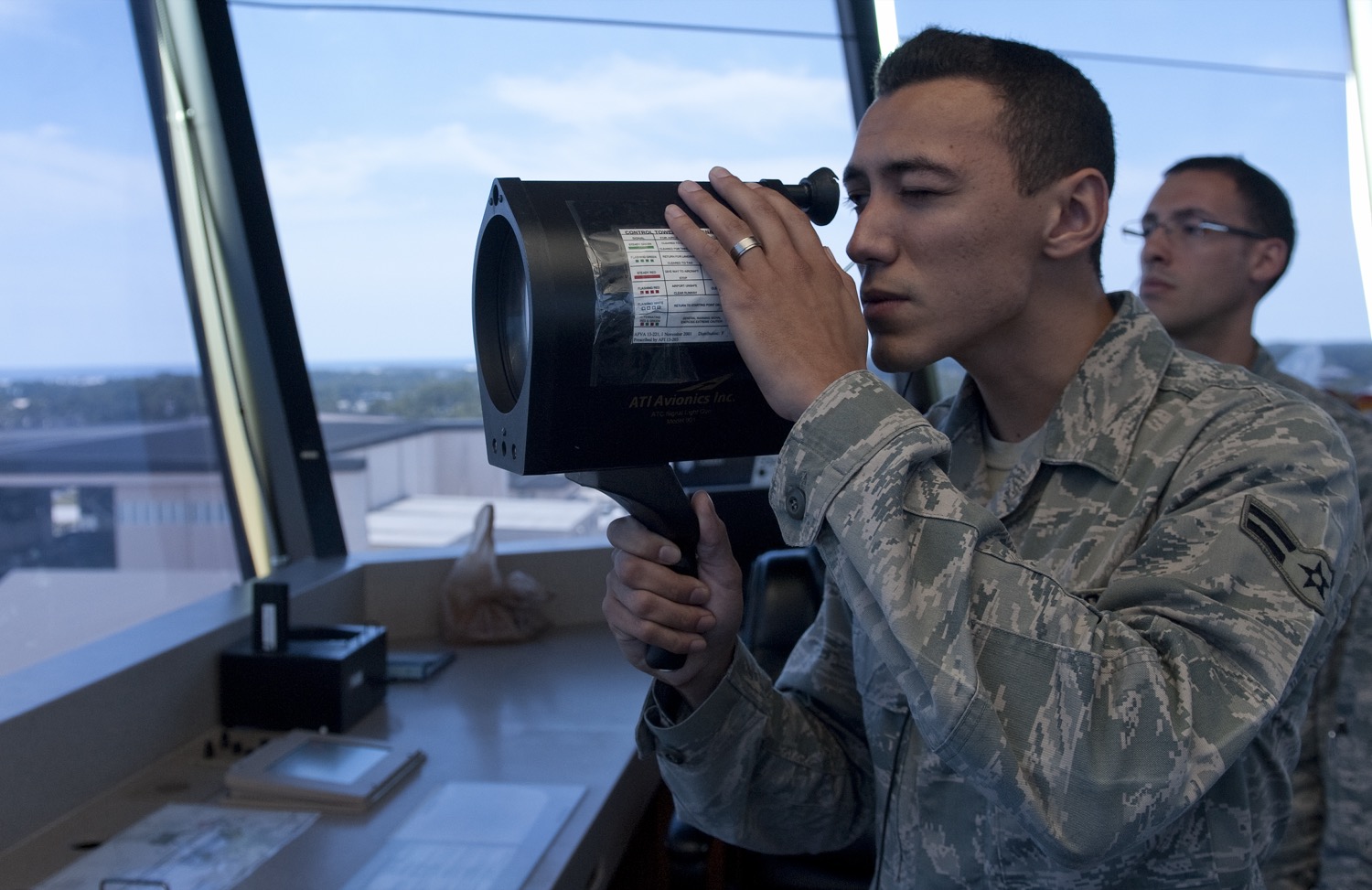
The light gun has two disadvantages (AIM 4-3-13). They are:
- pilots may not be looking at the control tower at the time a signal is directed toward their aircraft;
- the directions transmitted by a light signal are very limited, since only approval or disapproval of a pilot's anticipated actions may be transmitted, and no supplementary or explanatory information may be transmitted except by the alternating red and green general warning signal.
Between sunset and sunrise, a pilot wishing to attract the attention of the control tower should turn on a landing light and taxi the aircraft into a position clear of the active runway so that the light is visible to the tower. Leave the landing light on until appropriate signals are received (AIM 4-3-13).
How you arrive depends on which parts of the radio have failed (AIM 4-2-13).
- Receiver inoperative. Remain outside or above the Class D surface area until the direction and flow of traffic has been determined, then advise the tower of your type of aircraft, position, altitude, and intention to land, and request that you be controlled with light signals. When you are approximately 3 to 5 miles from the airport, advise the tower of your position and join the airport traffic pattern. From that point on, watch the tower for light signals, and if a complete pattern is made, transmit your position downwind and turning base leg.
- Transmitter inoperative. Remain outside or above the Class D surface area until the direction and flow of traffic has been determined, then join the airport traffic pattern. Monitor the primary local control frequency as depicted on sectional charts for landing or traffic information, and look for a light signal which may be addressed to your aircraft.
- Transmitter and receiver inoperative. Remain outside or above the Class D surface area until the direction and flow of traffic has been determined, then join the airport traffic pattern and maintain visual contact with the tower to receive light signals.
Acknowledge a tower transmission or a light signal in one of three ways, according to where you are and whether it is day or night (AIM 4-2-13, 4-3-13). They are:
- in flight during hours of daylight, rock your wings;
- on the ground during daylight hours, move the ailerons or rudder;
- at night, blink the landing or navigation lights.
If the aircraft radio fails in flight under VFR, the pilot in command may operate that aircraft and land if (14 CFR 91.129(d)(2)):
- weather conditions are at or above basic VFR weather minimums;
- visual contact with the tower is maintained; and
- a clearance to land is received.
The identical three conditions permit you to operate the aircraft and land after a radio failure at an airport in Class G airspace that has an operational control tower (14 CFR 91.126(d)). A radio failure in flight under IFR falls under 14 CFR 91.185, which an instrument course covers.
If you experience radio failure before leaving the parking area, make every effort to have the equipment repaired. If you are unable to have the malfunction repaired, call the tower by telephone and request authorization to depart without two-way radio communications. If tower authorization is granted, you will be given departure information and requested to monitor the tower frequency or watch for light signals as appropriate (AIM 4-2-13). Arrivals without a radio, called no radio (NORDO) arrivals, are not accepted at busy airports (PHAK Chapter 14). If it is practical, consider landing instead at a lower traffic airport without an operating control tower, where no radio communication is necessary. Other traffic expecting the standard radio calls may not be aware of your presence (PHAK Chapter 14).
If an aircraft with a coded radar beacon transponder experiences a loss of two-way radio capability, the pilot should adjust the transponder to reply on Mode A/3, Code 7600 (AIM 6-4-2). The transponder codes and the frequencies that belong to an emergency rather than a radio failure come with Diversions and Lost Procedures in Unit 10.
14 CFR 91.125, 91.126(d), 91.129(d)(2); AIM 4-2-13, 4-3-13 and TBL 4-3-13, 6-4-2; PHAK Ch 14, "Lost Communication Procedures" and Figure 14-42
What the rest of this unit adds
This lesson has covered the sequence of frequencies at a towered airport, the two-way communications the airspace requires, the LAHSO clearance, the taxi clearance and its readback, compliance with ATC instructions under 14 CFR 91.123, radar traffic advisories for a VFR flight, and the light gun signals.
- Reading the Sectional Chart covers the airport data block where the tower and ATIS frequencies print alongside the common traffic advisory frequency (CTAF), the RP notation that marks a right-hand pattern, the airport diagram and its hot spots, and the rest of the chart legend.
You transmit before you cross the airspace boundary, before the airplane enters a runway, and before you act on an instruction you cannot fly or do not understand.
- Call the tower far enough out that two-way radio communications are established before you reach the boundary. The initial callup is made about 15 miles from the airport, and the regulation requires the communications to exist before you enter the airspace.
- Read back the runway assignment, any clearance to enter a runway, and every hold short instruction, with your call sign. The controller is required to obtain that readback, and a clearance must be obtained before crossing any runway.
- When you are uncertain of a clearance, immediately request clarification from ATC. When you cannot fly an instruction, tell ATC and request amended instructions.
Check your understanding
Answer from memory, without scrolling back up. Recalling it yourself is what makes it stick.
A land and hold short clearance is offered to you as a student pilot. You should?
Student pilots or pilots not familiar with LAHSO should not participate in the program, and the pilot in command has the final authority to accept or decline any land and hold short clearance. (AIM 4-3-11)
Declining LAHSO is not a bar on landing. You inform air traffic promptly and request the full length of the runway, or another runway, ideally even before the clearance is issued.
Ground gives you a taxi route with an instruction to hold short of Runway 33. You?
Read back the runway assignment, any clearance to enter a specific runway, and any instruction to hold short of a specific runway. Air traffic controllers are required to obtain from the pilot a readback of all runway hold short instructions. (AIM 4-3-18)
The hold short instruction is the item the controller must hear back from you. A clearance must be obtained prior to crossing any runway, and ATC issues an explicit clearance for every runway crossing.
Under 14 CFR 91.123, you may deviate from an ATC clearance when?
When an ATC clearance has been obtained, no pilot in command may deviate from that clearance unless an amended clearance is obtained, an emergency exists, or the deviation is in response to a traffic alert and collision avoidance system resolution advisory. (14 CFR 91.123(a))
The three grounds are an amended clearance obtained, an emergency, and a resolution advisory. Requesting an amendment is not the same as obtaining one, and a weather change is not on the list.
You are receiving VFR traffic advisories from approach control. That service?
Many factors could prevent the controller from providing this service, and controllers possess complete discretion for determining whether they are able to provide or continue it. The service is not intended to relieve the pilot of the responsibility for continual vigilance to see and avoid other aircraft. (AIM 4-1-15)
Traffic information is provided on a workload permitting basis and the controller may stop providing it without explanation. Nothing in the service relieves you of the duty to see and avoid.
In flight with a failed radio, the tower shows you a flashing green light. It means?
Flashing green to an aircraft in flight means return for landing, to be followed by a steady green at the proper time. Steady green is cleared to land, and steady red is give way to other aircraft and continue circling. (14 CFR 91.125)
Steady green is the clearance to land. Flashing green sends you back around for it. Acknowledge by rocking your wings in daylight, or by blinking the landing or navigation lights at night.
Arriving at a Class D airport, your initial callup to the tower is made?
Initial callup should be made about 15 miles from the airport (AIM 4-3-2), and each person arriving must establish two-way radio communications with the ATC facility prior to entering that airspace (14 CFR 91.129(c)(1)).
The regulation requires the communications to exist before you enter the airspace, and the AIM puts the callup about 15 miles out so that they are established before you cross the boundary.
A local controller gives you, flying VFR, a suggested heading for radar identification. It is?
A local controller's generalized instructions and suggested headings to a pilot flying VFR are advisory aids and are not radar vectors. You have complete discretion regarding acceptance of the suggested headings or directions and sole responsibility for seeing and avoiding other aircraft. (AIM 4-3-2)
That discretion applies only to those generalized directions and suggested headings. An ATC instruction otherwise binds you except in an emergency, under 14 CFR 91.123(b).
Your radio fails in flight under VFR at a towered field. You may land if?
If the aircraft radio fails in flight under VFR, the pilot in command may operate that aircraft and land if weather conditions are at or above basic VFR weather minimums, visual contact with the tower is maintained, and a clearance to land is received. (14 CFR 91.129(d)(2))
The three conditions are basic VFR weather minimums, visual contact with the tower, and a clearance to land. With the radio out, that clearance is the tower's steady green light.
A transponder-equipped aircraft that loses two-way radio capability squawks?
If an aircraft with a coded radar beacon transponder experiences a loss of two-way radio capability, the pilot should adjust the transponder to reply on Mode A/3, Code 7600. (AIM 6-4-2)
7600 is the two-way radio failure code. The transponder codes and frequencies that belong to an emergency come with Diversions and Lost Procedures in Unit 10.
On the ground in daylight with a failed radio, you acknowledge a light signal by?
On the ground during daylight hours, acknowledge by moving the ailerons or rudder. (AIM 4-2-13, 4-3-13)
Rocking the wings is the daylight acknowledgement while in flight, and blinking the landing or navigation lights is the acknowledgement at night. On the ground in daylight you move the ailerons or rudder.
Go deeper (primary source): read AIM Chapter 4, Section 3, Airport Operations in full, paying attention to the LAHSO paragraph and the taxi paragraph, then read AIM 4-1-18, Terminal Radar Services for VFR Aircraft. Then read 14 CFR 91.123 straight through and note which of its five paragraphs applies to a clearance and which to an instruction.