Private Pilot · Unit 6 · 30 min
Airport Markings and Signs
By the end of this lesson you will know:
- how runways laid out in the same direction are told apart, and which end of the pavement each letter belongs to
- the white elements that make up runway markings, and which of the three marking types carries each one
- what the pavement behind a displaced threshold may be used for, and what yellow chevrons rule out
- how a closed runway is marked, and where its closure is published authoritatively
- what the four yellow lines of a runway holding position marking require of you, and which side you hold on
- the color and the purpose of each of the six types of signs installed on an airfield
What the airport surface tells you
Airport pavement markings and signs provide information that is useful to a pilot during takeoff, landing, and taxiing. Uniformity in airport markings and signs from one airport to another enhances safety and improves efficiency (AIM 2-3-1).
Airport pavement markings fall into four groups: runway markings, taxiway markings, holding position markings, and other markings (AIM 2-3-2). The markings use two colors:
- Markings for runways are white.
- Markings for taxiways, for areas not intended for use by aircraft, and for holding positions are yellow. A holding position marking stays yellow even where it is painted on a runway.
The pavement is divided by authority as well as by color. The movement area is the runways, taxiways, and other areas of an airport used for taxiing, takeoff, and landing of aircraft, exclusive of loading ramps and parking areas. At an airport with a tower, specific approval for entry onto the movement area must be obtained from air traffic control (ATC) (Pilot/Controller Glossary).
The regulation behind that approval is 14 CFR 91.129(i): no person may, at any airport with an operating control tower, operate an aircraft on a runway or taxiway, or take off or land an aircraft, unless an appropriate clearance is received from ATC.
AIM 2-3-1, 2-3-2; Pilot/Controller Glossary, "Movement Area"; 14 CFR 91.129(i)
Parallel runways and their letters
The traffic pattern lesson gave the rule for a runway number. It is the whole number nearest one tenth of the magnetic azimuth of the centerline of the runway, measured clockwise from magnetic north (PHAK Chapter 14). Two strips of pavement pointing the same way would carry the same number.
Certain airports have two or even three runways laid out in the same direction. These are referred to as parallel runways, and they are distinguished by a letter added to the runway number: Runway 36L for left, Runway 36C for center, and Runway 36R for right (PHAK Chapter 14). Two parallel runways take L and R. Three take L, C, and R (AIM 2-3-3).
Runway numbers and letters are determined from the approach direction (AIM 2-3-3). The pavement marked 36L for an airplane landing to the north is marked 18R for an airplane landing to the south, because the left-hand runway of a pair viewed from one end is the right-hand runway viewed from the other.
The full designation is painted on the runway surface near the threshold, and it appears again on every sign that names that runway.
PHAK Ch 14, "Runway Markings and Signs" and "Runway Designation Marking"; AIM 2-3-3
What is painted on a runway
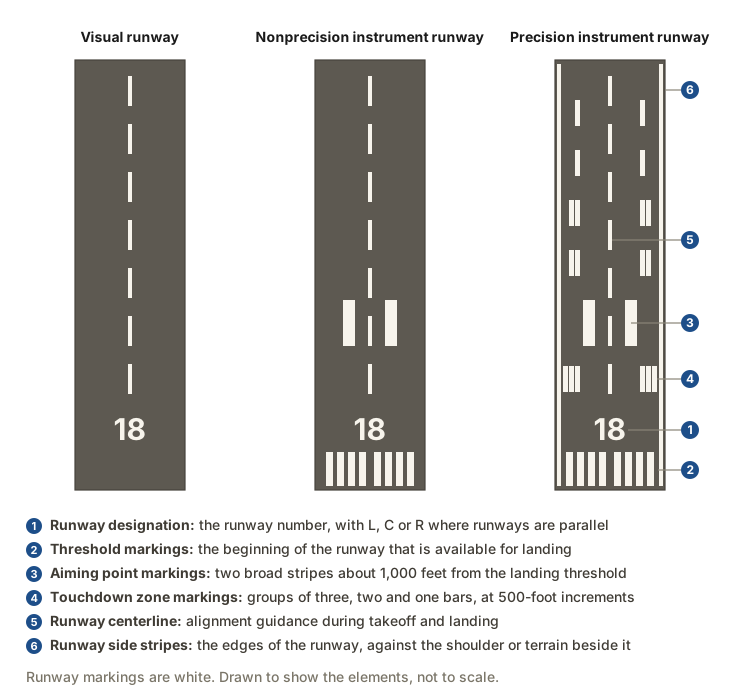
Runway markings vary depending on the type of operations conducted at the airport (PHAK Chapter 14). There are three types of markings for runways: visual, nonprecision instrument, and precision instrument (AIM 2-3-3). All three are assembled from the same list of white elements.
- The runway designation is the number, with its letter where the runways are parallel.
- The runway centerline marking identifies the center of the runway and provides alignment guidance during takeoff and landings. It consists of a line of uniformly spaced stripes and gaps (AIM 2-3-3).
- Runway threshold markings help identify the beginning of the runway that is available for landing. They are either eight longitudinal stripes of uniform dimensions disposed symmetrically about the runway centerline, or a number of stripes related to the runway width: four stripes at 60 feet, six at 75 feet, eight at 100 feet, twelve at 150 feet, and sixteen at 200 feet (AIM 2-3-3, Table 2-3-2).
- The aiming point marking serves as a visual aiming point for a landing aircraft. It is two rectangular markings, consisting of a broad white stripe located on each side of the runway centerline and approximately 1,000 feet from the landing threshold (AIM 2-3-3).
- Touchdown zone markings identify the touchdown zone for landing operations, and they are coded to provide distance information in 500-foot increments. They consist of groups of one, two, and three rectangular bars arranged symmetrically in pairs about the runway centerline (AIM 2-3-3).
- Runway side stripe markings delineate the edges of the runway. They provide a visual contrast between the runway and the abutting terrain or shoulders, and they are continuous white stripes on each side of the runway (AIM 2-3-3).
All three marking types carry the designation and the centerline. A nonprecision instrument runway adds the threshold markings and the aiming point marking. A precision instrument runway adds the touchdown zone markings and the side stripes on top of those. A visual runway carries threshold markings only where it is used, or intended to be used, by international commercial transports, and an aiming point marking only where it is 4,000 feet or longer and used by jet aircraft (AIM 2-3-3, Table 2-3-1).
AIM 2-3-3 and Tables 2-3-1 and 2-3-2; PHAK Ch 14, "Runway Markings and Signs"; PHAK Appendix C
Displaced and relocated thresholds
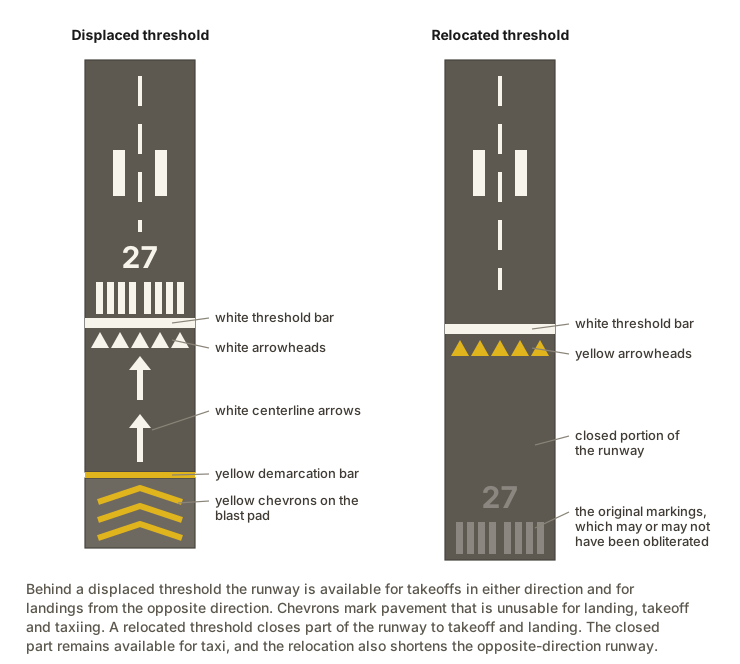
A displaced threshold is a threshold located at a point on the runway other than the designated beginning of the runway. Displacement of a threshold reduces the length of runway available for landings. The portion of runway behind a displaced threshold is available for takeoffs in either direction and landings from the opposite direction (AIM 2-3-3).
Three markings identify it. A ten-foot-wide white threshold bar is located across the width of the runway at the displaced threshold. White arrows are located along the centerline in the area between the beginning of the runway and the displaced threshold. White arrowheads are located across the width of the runway just prior to the threshold bar (AIM 2-3-3). The bar itself is what delineates the beginning of the runway available for landing (AIM 2-3-3).
A relocated threshold closes pavement rather than reserving it. Construction, maintenance, or other activities sometimes require the threshold to be moved toward the rollout end of the runway. When a threshold is relocated, it closes not only a set portion of the approach end of a runway, but also shortens the length of the opposite direction runway (AIM 2-3-3). The closed portion is not available for takeoff or landing, though it is available for taxi (PHAK Chapter 14). A NOTAM should be issued by the airport operator identifying the portion of the runway that is closed (AIM 2-3-3).
How a relocated threshold is marked varies, because the relocation can last anywhere from a few hours to several months. One common practice is a ten-foot-wide white threshold bar across the width of the runway (AIM 2-3-3), with yellow arrowheads placed across the width just prior to that bar (PHAK Chapter 14). The runway markings between the old threshold and the new one may or may not be obliterated, removed, or covered, and the runway lights in that stretch will not be illuminated (AIM 2-3-3).
Two yellow markings identify pavement that is not runway. A demarcation bar delineates a runway with a displaced threshold from a blast pad, stopway, or taxiway that precedes the runway. It is 3 feet wide and yellow, since it is not located on the runway (AIM 2-3-3). Chevrons are used to show pavement areas aligned with the runway that are unusable for landing, takeoff, and taxiing. Chevrons are yellow (AIM 2-3-3).
AIM 2-3-3; PHAK Ch 14, "Relocated Runway Threshold" and "Displaced Threshold"
Closed runways
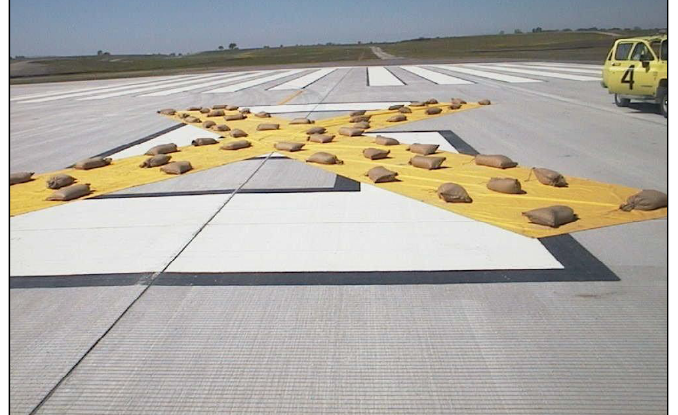
For runways and taxiways which are permanently closed, the lighting circuits will be disconnected. The runway threshold, runway designation, and touchdown markings are obliterated, and yellow crosses are placed at each end of the runway and at 1,000-foot intervals (AIM 2-3-6).
To provide a visual indication to pilots that a runway is temporarily closed, crosses are placed on the runway only at each end, and the crosses are yellow (AIM 2-3-6). A raised lighted yellow cross may be placed on each runway end in place of the painted marking (AIM 2-3-6). PHAK calls the lighted cross a very effective and preferable visual aid for depicting a temporary closure, because it is much more discernible to approaching aircraft than the materials laid on the surface (PHAK Chapter 14).
A visual indication may not be present at all. Whether one appears depends on the reason for the closure, the duration of the closure, the airfield configuration, and the existence and the hours of operation of an airport traffic control tower (AIM 2-3-6). Pilots should check NOTAMs and the Automated Terminal Information System (ATIS) for local runway and taxiway closure information (AIM 2-3-6). The NOTAM is the authoritative record of a closure, and the airspace unit introduced that system.
Temporarily closed taxiways are usually treated as hazardous areas, in which no part of an aircraft may enter, and they are blocked with barricades. As an alternative, a yellow cross may be installed at each entrance to the taxiway (AIM 2-3-6).
AIM 2-3-6; PHAK Ch 14, "Marking and Lighting of Permanently Closed Runways and Taxiways" and "Temporarily Closed Runways and Taxiways"
Taxiway markings
All taxiways should have centerline markings, and they should have runway holding position markings wherever they intersect a runway (AIM 2-3-4).
The taxiway centerline is a single continuous yellow line, 6 inches to 12 inches in width, which provides a visual cue to permit taxiing along a designated path. Ideally the aircraft should be kept centered over this line during taxi. Being centered on the taxiway centerline does not guarantee wingtip clearance with other aircraft or other objects (AIM 2-3-4).
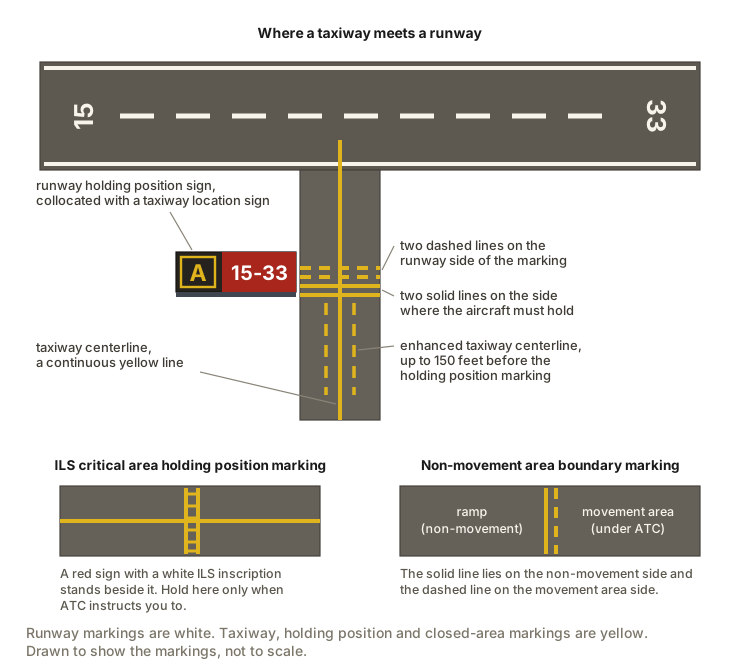
At some airports, mostly the larger commercial service airports, an enhanced taxiway centerline is used. It consists of a parallel line of yellow dashes on either side of the normal taxiway centerline, and the centerlines are enhanced for a maximum of 150 feet prior to a runway holding position marking. The purpose of the enhancement is to warn the pilot that a runway holding position marking is coming and that the aircraft should be prepared to stop, unless ATC has cleared it onto or across the runway (AIM 2-3-4).
Taxiway edge markings define the edge of the taxiway. There are two kinds:
- A continuous double yellow line defines the taxiway edge from the shoulder or some other abutting paved surface that is not intended for use by aircraft (AIM 2-3-4).
- A dashed double yellow line is used where the adjoining pavement is intended for use by aircraft, such as an apron (AIM 2-3-4).
Taxiways, holding bays, and aprons are sometimes provided with paved shoulders to prevent blast and water erosion. Although shoulders may have the appearance of full-strength pavement, they are not intended for use by aircraft and may be unable to support an aircraft. Taxiway shoulder markings are yellow (AIM 2-3-4).
Two further yellow markings divide the surface up rather than guide you along it:
- Non-movement area boundary markings delineate the movement area. They consist of two yellow lines 6 inches in width, one solid and one dashed. The solid line is located on the non-movement area side and the dashed line on the movement area side (AIM 2-3-6).
- Holding position markings for intersecting taxiways consist of a single dashed line extending across the width of the taxiway. They are located on taxiways where ATC holds aircraft short of a taxiway intersection (AIM 2-3-5).
Some signs are painted on the pavement rather than posted beside it. Surface painted taxiway direction signs have a yellow background with a black inscription, and surface painted location signs have a black background with a yellow inscription (AIM 2-3-4).
AIM 2-3-4, 2-3-5, 2-3-6; PHAK Ch 14, "Taxiway Markings and Signs" and "Enhanced Taxiway Centerline Markings"
The runway holding position marking
For runways, runway holding position markings indicate where aircraft must stop when approaching a runway. They consist of four yellow lines, two solid and two dashed, spaced six or twelve inches apart, and extending across the width of the taxiway or runway. The solid lines are always on the side where the aircraft must hold (AIM 2-3-5). Taxiing toward a runway you meet the solid pair first.
There are three locations where runway holding position markings are encountered: on taxiways, on runways, and on taxiways located in runway approach areas (AIM 2-3-5).
On a taxiway, the marking identifies the location where an aircraft must stop when a clearance has not been issued to proceed onto the runway. When instructed by ATC to hold short of a runway, you must stop so that no part of the aircraft extends beyond the runway holding position marking. When approaching runways at airports with an operating control tower, pilots must not cross the marking without ATC clearance. Pilots approaching runways at airports without an operating control tower must ensure adequate separation from other aircraft, vehicles, and pedestrians prior to crossing the marking (AIM 2-3-5).
When the tower is closed, or when you are operating at a nontowered airport, you may taxi onto or across the runway only when the runway is clear and there are no aircraft on final approach. Use extreme caution and look both ways (PHAK Chapter 14).
An aircraft exiting a runway is not clear of the runway until all parts of the aircraft have crossed the applicable holding position marking (AIM 2-3-5). No ATC clearance is needed to cross the marking on the way out (PHAK Chapter 14).
Generally, runway holding position markings also identify the boundary of the runway safety area for aircraft exiting the runway (AIM 2-3-5). The runway safety area is a defined surface surrounding the runway prepared, or suitable, for reducing the risk of damage to airplanes in the event of an undershoot, overshoot, or excursion from the runway. Its lateral boundaries are usually identified by the presence of the runway holding position signs and markings on the adjoining taxiway stubs (PHAK Chapter 14).
Holding position markings for instrument landing system (ILS) critical areas consist of two yellow solid lines spaced two feet apart connected by pairs of solid lines spaced ten feet apart, extending across the width of the taxiway (AIM 2-3-5). The instrument landing system broadcasts signals to arriving instrument aircraft to guide them to the runway, and each such system has a critical area that must be kept clear of obstacles to ensure the quality of the broadcast signal (PHAK Chapter 14). When instructed by ATC to hold short of the critical area, you must stop so that no part of the aircraft extends beyond the marking, and you must not cross the marking without ATC clearance (AIM 2-3-5). If ATC does not instruct you to hold at this point, you may bypass the marking and continue with your taxi (PHAK Chapter 14).
AIM 2-3-5; PHAK Ch 14, "Runway Holding Position Sign," "Runway Holding Position Marking," "Runway Safety Area," and "Holding Position Signs and Markings for an Instrument Landing System (ILS) Critical Area"
The six types of airport signs
There are six types of signs installed on airfields: mandatory instruction signs, location signs, direction signs, destination signs, information signs, and runway distance remaining signs (AIM 2-3-7).
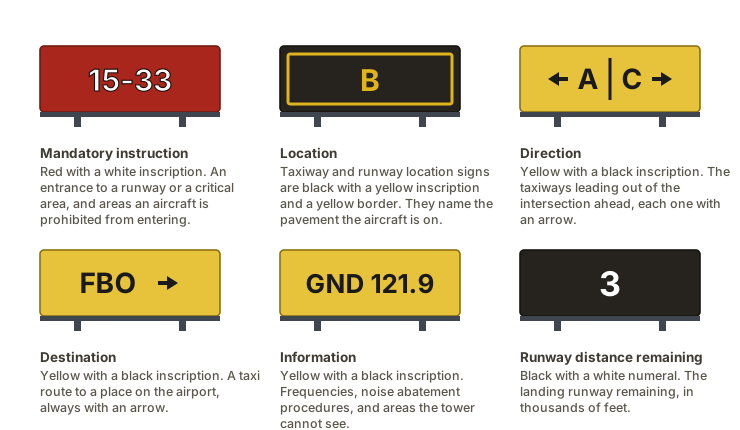
Mandatory instruction signs have a red background with a white inscription. They are used to denote an entrance to a runway or critical area, and areas where an aircraft is prohibited from entering (AIM 2-3-8). Four of them are typical:
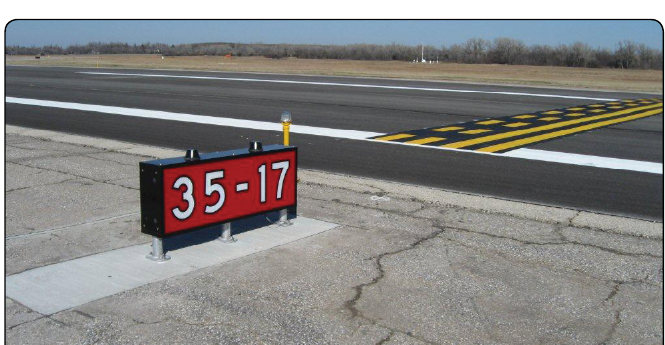
- The runway holding position sign is located at the holding position on taxiways that intersect a runway, or on runways that intersect other runways. The sign has white characters outlined in black on a red background, and it is always collocated with the surface painted holding position markings (AIM 2-3-8; PHAK Chapter 14).
- The runway approach area holding position sign holds an aircraft on a taxiway that lies in the approach or departure area of a runway, so that the aircraft does not interfere with operations on that runway. A sign reading 15-APCH protects the approach area for Runway 15, and one reading 15-APCH-33-DEP protects the departure area for Runway 33 as well (AIM 2-3-8).
- The ILS critical area holding position sign carries the inscription ILS and is located adjacent to the ladder marking on the taxiway (AIM 2-3-8).
- The no entry sign prohibits an aircraft from entering an area. It is typically located on a taxiway intended to be used in only one direction, or where a vehicle roadway meets a runway, taxiway, or apron and the roadway might be mistaken for an aircraft movement surface (AIM 2-3-8).
The inscription on a runway holding position sign contains the designation of the intersecting runway, and the runway numbers on the sign are arranged to correspond to the respective runway threshold. An inscription reading 15-33 indicates that the threshold for Runway 15 is to the left and the threshold for Runway 33 is to the right (AIM 2-3-8). On taxiways that intersect the beginning of the takeoff runway, only the designation of the takeoff runway may appear on the sign, while all other signs carry the designation of both runway directions (AIM 2-3-8). Where a taxiway intersects the intersection of two runways, the designations for both runways are shown along with arrows giving the approximate alignment of each, and each arrow indicates the direction to the threshold of the runway whose designation is immediately next to it (AIM 2-3-8).
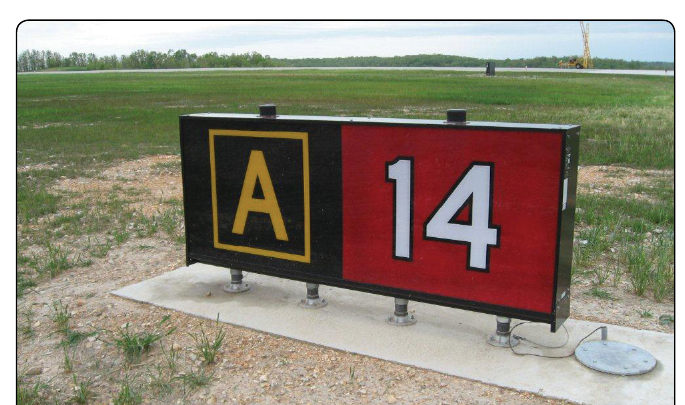
Location signs are used to identify either a taxiway or runway on which the aircraft is located, and some of them provide a visual cue to help a pilot determine when the aircraft has exited an area (AIM 2-3-9). The class holds two pairs:
- The taxiway location sign and the runway location sign have a black background with a yellow inscription and a yellow border. The inscription is the designation of the taxiway or the runway the aircraft is on (AIM 2-3-9).
- The runway boundary sign and the ILS critical area boundary sign have a yellow background with a black inscription and a graphic depicting the pavement holding position marking. Each one faces the area it bounds and is visible to a pilot leaving it (AIM 2-3-9). You are out of the runway safety area boundary when the entire aircraft passes the sign and the accompanying surface painted marking (PHAK Chapter 14).
The remaining four classes carry no requirement:
- Direction signs have a yellow background with a black inscription. The inscription identifies the designations of the intersecting taxiways leading out of the intersection that a pilot would normally be expected to turn onto or hold short of, each accompanied by one arrow. They are normally located on the left prior to the intersection, and the designations are arranged clockwise starting from the first taxiway on the pilot's left (AIM 2-3-10).
- Destination signs have a yellow background with a black inscription indicating a taxi route to a destination on the airport, and they always have an arrow showing the direction of that route (AIM 2-3-11).
- Information signs have a yellow background with a black inscription. They provide information on such things as areas that cannot be seen from the control tower, applicable radio frequencies, and noise abatement procedures (AIM 2-3-12).
- Runway distance remaining signs have a black background with a white numeral inscription and may be installed along one or both sides of the runway. The number indicates the distance, in thousands of feet, of landing runway remaining. The last sign, the one with the numeral 1, is located at least 950 feet from the runway end (AIM 2-3-13).
Runway holding position signs and markings are installed on runways used for land and hold short operations (LAHSO), which are operations in which a landing aircraft is instructed by the controller to hold short of an intersecting runway or taxiway, a predetermined point, or an approach or departure flightpath (Pilot/Controller Glossary). The signs and markings are placed at the LAHSO point, prior to the runway intersection, to show where to stop and hold the aircraft (PHAK Chapter 14). If you receive a clearance to land with no hold short instruction, you are authorized to use the entire landing length of the runway and should disregard any LAHSO holding position markings on it (PHAK Chapter 14).
AIM 2-3-7 through 2-3-13; PHAK Ch 14, "Airport Signs," "Runway Holding Position Sign," "Runway Safety Area," and "Land and Hold Short Operations (LAHSO)"; Pilot/Controller Glossary, "Land and Hold Short Operations"
Runway incursion avoidance
A runway incursion is any occurrence in the airport runway environment involving an aircraft, vehicle, person, or object on the ground that creates a collision hazard or results in a loss of required separation with an aircraft taking off, intending to take off, landing, or intending to land (PHAK Chapter 14). Approximately three runway incursions occur each day at towered airports within the United States. About 65 percent of all runway incursions are caused by pilots, and FAA data shows that almost half of those are caused by general aviation pilots (PHAK Chapter 14).
Detailed investigations of runway incursions over the past ten years identified three major contributing areas (PHAK Chapter 14):
- failure to comply with ATC instructions;
- lack of airport familiarity;
- nonconformance with standard operating procedures.
The following are some practices that help prevent a runway incursion (PHAK Chapter 14):
- read back all runway crossing and hold instructions;
- review airport layouts as part of preflight planning, before descending to land, and while taxiing;
- know airport signage;
- review NOTAMs for information on runway and taxiway closures and construction areas;
- request progressive taxi instructions from ATC when unsure of the taxi route;
- check for traffic before crossing any runway hold line and before entering a taxiway;
- turn on the aircraft lights and the rotating beacon or strobe lights while taxiing;
- clear the active runway as soon as possible after landing, then wait for taxi instructions before further movement;
- write down complex taxi instructions at unfamiliar airports.
A hot spot is a location on an airport movement area with a history of potential risk of collision or runway incursion, where heightened attention by pilots and drivers is necessary (Pilot/Controller Glossary). Typically it is a complex or confusing taxiway intersection or taxiway and runway intersection. The FAA publishes an airport diagram, a plan-view drawing of an airport's runways and taxiways, to assist in the movement of ground traffic at locations with complex runway and taxiway configurations. Hot spots are indicated on the airport diagram with a brown open circle or ellipse leadered to a hot spot number, such as HS 1 (FAA Aeronautical Chart Users' Guide). Reading the airport diagram itself is the subject of Reading the Sectional Chart, later in this unit.
Runway confusion is a subset of runway incursions, and it often results in unintentionally taking off or landing on a taxiway or the wrong runway. Generally you are unaware of the mistake until after it has occurred (PHAK Chapter 14).
Three factors increase the risk of runway confusion (PHAK Chapter 14):
- airport complexity;
- close proximity of runway thresholds;
- joint use of a runway as a taxiway.
Where thresholds sit close together, set the heading bug to the runway heading and align the airplane with that heading. Before adding power, make one last instrument scan to ensure the aircraft heading and the runway heading agree (PHAK Chapter 14).
Clear, concise, and effective pilot and controller communication is paramount to safe airport surface operations, and it is mandatory to read back all runway hold short instructions verbatim (PHAK Chapter 14).
PHAK Ch 14, "Runway Incursion Avoidance," "Causal Factors of Runway Incursions," and "Runway Confusion"; Pilot/Controller Glossary, "Hot Spot"; FAA Aeronautical Chart Users' Guide, "Hot Spots"
What the rest of this unit adds
This lesson has covered the painted surface and the signs beside it: the letters that separate parallel runways, the three types of runway marking and the white elements they are built from, displaced and relocated thresholds, closed runways, taxiway markings, the runway holding position marking, the six sign types, and the practices that prevent a runway incursion.
- Airport Lighting and Wake Turbulence covers the airport beacon, the runway and taxiway lighting, the visual glideslope indicators, pilot-controlled lighting, and the wake turbulence avoidance procedures the drag lesson promised.
- Radio Communications covers the position reports made on the CTAF, the words of a self-announce call, and ATIS and the automated weather stations.
- Communicating with Air Traffic Control covers towered-airport phraseology, the taxi clearance and its readback, the acceptance or refusal of a LAHSO clearance, the light gun signals for a radio failure, and compliance with ATC instructions under 14 CFR 91.123.
- Reading the Sectional Chart covers the airport symbol, the RP notation that marks a right-hand pattern, the airport diagram and its hot spots, and the rest of the chart legend.
You read the airport diagram before the airplane moves, and each marking before the airplane reaches it.
- Trace the route to the runway before you start taxiing. Lack of airport familiarity is one of the three major contributors to runway incursions.
- Stop short of the solid lines. At a towered airport no part of the airplane may cross a runway holding position marking without a clearance from ATC (AIM 2-3-5; 14 CFR 91.129(i)).
- Read the threshold before you use the pavement in front of it. The displaced portion of a runway still permits takeoff in either direction; chevroned pavement permits no operation at all.
- Keep rolling until the whole airplane is past the marking when you exit a runway.
Check your understanding
Answer from memory, without scrolling back up. Recalling it yourself is what makes it stick.
Three runways at one airport are laid out in the same direction. They are designated?
Certain airports have two or even three runways laid out in the same direction. They are distinguished by a letter added to the runway number: L, C and R. (PHAK Ch 14; AIM 2-3-3)
The letters are L for left, C for center and R for right. The number stays the same for all three, because all three runways point the same way.
The two broad white stripes about 1,000 feet down the runway are?
The aiming point marking serves as a visual aiming point for a landing aircraft, and it consists of a broad white stripe on each side of the centerline approximately 1,000 feet from the landing threshold. (AIM 2-3-3)
Touchdown zone markings are groups of one, two and three bars at 500-foot increments. Threshold markings are the longitudinal stripes at the beginning of the landing surface.
The portion of runway behind a displaced threshold is available for?
Displacement of a threshold reduces the length of runway available for landings, and the portion behind it is available for takeoffs in either direction and landings from the opposite direction. (AIM 2-3-3)
What displacement removes is landing length in that one direction. Takeoff in either direction and landing from the opposite direction both remain available on that pavement.
Yellow chevrons mark pavement aligned with the runway that is?
Chevrons are used to show pavement areas aligned with the runway that are unusable for landing, takeoff, and taxiing. Chevrons are yellow. (AIM 2-3-3)
Chevrons rule out every operation, taxiing included. The pavement behind a displaced threshold is the one that still supports takeoffs and opposite-direction landings.
A yellow cross is laid on a runway. What does it mean, and what confirms it?
Yellow crosses mark a closed runway. A visual indication may not always be present, so pilots should check NOTAMs and the ATIS for local runway and taxiway closure information. (AIM 2-3-6)
The cross means closed rather than unlit, and the authoritative source is the NOTAM. Depending on the reason for the closure and its duration, no visual indication may be present at all.
Taxiing toward a runway, you reach four yellow lines. You must stop?
The marking consists of four yellow lines, two solid and two dashed, and the solid lines are always on the side where the aircraft must hold. (AIM 2-3-5)
The solid pair marks the holding side, so an aircraft approaching the runway meets it first. The dashed pair faces the runway and is what an exiting aircraft meets first.
Exiting a runway after landing, your aircraft is clear of the runway when?
An aircraft exiting a runway is not clear of the runway until all parts of the aircraft have crossed the applicable holding position marking. (AIM 2-3-5)
The whole aircraft counts, tail included. Crossing the dashed pair with the nose leaves the rest of the airplane inside the runway safety area.
A red sign with a white inscription, and a black sign with a yellow one, are?
Mandatory instruction signs have a red background with a white inscription. Taxiway and runway location signs have a black background with a yellow inscription and a yellow border. (AIM 2-3-8, 2-3-9)
Red with white is mandatory, denoting an entrance to a runway or a critical area. Black with yellow is a taxiway or runway location sign, naming the pavement the aircraft is on. Direction signs are yellow with black.
A black sign beside the runway carries a white numeral 3. It tells you that?
Runway distance remaining signs have a black background with a white numeral, and the number indicates the distance, in thousands of feet, of landing runway remaining. (AIM 2-3-13)
The number counts down the runway ahead of you in thousands of feet, so a 3 means 3,000 feet remain. The last sign, the numeral 1, sits at least 950 feet from the runway end.
At an airport with an operating control tower, 14 CFR 91.129(i) requires?
No person may, at any airport with an operating control tower, operate an aircraft on a runway or taxiway, or take off or land an aircraft, unless an appropriate clearance is received from ATC. (14 CFR 91.129(i))
The paragraph names runways and taxiways together, and it requires a clearance rather than a call. Loading ramps and parking areas lie outside the movement area.
Go deeper (primary source): read AIM Chapter 2, Section 3, Airport Marking Aids and Signs in full, and compare its figures with the signs and markings tables of PHAK Appendix C. Then pull up the FAA airport diagram for your home airport and find every hot spot marked on it.