Private Pilot · Unit 6 · 30 min
Radio Communications
By the end of this lesson you will know:
- the phonetic alphabet, how numbers and frequencies are spoken, and what an initial call to a facility contains
- what the common traffic advisory frequency (CTAF) is at an airport without an operating control tower, and the seven points at which a broadcast is recommended
- the words of a self-announce call, and why the airport name is spoken at both the beginning and the end
- what the automatic terminal information service (ATIS) carries, what naming its letter on first contact does, and where the automated weather is broadcast at a field with no tower
The aircraft radio
Operating in and out of a towered airport, as well as in a good portion of the airspace system, requires that an aircraft have two-way radio communication capability (PHAK Chapter 14). The airspace requirements table listed which classes require a radio and which do not. At an airport without an operating control tower, two-way radio communications are not required. Transmitting your intentions on the published frequency is good operating practice for the benefit of other traffic, as the traffic pattern lesson covered.
In general aviation the most common types of radios are very high frequency (VHF). A VHF radio operates on frequencies between 118.0 megahertz (MHz) and 136.975 MHz (PHAK Chapter 14). VHF radios are limited to line of sight transmissions, so aircraft at higher altitudes are able to transmit and receive at greater distances (PHAK Chapter 14; AIM 4-2-2). Two airplanes sitting on the ground at different airports may be unable to hear each other while both hear a third airplane at altitude between them.
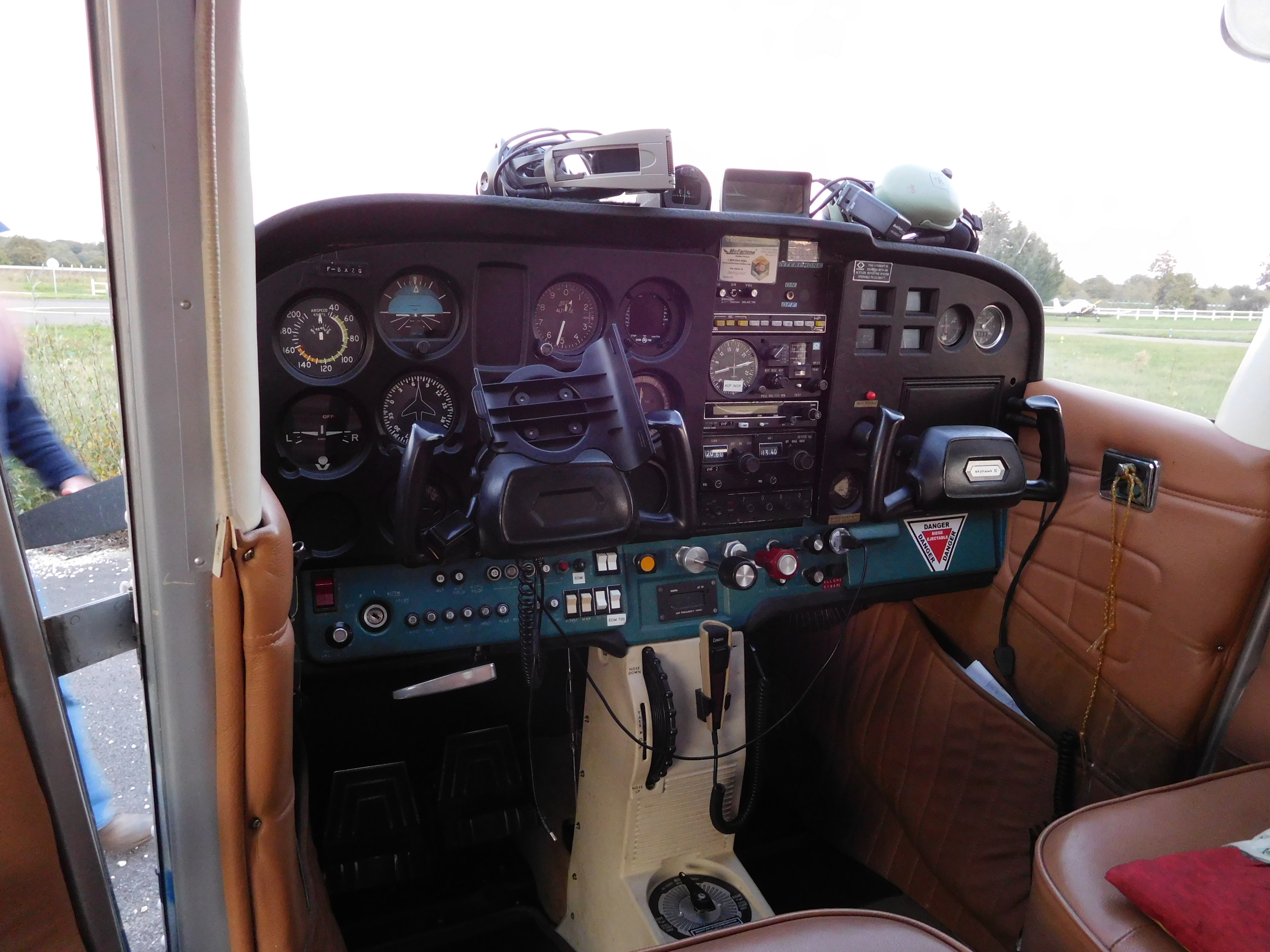
Two licenses exist. The restricted radiotelephone permit applies to the pilot, and the station license applies to the aircraft. There is no license requirement for a pilot operating in the United States. A pilot who operates internationally is required to hold a restricted radiotelephone permit issued by the Federal Communications Commission (FCC). There is also no station license requirement for most general aviation aircraft operating in the United States. A station license is required for an aircraft that is operating internationally, that uses other than a VHF radio, and that meets other criteria (PHAK Chapter 14).
PHAK Ch 14, "Radio Communications," "Radio License," and "Radio Equipment"; AIM 4-2-2
How to speak: the alphabet, the numbers, and your call sign
Acknowledge each radio communication with air traffic control (ATC) by using the appropriate aircraft call sign. Contacts should be kept as brief as possible, but controllers must know what you want to do before they can properly carry out their control duties. You must know exactly what the controller wants you to do. Since concise phraseology may not always be adequate, use whatever words are necessary to get your message across (AIM 4-2-1).
Listen before you transmit. Many times you can get the information you want through the ATIS or by monitoring the frequency. If you hear someone else talking, keying your transmitter will probably jam their receivers and cause them to repeat their call. If you have just changed frequencies, pause, listen, and make sure the frequency is clear. Think before keying your transmitter. If the message is lengthy, jot it down. Hold the microphone very close to your lips. Pause slightly after pressing the button so the first word is transmitted. Speak in a normal, conversational tone. When you release the button, wait a few seconds before calling again, because the controller may be writing your number down, looking for your flight plan, or transmitting on another frequency (AIM 4-2-2).
The International Civil Aviation Organization (ICAO) phonetic alphabet is used by FAA personnel when communications conditions are such that the information cannot be readily received without it. Use the phonetic alphabet when identifying your aircraft during initial contact with air traffic control facilities, and use the phonetic equivalents to spell out groups of letters or difficult words during adverse communications conditions (AIM 4-2-7).
| Letter | Word | Letter | Word |
|---|---|---|---|
| A | Alfa (AL-FAH) | N | November (NO-VEM-BER) |
| B | Bravo (BRAH-VOH) | O | Oscar (OSS-CAH) |
| C | Charlie (CHAR-LEE) | P | Papa (PAH-PAH) |
| D | Delta (DELL-TAH) | Q | Quebec (KEH-BECK) |
| E | Echo (ECK-OH) | R | Romeo (ROW-ME-OH) |
| F | Foxtrot (FOKS-TROT) | S | Sierra (SEE-AIR-RAH) |
| G | Golf (GOLF) | T | Tango (TANG-GO) |
| H | Hotel (HOH-TEL) | U | Uniform (YOU-NEE-FORM) |
| I | India (IN-DEE-AH) | V | Victor (VIK-TAH) |
| J | Juliett (JEW-LEE-ETT) | W | Whiskey (WISS-KEY) |
| K | Kilo (KEY-LOH) | X | Xray (ECKS-RAY) |
| L | Lima (LEE-MAH) | Y | Yankee (YANG-KEY) |
| M | Mike (MIKE) | Z | Zulu (ZOO-LOO) |
The AIM gives four rules for speaking numbers (AIM 4-2-8):
- Figures indicating hundreds and thousands in round numbers, as for ceiling heights and upper wind levels up to 9,900, are spoken as those words: 500 is "five hundred" and 4,500 is "four thousand five hundred."
- Numbers above 9,900 are spoken by separating the digits preceding the word thousand: 10,000 is "one zero thousand" and 13,500 is "one three thousand five hundred."
- All other numbers are transmitted by pronouncing each digit, so 10 is "one zero."
- When a radio frequency contains a decimal point, the decimal point is spoken as "point": 122.1 is "one two two point one."
The AIM gives the spoken form of each digit (AIM 4-2-7).
| Digit | Word | Digit | Word |
|---|---|---|---|
| 0 | Zero (ZEE-RO) | 5 | Five (FIFE) |
| 1 | One (WUN) | 6 | Six (SIX) |
| 2 | Two (TOO) | 7 | Seven (SEV-EN) |
| 3 | Three (TREE) | 8 | Eight (AIT) |
| 4 | Four (FOW-ER) | 9 | Nine (NIN-ER) |
State an altitude up to but not including 18,000 feet mean sea level (MSL) as the separate digits of the thousands plus the hundreds if appropriate, so 12,500 is "one two thousand five hundred" (AIM 4-2-9). The three digits of a bearing, course, heading, or wind direction should always be magnetic. The word "true" must be added when it applies (AIM 4-2-10).
State the aircraft type, model, or manufacturer's name, followed by the digits and letters of the registration number. When the aircraft manufacturer's name or model is stated, the prefix "N" is dropped, so N2464A becomes "Aztec Two Four Six Four Alpha" (AIM 4-2-4). Improper use of call signs can result in pilots executing a clearance intended for another aircraft, so call signs should never be abbreviated on an initial contact or at any time when other aircraft call signs have similar numbers, sounds, or identical letters. ATC specialists may initiate abbreviated call signs of civil aircraft by using the prefix and the last three digits or letters after communications are established. You may then use the abbreviated call sign in subsequent contacts with that specialist. If doubt exists concerning proper identity, use the phrase "verify clearance for" followed by your complete call sign (AIM 4-2-4).
An initial contact, meaning the first radio call you make to a given facility or the first call to a different controller within a facility, uses this format (AIM 4-2-3):
- the name of the facility being called;
- your full aircraft identification;
- your position, when operating on an airport surface;
- the type of message to follow, or your request if it is short;
- the word "over" if required.
The AIM gives three examples of an initial contact (AIM 4-2-3):
- "New York Radio, Mooney Three One One Echo";
- "Columbia Ground, Cessna Three One Six Zero Foxtrot, south ramp, I-F-R Memphis";
- "Miami Center, Baron Five Six Three Hotel, request V-F-R traffic advisories."
Acknowledge a callup or a clearance with your aircraft identification, either at the beginning or at the end of your transmission, and one of the words "wilco," "roger," "affirmative," "negative," or other appropriate remarks (AIM 4-2-3). The Pilot/Controller Glossary defines those words, together with "stand by" and "say again":
- Roger means "I have received all of your last transmission." It should not be used to answer a question requiring a yes or a no answer.
- Wilco means "I have received your message, understand it, and will comply with it."
- Affirmative means yes. Negative means no, or permission not granted, or that is not correct.
- Stand by means the controller or pilot must pause for a few seconds, usually to attend to other duties of a higher priority. Stand by is not an approval or denial, and the caller should reestablish contact if a delay is lengthy.
- Say again requests a repeat of the last transmission, and it usually specifies the portion not understood or received.
AIM 4-2-1, 4-2-2, 4-2-3, 4-2-4, and 4-2-7 through 4-2-10; PHAK Ch 14, "Using Proper Radio Procedures"; Pilot/Controller Glossary, "Roger," "Wilco," "Affirmative," "Negative," "Stand By," and "Say Again"
Self-announcing on the CTAF
At an airport without an operating control tower, there is no controller to clear you to land or to sequence the traffic. It is essential that pilots be alert, look for other traffic, and exchange traffic information when approaching or departing. Other aircraft may not have communication capability, and in some cases pilots may not communicate their presence or intentions. All radio-equipped aircraft transmit and receive on a common frequency identified for the purpose of airport advisories. Pilots use the correct airport name as identified in appropriate aeronautical publications (AIM 4-1-9).
That common frequency is the common traffic advisory frequency (CTAF). At an airport that does not have an operating tower, pilots have three ways to communicate their intentions and obtain airport and traffic information (AIM 4-1-9):
- communicating with a flight service station (FSS);
- communicating with a UNICOM operator;
- making a self-announce broadcast.
FSS airport advisories are available only in Alaska.
The CTAF may be a UNICOM, MULTICOM, FSS, or tower frequency (AIM 4-1-9). Where there is no tower, FSS, or UNICOM station on the airport, use MULTICOM frequency 122.9 for self-announce procedures (AIM 4-1-9). The FCC designates 122.700, 122.725, 122.800, 122.975, 123.000, 123.050 and 123.075 for airports without an operating control tower, and 122.950 for airports with a control tower or FSS on the airport (AIM 4-1-11, TBL 4-1-11).
Pilots of inbound traffic should monitor and communicate as appropriate on the designated CTAF from 10 miles to landing. Pilots of departing aircraft should monitor and communicate on the appropriate frequency from start-up, during taxi, and until 10 miles from the airport, unless the CFRs or local procedures require otherwise. Pilots conducting other than arriving or departing operations at altitudes normally used by arriving and departing aircraft, such as practicing maneuvers, should monitor and communicate on the appropriate frequency while within 10 miles of the airport unless required to do otherwise by the CFRs or local procedures (AIM 4-1-9).
Within those distances the AIM recommends a broadcast at seven specific points.
| Facility at airport | Frequency use | Outbound | Inbound |
|---|---|---|---|
| UNICOM (no tower or FSS) | Communicate with the UNICOM station on the published CTAF frequency. If unable to contact the UNICOM station, use self-announce procedures on the CTAF. | Before taxiing and before taxiing on the runway for departure. | 10 miles out. Entering downwind, base, and final. Leaving the runway. |
| No tower, FSS, or UNICOM | Self-announce on MULTICOM frequency 122.9. | Before taxiing and before taxiing on the runway for departure. | 10 miles out. Entering downwind, base, and final. Leaving the runway. |
| FSS closed (no tower) | Self-announce on the CTAF. | Before taxiing and before taxiing on the runway for departure. | 10 miles out. Entering downwind, base, and final. Leaving the runway. |
| Tower or FSS not in operation | Self-announce on the CTAF. | Before taxiing and before taxiing on the runway for departure. | 10 miles out. Entering downwind, base, and final. Leaving the runway. |
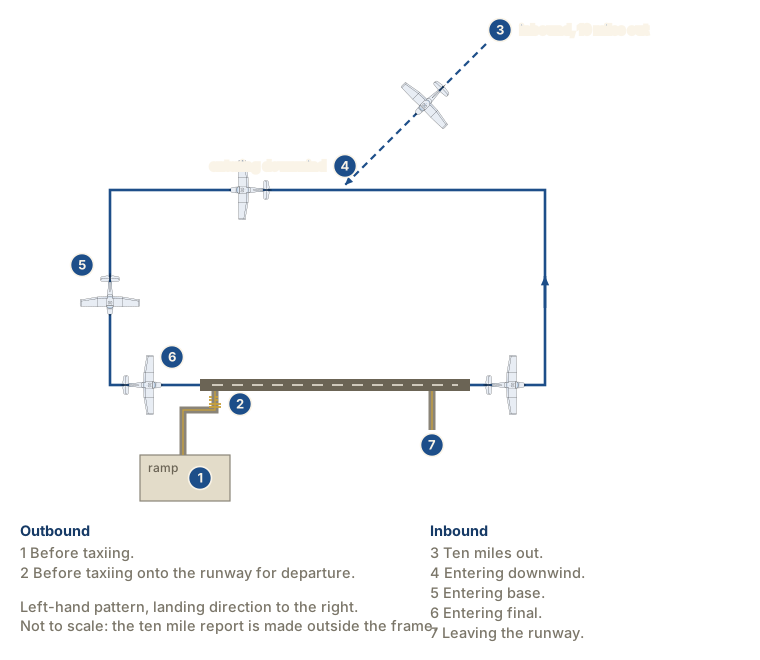
AIM 4-1-9 and TBL 4-1-9; AIM 4-1-11 and TBL 4-1-11; PHAK Ch 14, "Nontowered Airport" and Figure 14-1
The self-announce call, word by word
Self-announce is a procedure whereby pilots broadcast their position or intended flight activity or ground operation on the designated CTAF (AIM 4-1-9). The broadcast is addressed to the other traffic at the airport rather than to a facility. That is why you follow the airport name with the word traffic.
- The airport name, then the word traffic. "Strawn traffic."
- Your aircraft type and call sign. "Skyhawk Six Two Five Zulu."
- Where you are. A position and, inbound, an altitude, or a location on the airport when you are on the ground.
- What you intend to do. The runway, and whether the landing is a full stop or a touch-and-go.
- The airport name again. "Strawn."
Aircraft operating to or from another nearby airport may be making self-announce broadcasts on the same UNICOM or MULTICOM frequency. To help identify one airport from another, the airport name should be spoken at the beginning and end of each self-announce transmission (AIM 4-1-9). When referring to a specific runway, pilots should use the runway number and not use the phrase "Active Runway" (AIM 4-1-9).
The calls below adapt the AIM's recommended broadcasts for Strawn to one airplane on runway 17, keyed to the numbered markers on the figure above (AIM 4-1-9).
- Before taxiing. "Strawn traffic, Skyhawk Six Two Five Zulu, at the north ramp, taxiing to runway one seven, Strawn."
- Before taxiing onto the runway for departure. "Strawn traffic, Skyhawk Six Two Five Zulu, departing runway one seven, departing the pattern to the south, climbing to four thousand five hundred, Strawn." When you are leaving the pattern, add the direction of departure and the altitude you are climbing to.
- Ten miles out. "Strawn traffic, Skyhawk Six Two Five Zulu, one zero miles north, three thousand five hundred, descending, inbound for landing, Strawn."
- Entering downwind. "Strawn traffic, Skyhawk Six Two Five Zulu, entering left downwind runway one seven, full stop, Strawn."
- Entering base. "Strawn traffic, Skyhawk Six Two Five Zulu, base runway one seven, full stop, Strawn."
- Entering final. "Strawn traffic, Skyhawk Six Two Five Zulu, final runway one seven, full stop, Strawn."
- Leaving the runway. "Strawn traffic, Skyhawk Six Two Five Zulu, clear of runway one seven, Strawn."
The CTAF frequency for a particular airport is contained in the Chart Supplement U.S., the Chart Supplement Alaska, the Alaska Terminal Publication, instrument approach procedure charts, and instrument departure procedure charts, and it can also be obtained by contacting any FSS (AIM 4-1-9).
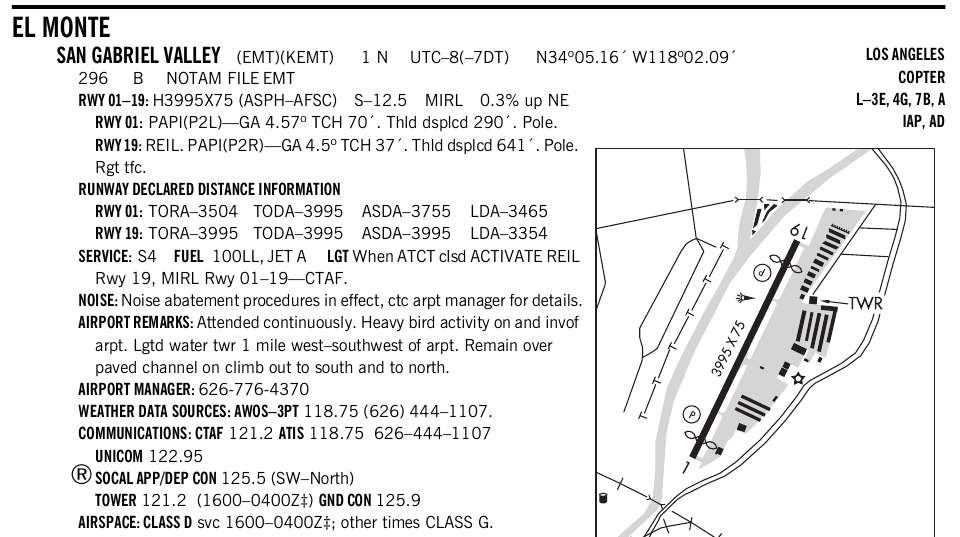
UNICOM is a nongovernment air/ground radio communication station which may provide airport information at public use airports where there is no tower or FSS. On pilot request, UNICOM stations may provide pilots with weather information, wind direction, the recommended runway, or other necessary information (AIM 4-1-9). Report approximately 10 miles from the airport, giving your altitude, aircraft type, aircraft identification, and location relative to the airport. State whether you are landing or overflying, and request wind information and the runway in use. Report on downwind, base, and final approach, and report leaving the runway (AIM 4-1-9).
A UNICOM operator does not clear, instruct, or sequence traffic of their own accord. The pilot in command chooses the runway and fits into the traffic already there. UNICOM service may be used for ATC purposes only under the following circumstances (AIM 4-1-12):
- a revision to a proposed departure time;
- a takeoff, arrival, or flight plan cancellation time;
- an ATC clearance, provided arrangements are made between the ATC facility and the UNICOM licensee to handle such messages.
The FAA discourages VFR straight-in approaches to landings due to the increased risk of a mid-air collision. If a pilot chooses to execute a straight-in approach for landing without entering the airport traffic pattern, the pilot should self-announce their position on the designated CTAF approximately 8 to 10 miles from the airport and coordinate the straight-in approach and landing with other airport traffic. Pilots executing a straight-in approach do not have priority over other aircraft in the traffic pattern, and must comply with the right-of-way rules of 14 CFR 91.113(g) (AIM 4-1-9).
AIM 4-1-9 and TBL 4-1-9; AIM 4-1-12; 14 CFR 91.113(g); PHAK Ch 14, "Nontowered Airport" and "Sources for Airport Data"
ATIS and the automated weather stations
The automatic terminal information service (ATIS) is the continuous broadcast of recorded noncontrol information in selected high activity terminal areas. Its purpose is to improve controller effectiveness and to relieve frequency congestion by automating the repetitive transmission of essential but routine information (AIM 4-1-13). The information is broadcast over a discrete VHF radio frequency or the voice portion of a local navigation aid. The Chart Supplement indicates the airports for which ATIS is provided (AIM 4-1-13).
An ATIS broadcast carries five items (AIM 4-1-13):
- the airport or facility name;
- a phonetic letter code;
- the time of the latest weather sequence in Coordinated Universal Time (UTC);
- the weather;
- the instrument approach and runway in use.
The weather consists of wind direction and velocity, visibility, obstructions to vision, and present weather: sky condition, temperature, dew point, altimeter, a density altitude advisory when appropriate, and other pertinent remarks included in the official weather observation (AIM 4-1-13). The ceiling or sky condition, the visibility, and obstructions to vision may be omitted from the broadcast if the ceiling is above 5,000 feet and the visibility is more than 5 miles, so their absence tells you the weather is at least that good (AIM 4-1-13).
Each new recording takes the next letter of the phonetic alphabet, so information Alfa is replaced by information Bravo (PHAK Chapter 14). The broadcast must be updated upon the receipt of any official hourly and special weather. A new recording is also made when there is a change in other pertinent data such as a runway change or a change in the instrument approach in use (AIM 4-1-13). Notify controllers on initial contact that you have received the ATIS broadcast by repeating the alphabetical code word appended to the broadcast: "information Sierra received." When you acknowledge receipt, controllers may omit those items contained in the broadcast if they are current. Controllers will issue pertinent information to pilots who do not acknowledge receipt of a broadcast, or who acknowledge receipt of a broadcast which is not current (AIM 4-1-13).
An airport without a tower has no ATIS. Automated weather observing systems (ASOS and AWOS) are installed at many airports throughout the National Airspace System. At uncontrolled airports equipped with ASOS or AWOS with ground-to-air broadcast capability, the one-minute updated airport weather should be available to you within approximately 25 nautical miles (NM) of the airport below 10,000 feet. The frequency for the weather broadcast is published on sectional charts and in the Chart Supplement. Some part-time towered airports may also broadcast the automated weather on their ATIS frequency during the hours that the tower is closed (AIM 4-3-27).
All aircraft arriving at or departing from an uncontrolled airport equipped with ASOS or AWOS should monitor the airport weather frequency to ascertain the status of the airspace (AIM 4-3-27). Pilots in Class E airspace must be alert for changing weather conditions which may affect the status of the airspace from IFR to VFR or the reverse. Pilots have access to more current weather at these airports than do the controllers, who may be located several miles away, so controllers rely on the pilot to determine the current airport weather from the ASOS or AWOS. The broadcast is spoken in plain language on the radio. The coded written weather reports and forecasts, the METAR and the TAF, are the subject of Reading METARs and TAFs in Unit 8.
AIM 4-1-13, 4-3-27; PHAK Ch 14, "Automated Terminal Information Service (ATIS)"; Pilot/Controller Glossary, "Automatic Terminal Information Service"
What the rest of this unit adds
This lesson has covered the radio itself, the alphabet and the numbers, the initial call to a facility, the self-announce broadcast and the frequency that carries it, and ATIS and the automated weather stations.
- Communicating with Air Traffic Control covers the sequence of frequencies at a towered airport, the taxi clearance and the land and hold short operations (LAHSO) clearance and their readbacks, compliance with ATC instructions under 14 CFR 91.123, radar traffic advisories for a VFR flight, and the light gun signals for a radio failure.
- Reading the Sectional Chart covers the airport data block where the tower, ATIS, and CTAF frequencies print, the RP notation that marks a right-hand pattern, the airport diagram and its hot spots, and the rest of the chart legend.
You share a common traffic advisory frequency with pilots who cannot see you.
- Say the airport name at both ends of every self-announce call, and say the runway number rather than the active runway. A nearby airport may be on the same UNICOM or MULTICOM frequency.
- Monitor the CTAF from 10 miles inbound to landing, and broadcast at each of the recommended points. The pilots already in the pattern build their picture of you from those calls.
- Listen before you transmit, and listen to the ATIS before your first call to a controller. A frequency you have just selected may already carry a transmission you would block. Naming the ATIS letter lets the controller omit what you already have.
Check your understanding
Answer from memory, without scrolling back up. Recalling it yourself is what makes it stick.
Your first radio call to a facility opens with?
Initial contact uses the name of the facility being called, your full aircraft identification, your position when you are on an airport surface, and your request. Call signs should never be abbreviated on an initial contact. (AIM 4-2-3, 4-2-4)
The facility name comes first so the controller knows the call is for them. The call sign is spoken in full, because ATC may initiate an abbreviation only after communications are established.
A self-announce call opens and closes with the airport name because?
Aircraft operating to or from another nearby airport may be making self-announce broadcasts on the same UNICOM or MULTICOM frequency, so the airport name should be spoken at the beginning and end of each self-announce transmission. (AIM 4-1-9)
No controller works a CTAF. The reason is that a nearby airport may be using the same UNICOM or MULTICOM frequency, and the name at both ends says whose traffic the call describes.
The field has no tower, no FSS, and no UNICOM. You self-announce on?
Where there is no tower, FSS, or UNICOM station on the airport, use MULTICOM frequency 122.9 for self-announce procedures. Pilots of inbound traffic should monitor and communicate as appropriate on the designated CTAF from 10 miles to landing. (AIM 4-1-9)
122.9 is the MULTICOM frequency for an airport with no tower, FSS, or UNICOM. 121.5 is the emergency frequency, and 122.95 is designated for airports that have a control tower or an FSS on the airport.
Which phrase does the AIM say should not be used under any condition?
Pilots stating "Traffic in the area, please advise" is not a recognized Self-Announce Position and/or Intention phrase and should not be used under any condition. (AIM 4-1-9)
"Traffic in the area, please advise" is the phrase the AIM rules out under any condition. Broadcast your own position and intentions rather than asking every other pilot on the frequency to broadcast theirs.
Naming the current ATIS letter on first contact tells the controller?
Notify controllers on initial contact that you have received the ATIS broadcast by repeating the alphabetical code word appended to it. Controllers may then omit those items contained in the broadcast if they are current. (AIM 4-1-13)
The phrase meaning wind, runway, and altimeter only is "have numbers," and it does not indicate receipt of the ATIS broadcast. The letter says you have the whole current recording.
Numbers above 9,900 are spoken by?
Numbers above 9,900 are spoken by separating the digits preceding the word thousand, so 10,000 is "one zero thousand" and 13,500 is "one three thousand five hundred." (AIM 4-2-8)
Round hundreds and thousands up to 9,900 are spoken as those words, so 4,500 is "four thousand five hundred." Above 9,900 the digits before the word thousand are separated.
The AIM gives the spoken form of the digits three, five, and nine as?
The AIM's table gives three as TREE, five as FIFE, and nine as NIN-ER. (AIM 4-2-7)
Each digit has a spoken form fixed by the AIM's table rather than by ordinary pronunciation. Three is TREE, five is FIFE, and nine is NIN-ER.
On the frequency, the word roger means?
Roger means "I have received all of your last transmission." It should not be used to answer a question requiring a yes or a no answer. (Pilot/Controller Glossary)
"I have received your message, understand it, and will comply with it" is wilco. Roger acknowledges receipt only, and it answers no question.
On pilot request, a UNICOM station may provide?
On pilot request, UNICOM stations may provide pilots with weather information, wind direction, the recommended runway, or other necessary information. (AIM 4-1-9)
A UNICOM operator does not clear, instruct, or sequence traffic of their own accord. The runway it gives is a recommendation, and the pilot in command chooses the runway.
A pilot who flies a straight-in approach to a nontowered airport should?
A pilot who chooses a straight-in approach should self-announce their position on the designated CTAF approximately 8 to 10 miles from the airport. Straight-in traffic does not have priority over other aircraft in the traffic pattern, and must comply with the right-of-way rules of 14 CFR 91.113(g). (AIM 4-1-9)
The FAA discourages VFR straight-in approaches because of the increased risk of a mid-air collision. The call is made approximately 8 to 10 miles out, and it confers no priority.
Go deeper (primary source): read AIM Chapter 4, Section 2, Radio Communications Phraseology and Techniques in full, then read AIM 4-1-9, Traffic Advisory Practices at Airports Without Operating Control Towers and its table of recommended communication procedures. Then look up your home airport and one nearby field in the Chart Supplement and write down the CTAF, the automated weather frequency, and whether the two fields share a frequency.