Private Pilot · Unit 2 · 25 min
Drag and the Drag Curve
By the end of this lesson you will know:
- the two families of drag and what causes parasite and induced drag
- why parasite drag grows with airspeed while induced drag shrinks
- how wingtip vortices arise and why they produce induced drag
- what L/D max and best glide speed mean on the drag curve
- why ground effect reduces induced drag near the runway
Two kinds of drag
Drag is the force that resists the airplane's movement through the air, acting parallel to the relative wind. Everything about the airplane contributes to it, but every contribution belongs to one of two families. Parasite drag is the resistance of simply pushing an object through the air; it has nothing to do with producing lift, which is how it earned the name. Induced drag is the penalty of producing lift: it exists whenever the wing is producing lift, and it cannot be separated from the lift that causes it.
PHAK Ch 5, "Drag"
Parasite drag
Parasite drag divides into three types, and each one names something a designer, a mechanic, or you can influence:
- Form drag comes from the airplane's shape and the airflow around it. Air separates to pass a body and rejoins behind it; the more turbulent that rejoining, the more drag. It is the reason a streamlined fairing has a fraction of the drag of a flat plate of the same frontal area, and the reason cowlings and wheel pants are shaped the way they are.
- Interference drag arises where two airstreams meet, such as the junction of wing and fuselage. The merged flow is more turbulent than either stream alone, and the effect is worst where surfaces meet at perpendicular angles. Fairings over these junctions exist to ease the intersection.
- Skin friction drag is the resistance of air rubbing along the airplane's surface, which under a microscope is rough no matter how smooth it looks. Designers counter it with flush rivets and smooth finishes. You counter it by keeping the airplane clean and waxed; dirt on the skin is drag you can remove with a rag.
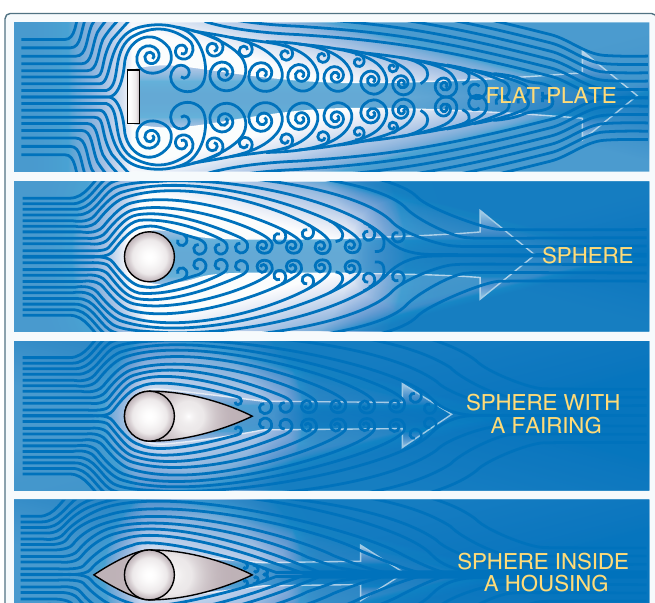
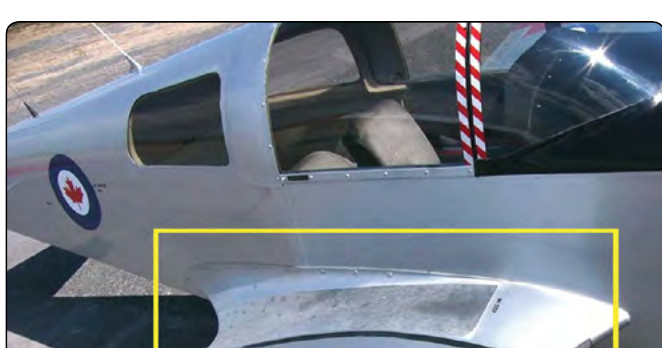
One behavior unites the whole family: parasite drag grows with the square of airspeed. Double your speed and the airplane pushes through four times the parasite drag. This is the drag that dominates when you fly fast.
PHAK Ch 5, "Parasite Drag"
Induced drag and wingtip vortices
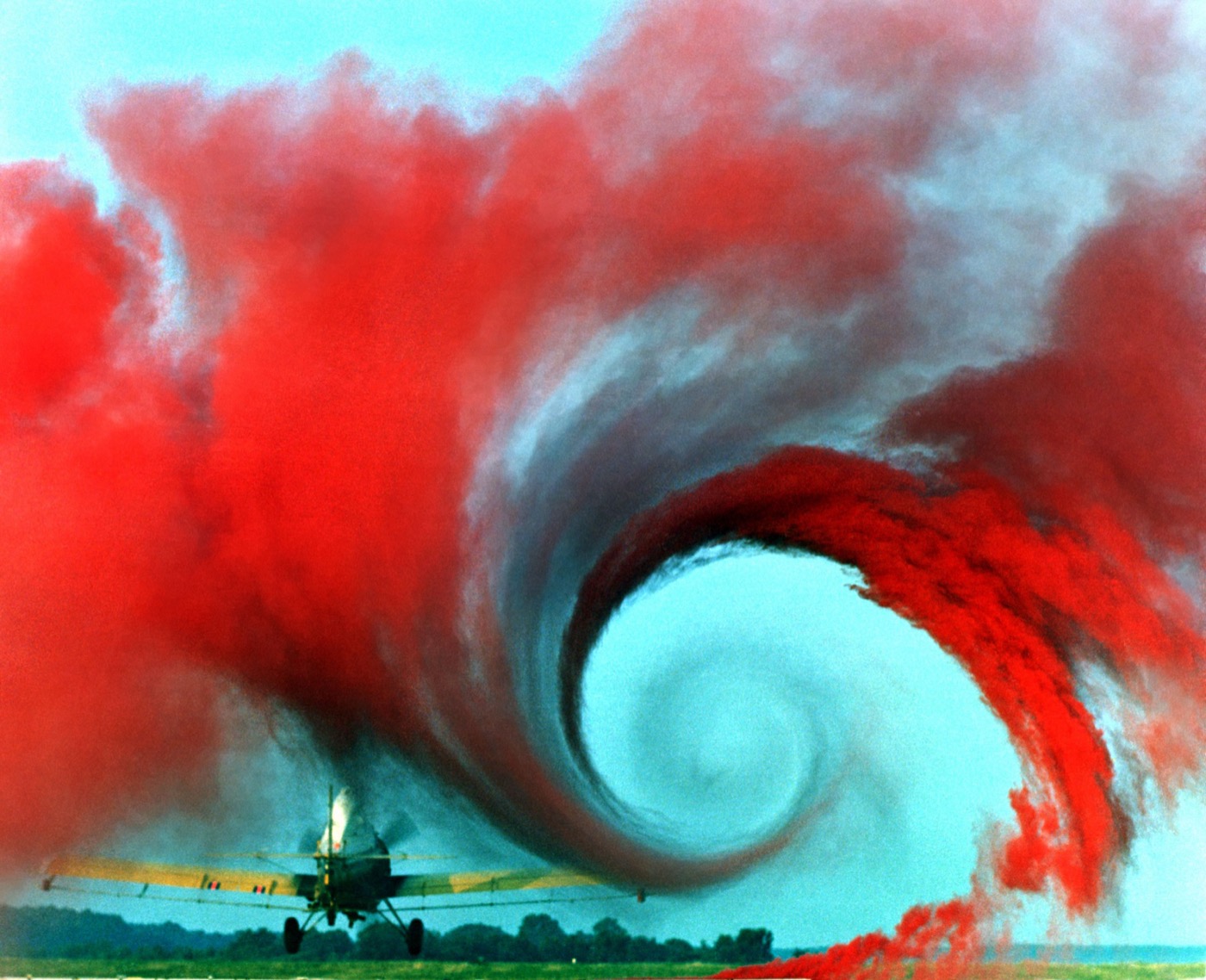
Induced drag originates at the wingtips. A lifting wing carries higher pressure on its lower surface than on its upper surface, and at the tip the two surfaces meet, so the pressure difference drives a flow there: air moves outward along the lower surface, around the tip, and inward toward the low pressure on top. Combined with the airplane's forward motion, this circulation rolls the air into a wingtip vortex trailing behind each tip, rotating counterclockwise off the right tip and clockwise off the left when viewed from behind.
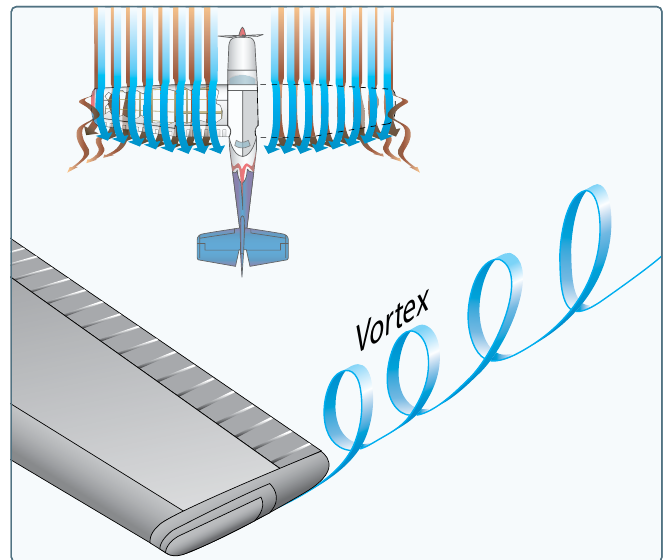
The vortices strengthen the downwash behind the wing. Recall that lift acts perpendicular to the relative wind: the added downwash tilts the local relative wind at the wing slightly downward, so the lift vector, remaining perpendicular to it, leans slightly aft. That rearward component of lift is induced drag. Energy also goes into the rotation of the vortices themselves, and that energy loss appears as additional drag.
Induced drag grows with angle of attack. Fly slowly and the wing needs a high angle of attack to make enough lift, the pressure difference across the tip grows, the vortices strengthen, and induced drag rises. The relationship is the inverse of parasite drag's: induced drag varies inversely with the square of airspeed. Halve your speed and induced drag roughly quadruples. This is the drag that dominates when you fly slow.
PHAK Ch 5, "Induced Drag" and "Wingtip Vortices"
The drag curve
Adding the two families together across the speed range produces the chart below. At low speed, induced drag is by far the larger component. At high speed, parasite drag is. Between the two extremes, their sum, the total drag, reaches a minimum.
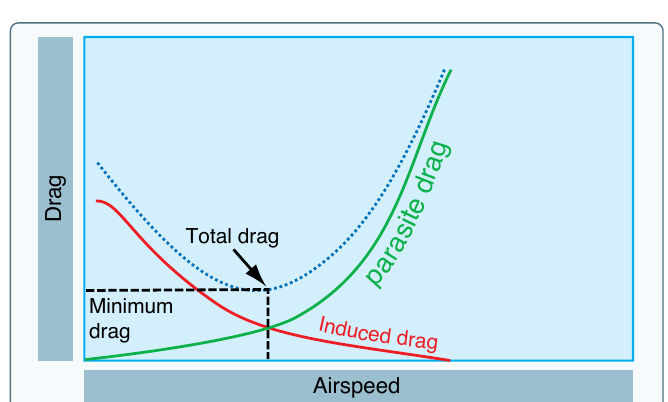
The minimum has a name. The lift-to-drag ratio (L/D) measures the wing's efficiency: how much lift it produces for the drag it costs. The ratio peaks at one specific angle of attack, written L/Dmax, and flying there produces the required lift for the least possible total drag. You saw this on the coefficient chart in How a Wing Generates Lift: the green L/D curve peaks at a single angle of attack. Fly slower than that point and induced drag rises; fly faster and parasite drag does.
L/Dmax has a direct application. The best glide speed printed in your handbook is the airspeed that flies the wing at L/Dmax: minimum drag, and the farthest forward travel for every foot of altitude spent. When an engine failure has you gliding, that number comes straight off the drag curve.
PHAK Ch 5, "Lift/Drag Ratio"
Ground effect
Induced drag also depends on the wing's height above the surface. Within about one wingspan of the ground, the surface restricts the airflow pattern around the wing: the downwash and the wingtip vortices have less room to develop, and weaker vortices mean less induced drag. This is ground effect, and it strengthens rapidly as the wing gets lower: at one full wingspan above the surface the reduction in induced drag is about 1.4 percent, at one quarter of a span it is 23.5 percent, and at one tenth of a span it is 47.6 percent.
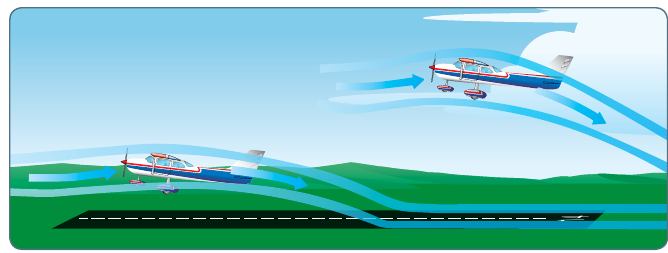
You will feel ground effect in both directions. Landing, the airplane descends into it: drag falls just as you flare, the airplane floats, and excess approach speed turns into runway consumed. Taking off, the airplane climbs out of it: an airplane lifted off early in ground effect may settle back to the runway when the full induced drag returns a few feet up, before it has the speed to climb without the cushion. Both behaviors have the same cause: induced drag returning as the wing leaves the cushion.
PHAK Ch 5, "Ground Effect"
Check your understanding
Answer from memory, without scrolling back up. Recalling it yourself is what makes it stick.
The two basic types of drag are?
Parasite drag is the cost of moving through the air; induced drag is the cost of producing lift. Every other name is a subtype. (PHAK Ch 5)
The two families are parasite and induced. Form, interference, and skin friction are the three subtypes of parasite drag.
Which lists the three types of parasite drag?
Form drag from shape, interference drag from meeting airstreams, and skin friction from air rubbing the surface. (PHAK Ch 5)
Induced drag is its own family, not a parasite subtype. The three parasite types are form, interference, and skin friction.
As airspeed doubles, parasite drag?
Parasite drag varies with the square of airspeed: twice the speed means four times the parasite drag. (PHAK Ch 5)
Parasite drag grows with the square of airspeed, so doubling your speed quadruples it. It is the dominant drag at high speed.
Induced drag is greatest when flying?
Slow flight demands a high angle of attack, which strengthens the tip vortices. Induced drag varies inversely with the square of airspeed. (PHAK Ch 5)
Induced drag is the slow-flight drag: it rises as airspeed falls, roughly quadrupling when you halve your speed.
Wingtip vortices form because air flows from?
The pressure difference drives air from below the wing, around the tip, to the low pressure above, rolling it into a trailing vortex. (PHAK Ch 5)
The flow goes from the high pressure below, around the tip, to the low pressure above. That circulation is the vortex.
Flying at L/D max, the airplane experiences?
At L/D max the lift-to-drag ratio peaks, so the required lift comes at the lowest total drag. Best glide speed lives here. (PHAK Ch 5)
L/D max is the efficiency peak: the needed lift for the least total drag. It sets best glide, not maximum lift or stall speed.
Why does the handbook's best glide speed matter in an engine failure?
Best glide is the airspeed for L/D max: minimum drag for the lift required, so the airplane travels farthest for each foot of altitude. (PHAK Ch 5)
Best glide is not the slowest or highest-lift speed. It is the L/D max speed, giving the most forward distance per foot of altitude lost.
Ground effect reduces which drag, causing what on landing?
Near the surface the vortices and downwash are restricted, cutting induced drag. With less drag in the flare, extra speed becomes float. (PHAK Ch 5)
Ground effect works on induced drag, the lift-related kind. Less of it in the flare means the airplane floats on any extra speed.
Lifting off too early in ground effect risks what?
A few feet up, full induced drag returns. An airplane that lifted off below its proper speed may not be able to climb and settles back. (PHAK Ch 5)
The risk is settling: out of ground effect the induced drag comes back, and an airplane that lifted off too slow cannot yet climb.
Which action reduces skin friction drag?
Skin friction is air rubbing the surface, so smoothness is the cure: flush rivets from the factory, a clean waxed skin from you. (PHAK Ch 5)
Fairings address interference drag and angle of attack addresses induced drag. Skin friction answers to surface smoothness.
Go deeper (primary source): read the "Drag," "Lift/Drag Ratio," and "Ground Effect" sections of PHAK Chapter 5. The wingtip vortices section continues into wake turbulence avoidance, which this course covers in Airport Lighting and Wake Turbulence.