Private Pilot · Unit 2 · 20 min
Left-Turning Tendencies
By the end of this lesson you will know:
- the four propeller-driven causes of left yaw, and how torque reaction, the spiraling slipstream, gyroscopic precession, and P-factor each produce it
- which tendency dominates on the takeoff roll, in the climb, and in a power-on stall
- why the correction for all four is right rudder
Why the nose pulls left
Push the throttle in for takeoff and the airplane tries to yaw left. Hold it straight down the runway and you find your right foot already pressing the pedal. That left yaw is not one effect but four, each produced by the spinning propeller, and all four are strongest in exactly the regime a new pilot first meets them: high power, high angle of attack, and low airspeed, which is the takeoff and initial climb. This lesson takes them one at a time, because the knowledge test asks you to name and distinguish them, and then shows how they combine in the cockpit.
One convention governs everything that follows. On nearly every American single-engine airplane, the propeller turns clockwise as seen from the pilot's seat, looking forward. Every direction stated below assumes that rotation. An airplane whose propeller turns the other way, as some foreign designs do, has its tendencies reversed, but the trainer you fly turns clockwise, so its tendencies pull the nose left.
PHAK Ch 5, "Torque and P-Factor"
The propeller is a rotating wing
Before the four tendencies make sense, one fact about the propeller has to be in place. Each blade is an airfoil, the same kind of curved cross-section as the wing, and as it spins it meets the air at an angle of attack and produces an aerodynamic force. On the wing that force is lift, acting upward. On a propeller blade the force tilts forward, and its forward component is thrust. The wing lesson, How a Wing Generates Lift, established that an airfoil's force grows with the angle at which it meets the relative wind and with the speed of the air past it. Both facts drive the tendencies below: torque and slipstream follow from the blades producing force at all, and P-factor follows from the two sides of the disc meeting the air at different angles.
That is as far as this lesson needs to go into the propeller. How the blade angle is built in, why the blade is twisted from hub to tip, and how fixed-pitch and constant-speed propellers differ are taken up in the Unit 3 lesson The Engine and Propeller. Here it is enough to treat each blade as a small rotating wing making a forward force.
PHAK Ch 5, "Propeller Principles"
Torque reaction
Newton's third law states that for every action there is an equal and opposite reaction. The engine turns the propeller clockwise, so the propeller turns the airplane counterclockwise. Seen from the seat, that reaction is a roll to the left about the longitudinal axis, the nose-to-tail line through the center of gravity that the stability lesson introduced with the three axes. This is torque reaction: the airframe reacting to the torque the engine applies to the propeller.
On the takeoff roll that left roll has a second consequence. The rolling tendency presses down on the left main landing gear, and the harder a tire presses on the runway the more friction it develops. The left tire's extra friction drags against the airplane's forward motion on the left side, and a rearward drag on the left produces a yaw to the left. So on the ground torque reaction reaches you twice: as a roll onto the left wheel and as the left yaw that the loaded wheel's friction adds.
Designers compensate for the steady component of the roll. Older designs are rigged so the wing being forced down makes slightly more lift; more modern designs mount the engine with a slight offset. Either way the compensation is set for cruise power and airspeed, where the airplane spends most of its time, so in cruise the wings stay level without aileron pressure. At full power on takeoff the compensation is no longer matched, and torque reaction returns.
PHAK Ch 5, "Torque Reaction"
Spiraling slipstream
The propeller does not throw its air straight back. Because the blades are rotating as they push, they leave the air with a rotational twist, so the slipstream, the column of air the propeller accelerates rearward, corkscrews around the fuselage as it travels aft. Following the clockwise rotation, this spiraling slipstream wraps around and strikes the left side of the vertical stabilizer. A push on the left side of the fin yaws the nose left about the vertical axis, the same axis the fin uses to weathervane the airplane into the relative wind.
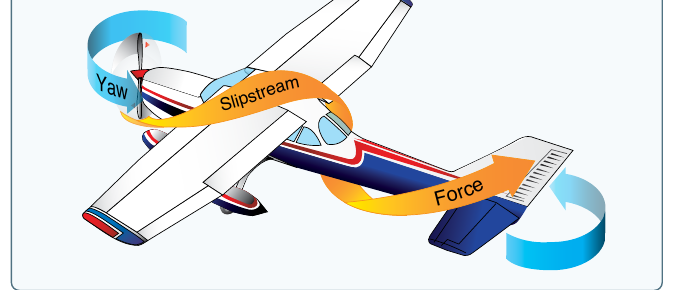
The strength of this effect depends on how tightly the slipstream is wound. At high power and low forward speed the propeller adds a large rotational twist to air that is not moving aft very fast, so the corkscrew is tight and its strike on the fin is firm. As the airplane accelerates, the same twist is stretched over a longer forward distance, the spiral loosens, and the effect weakens. That is why the spiraling slipstream is strongest in the climb and slackens in cruise.
PHAK Ch 5, "Corkscrew Effect"
Gyroscopic precession
A spinning propeller is a gyroscope: a mass rotating fast enough to resist changes to its plane of rotation, and it has a gyroscope's peculiar response to a push. Gyroscopic precession is the property by which a force applied to the rim of a spinning disc takes effect not where it is applied but 90 degrees around the rim, in the direction of rotation. Push on the disc at one point and the disc responds as though you had pushed a quarter-turn later. The full behavior of gyroscopes belongs to the Unit 3 lesson on the gyroscopic flight instruments; here you need only the 90-degree rule, and only as it applies to the propeller disc.
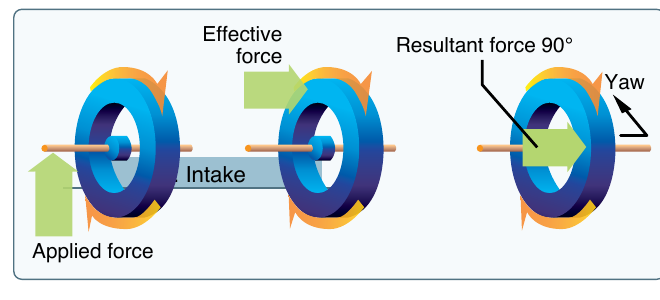
Apply this to the propeller. Anything that pitches or yaws the airplane applies a force to the propeller disc, and precession converts that force into a rotation about a different axis. Pitching the nose applies the force at the top or bottom of the disc, and it takes effect at the side, as a yaw. The classic case is a tailwheel airplane on the takeoff roll. As the pilot raises the tail early in the roll, the propeller disc is pitched forward, which applies a forward force at the top of the disc. On a clockwise propeller that force precesses 90 degrees around to the right side of the disc, and a forward push on the right of the disc yaws the nose left.
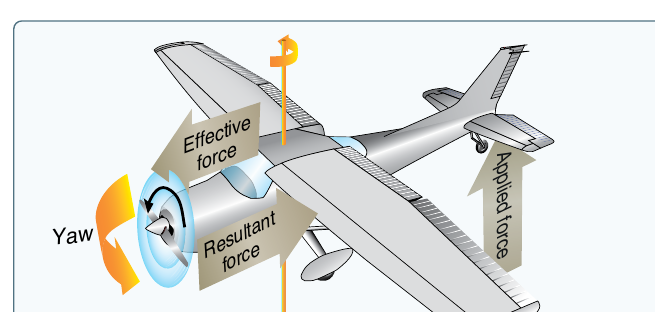
Precession acts only while the disc is being pitched or yawed, not while attitude is held steady, so it is a transient of the tail-raising moment on a taildragger and of any brisk pitch change. A tricycle-gear trainer keeps a level attitude during the takeoff roll and does not raise a tail, so precession is the smallest of the four tendencies in the airplane you train in. The same 90-degree rule returns in Unit 3, where it governs the gyroscopic flight instruments.
PHAK Ch 5, "Gyroscopic Action"
P-factor
The fourth tendency is P-factor, also called asymmetric loading, and it depends on the angle at which the whole airplane meets the air. When the airplane flies at a high angle of attack, as in a climb, the propeller disc is tilted back relative to the oncoming air. On the right side of the disc the blade is swinging downward as it turns, and on the left side the blade is swinging upward. Because the disc is tilted, the downswinging blade on the right meets the air at a greater angle and with a greater resultant velocity than the upswinging blade on the left.
Recall from the propeller primer above that a blade's force grows with both its angle of attack and its speed through the air. The downswinging right blade therefore produces more thrust than the upswinging left blade. The effective center of the propeller's thrust shifts to the right of the disc's center, and a thrust concentrated on the right of the nose yaws the nose left.
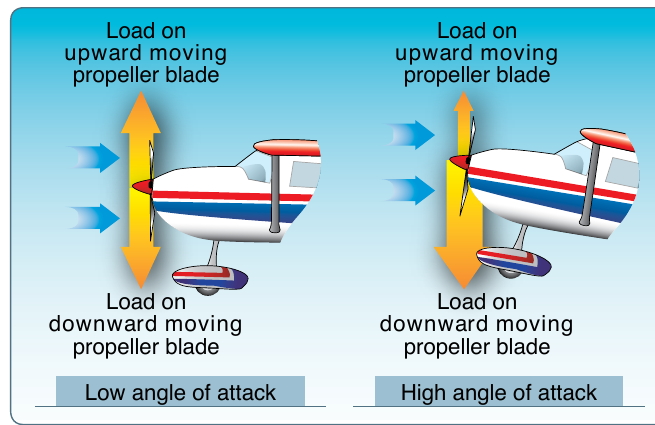
The condition that P-factor needs is a high aircraft angle of attack, not merely high power. At cruise the airplane flies at a low angle of attack, the disc meets the air nearly square, both sides of the disc are loaded almost equally, and P-factor nearly vanishes. It is pronounced in the climb, where power is high and the nose is up, and it is at its worst in a power-on stall, where the angle of attack is highest of all. That is why P-factor and the spiraling slipstream, not torque or precession, are the tendencies you fight hardest in the climb-out and in the power-on stalls that Stalls and Spins introduced.
PHAK Ch 5, "Asymmetric Loading (P-Factor)"
The four together in the cockpit
The four tendencies do not arrive equally at once; which one dominates depends on what the airplane is doing.
- The takeoff roll: torque reaction loads the left wheel and its tire friction yaws the airplane left, and the spiraling slipstream adds its push on the fin. This is why right rudder goes in as the power comes up, before the airplane has flying speed.
- Raising the tail in a taildragger: gyroscopic precession adds a sharp left yaw for the moment the tail comes up. A tricycle-gear trainer does not feel this one.
- The climb-out and power-on stalls: P-factor and the spiraling slipstream dominate, because the angle of attack is high and the forward speed is low. The steeper the climb and the slower the airplane, the more right rudder it takes.
The correction is the same in every case: right rudder, fed in by feel until the nose stops drifting and stays where you point it. You do not compute which tendency is acting or how much; you watch the nose, and you hold enough right rudder to keep the airplane in coordinated flight. As power comes back and speed builds, all four tendencies weaken together, and the pressure you hold eases off.
This closes Unit 2. You now have the forces on the airplane, the wing that makes lift, the drag that resists it, the stall and spin, the airplane's stability, the load factor in turns, and the propeller's pull on the nose. Next comes the machine that spins that propeller: Unit 3 opens with The Engine and Propeller.
PHAK Ch 5, "Torque and P-Factor"
Check your understanding
Answer from memory, without scrolling back up. Recalling it yourself is what makes it stick.
The four left-turning tendencies are?
Torque reaction, the spiraling slipstream, gyroscopic precession, and P-factor are the four, and all four are propeller-driven. (PHAK Ch 5)
Camber is an airfoil property and dihedral is a stability feature; the four propeller tendencies are torque, slipstream, precession, and P-factor.
Torque reaction rolls the airplane which way, and about which axis?
By Newton's third law the clockwise propeller rolls the airframe counterclockwise, a left roll about the nose-to-tail longitudinal axis. (PHAK Ch 5)
Torque reaction is a roll, not a yaw, so it acts about the longitudinal axis, and the clockwise propeller rolls the airframe left.
On the takeoff roll, torque reaction produces a left yaw because?
The left roll presses on the left main gear, and the loaded tire's extra friction drags on that side, yawing the nose left. (PHAK Ch 5)
The mechanism is the left tire, not the pedal or a lifted wheel: the left roll loads it, and its friction drags the left side aft into a yaw.
The spiraling slipstream yaws the nose left because it?
The clockwise-wound slipstream corkscrews back and pushes on the left of the fin, and a push there yaws the nose left about the vertical axis. (PHAK Ch 5)
The corkscrew wraps to the left side of the vertical fin, not the right side or the horizontal tail, and that push yaws the nose left.
The spiraling slipstream effect is strongest when?
At high power and low speed the twist is wound tightly over a short distance, so the corkscrew is tight and its strike on the fin is firm. (PHAK Ch 5)
High speed stretches the spiral and loosens it; the effect peaks with high power and low forward speed, as in the climb.
Gyroscopic precession makes an applied force take effect?
A force on the rim of a spinning disc acts 90 degrees around the rim in the direction the disc turns, not at the point applied. (PHAK Ch 5)
Precession carries the force forward 90 degrees in the direction of rotation, never behind it and never at the point of application.
Raising the tail of a tailwheel airplane yaws it left because?
Pitching the disc forward applies a force at its top, which precesses 90 degrees to the right side, and a forward push there yaws the nose left. (PHAK Ch 5)
The force precesses to the right of the disc, not the left, and it is a propeller effect, not tail drag; the result is a left yaw.
P-factor arises at high angle of attack because?
With the disc tilted back, the downswinging right blade meets the air at a greater angle and speed, makes more thrust, and shifts the thrust center right. (PHAK Ch 5)
It is the descending right blade, not the ascending left one, that meets the faster, steeper air, and the loading is uneven, not even.
P-factor is most pronounced in which condition?
It needs the disc tilted back, so it peaks at high angle of attack, as in a climb or a power-on stall, and nearly vanishes at cruise. (PHAK Ch 5)
A low angle of attack loads the blades evenly, and low power gives little thrust to make asymmetric; P-factor peaks with high power and high angle of attack.
The pilot's correction for all four tendencies is?
All four yaw the nose left, so all four answer to right rudder, fed in until the nose stops drifting and the ball stays centered. (PHAK Ch 5)
The correction is right rudder, not left rudder or aileron: the tendencies pull the nose left, and rudder is the yaw control that stops it.
Go deeper (primary source): read the "Torque and P-Factor" section of PHAK Chapter 5, covering torque reaction, the corkscrew effect, gyroscopic action, and asymmetric loading. The propeller that produces all four is the subject of the next lesson, The Engine and Propeller, which opens Unit 3.