Private Pilot · Unit 2 · 30 min
How a Wing Generates Lift
By the end of this lesson you will know:
- how Bernoulli's principle and Newton's third law each contribute to lift
- the parts of an airfoil: leading edge, trailing edge, chord line, and camber
- why the equal-transit-time explanation of lift is false
- how the center of pressure moves as the angle of attack changes
- what each factor in the lift equation is and which ones you control in flight
- how lowering the flaps raises lift at low speed
Two pieces of physics
The production of lift is a complex phenomenon and can get extremely technical. For a pilot's purposes, two pieces of classical physics explain it well.
Newton's laws of motion
In the 17th century, Sir Isaac Newton presented three principles of motion:
- First law: a body at rest tends to remain at rest, and a body in motion tends to keep moving at the same speed and in the same direction. You met this one in The Four Forces of Flight: balanced forces mean nothing changes.
- Second law: when a force acts on a body, the resulting acceleration is proportional to the force and inversely proportional to the body's mass: the familiar F = ma.
- Third law: every force applied to a body is opposed by an equal force in the opposite direction. For every action, an equal and opposite reaction.
The third law matters most here. If a wing can be made to push air downward, the air must push the wing upward with equal force.
Bernoulli's principle
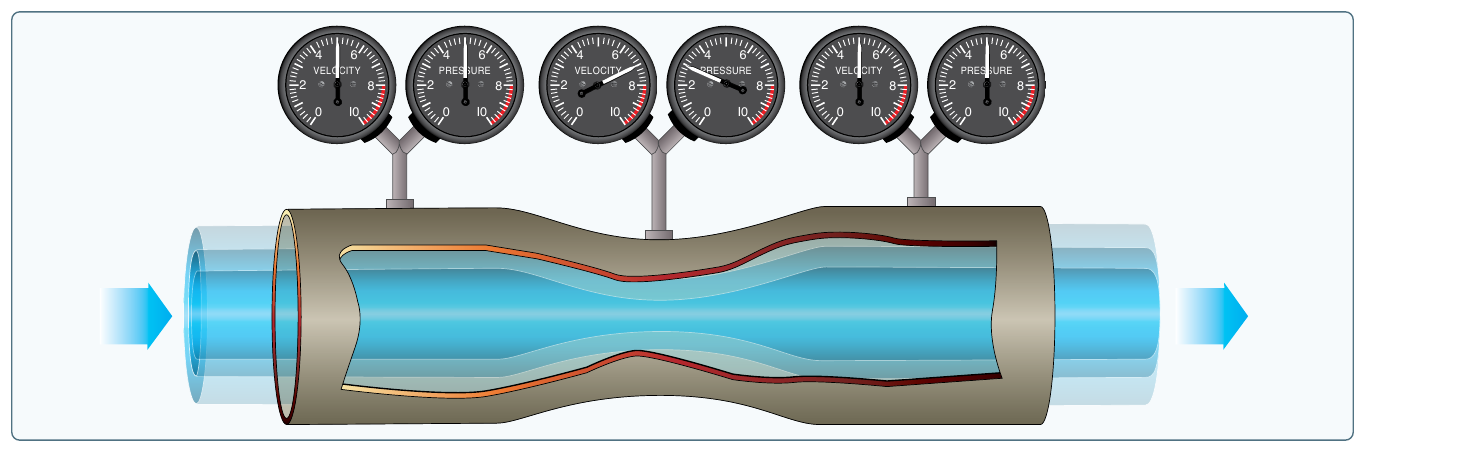
The second piece is named after Daniel Bernoulli, a Swiss mathematician. Simply stated: as the velocity of a fluid increases, its pressure decreases.
The figure below shows air moving through a tube with a constriction in the middle; such a tube is called a venturi. The fluid enters with a certain velocity and pressure. In the constriction it speeds up, and the gauges show what Bernoulli predicts: as the velocity rises, the pressure falls. Past the constriction the flow slows again, and the pressure recovers to its original value.
Hold onto that trade between speed and pressure. A wing is about to perform the same trick without the tube.
PHAK Ch 4, "Bernoulli's Principle"
The airfoil
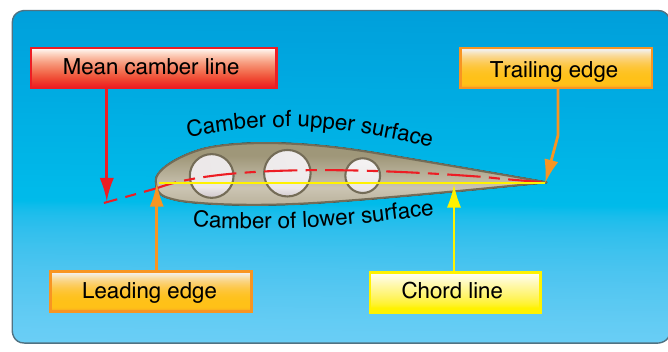
An airfoil is a structure designed to obtain a useful reaction from the air moving past its surface. Slice a wing from front to back and the airfoil is the cross-section you get. Its parts have names, and the knowledge test uses all of them:
- The leading edge meets the airflow first; the trailing edge is where the flows over the upper and lower surfaces rejoin and leave.
- The chord line is an imaginary straight line connecting the two edges.
- Camber is the characteristic curve of the upper and lower surfaces. The mean camber line runs midway between the two surfaces, and the point where it bows farthest from the chord line is the maximum camber.
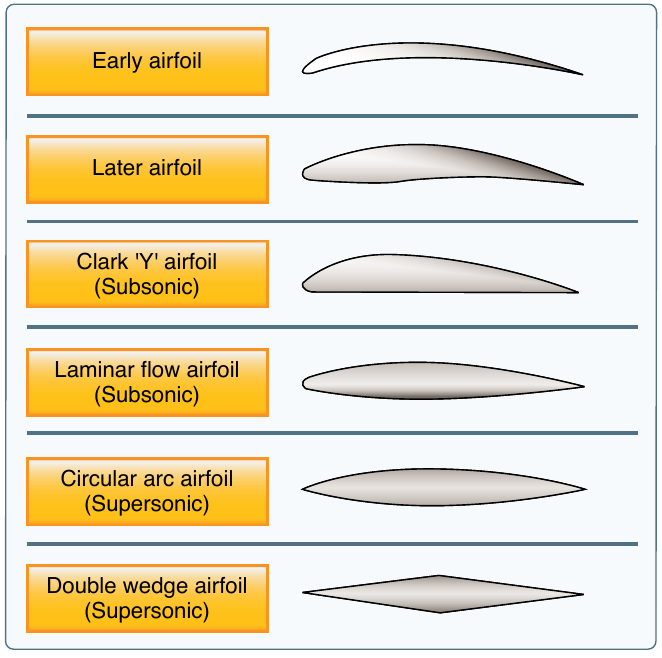
No single airfoil satisfies every flight requirement. The weight, speed, and purpose of each aircraft dictate the shape of its airfoil, from the deeply cambered sections of early airplanes to the thin symmetrical shapes of supersonic designs.
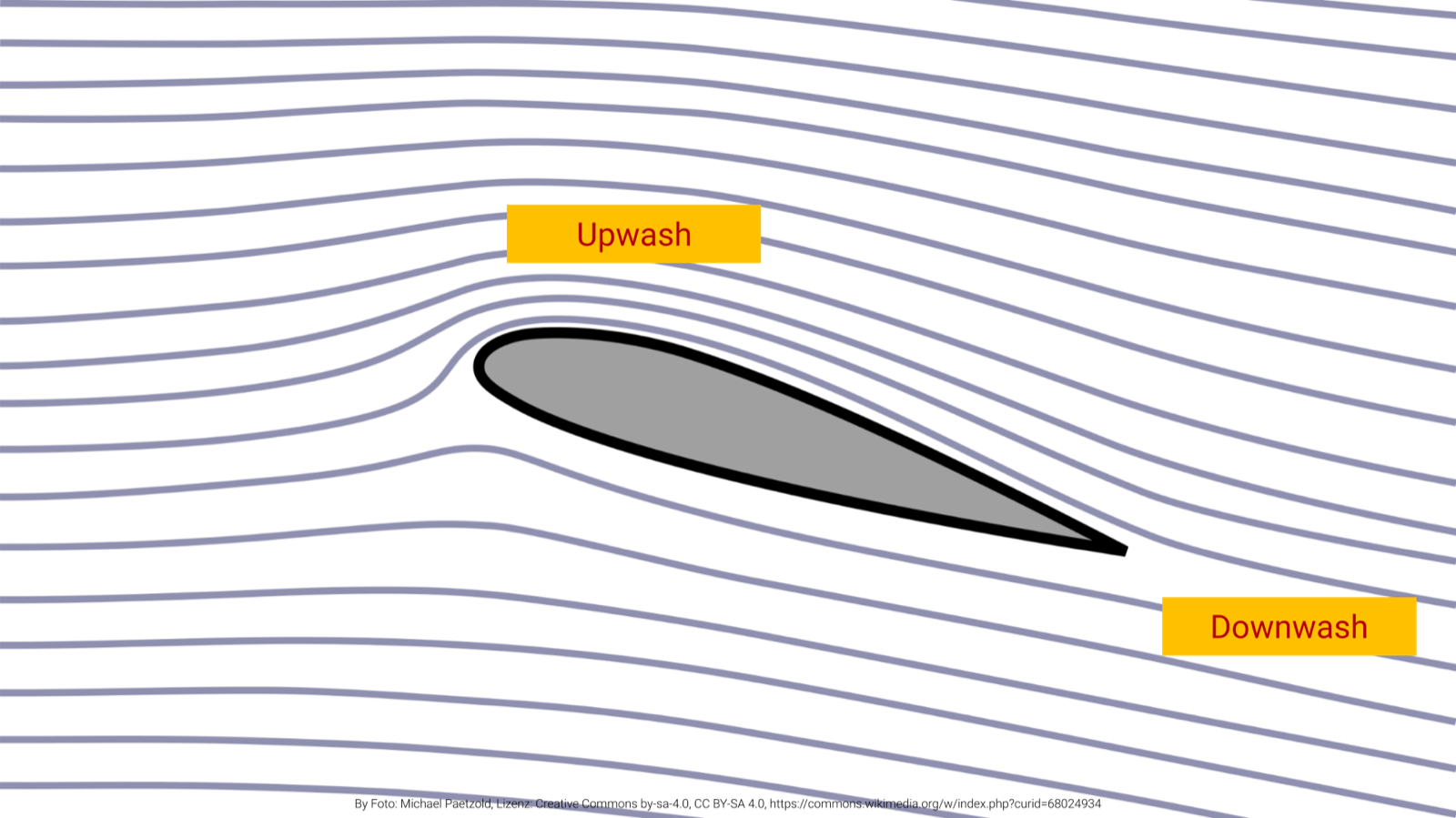
When the airfoil moves through the air, the flow divides at the leading edge. One stream runs along the lower surface; the other is diverted up and over the top, a flow called upwash. The streams rejoin at the trailing edge, and the combined flow leaves deflected downward. That departing, downward-bent flow is the downwash, and by Newton's third law, the wing's push on that air is answered by the air's equal push up on the wing.
PHAK Ch 4, "Airfoil Design"
Angle of attack
Understanding angle of attack is crucial to understanding how airplanes fly, which is why this course keeps returning to it. The angle of attack is the angle between the chord line and the relative wind, the airflow parallel to and opposite the airplane's flight path. Lift always acts perpendicular to the relative wind. And lift is proportional to the angle of attack: raise it and lift increases, up to a point this lesson reaches shortly.
Pressure distribution and the center of pressure
Here is where Bernoulli and Newton meet. The airfoil's shape and angle of attack make the air accelerate over the upper surface and decelerate along the lower one. Faster air above means lower pressure above; slower air below means higher pressure below. Around the airfoil, some regions sit at pressures above atmospheric and others below it, and the net force from all of those differences is the total lift the airfoil generates.
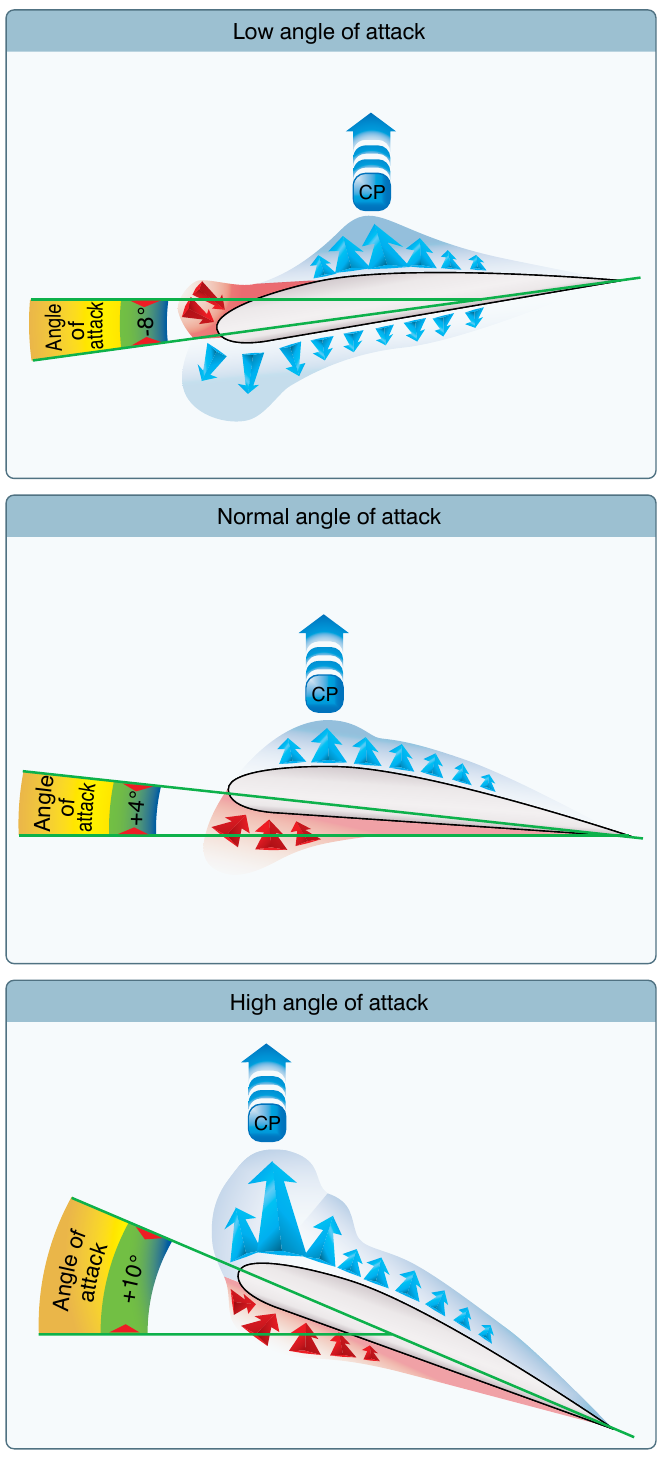
To simplify, we treat all of that distributed force as acting through a single point: the center of pressure. The point moves. Raise the angle of attack and the center of pressure moves forward along the chord, toward the leading edge; lower it and the center of pressure moves aft. Designers care about the limits of that travel because it affects the airplane's stability, and the lesson on stability and center of gravity picks the thread back up.
The full account of lift, then, has two components working together: the pressure difference (Bernoulli) and the reaction to downwash (Newton). Airfoils are designed to exploit both.
PHAK Ch 4, "Airfoil Behavior"; PHAK Ch 5, "Center of Pressure"
The coefficient of lift
Airfoils are tested in wind tunnels, and one measured number is key to understanding an airfoil's performance: the coefficient of lift (CL), which relates the lift the airfoil produces to its angle of attack.
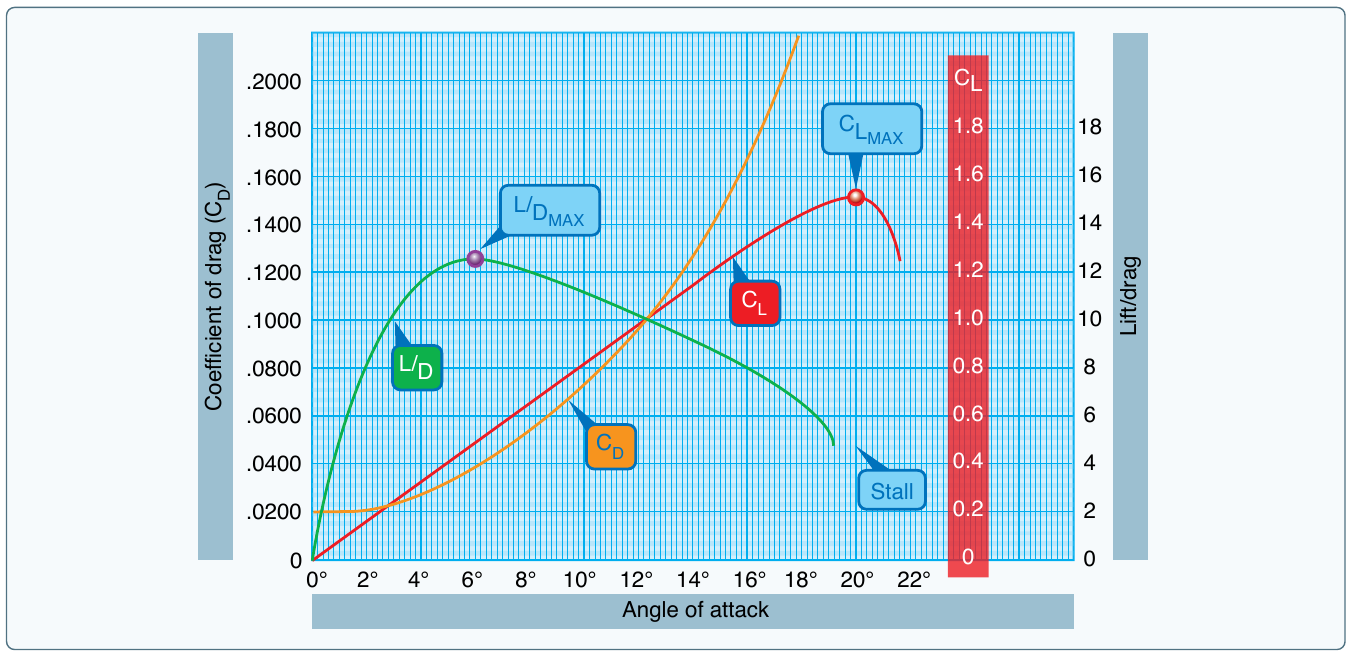
Follow the red lift curve: it climbs steadily, more angle of attack meaning more lift. Then it peaks. (The chart also traces the drag coefficient, which rises the whole way; drag gets its own lesson.) That peak is CLmax, the most lift this airfoil can produce, and the angle where it happens is the critical angle of attack. Any increase beyond the critical angle does not level lift off; lift decreases sharply, because the smooth airflow separates from the upper surface. That separation and loss of lift is the stall. It happens at the same angle of attack every time, regardless of airspeed, attitude, or weight, and it gets the whole of the next lesson.
PHAK Ch 5, "Lift"
The lift equation, and the pilot's share of it
Aerodynamicists compress all of this into one line:
Lift = CL × ½ ρ V² × S
You will never compute it in the cockpit, but every factor in it is either set by the day or flown by you:
- CL captures the airfoil's shape and its angle of attack. You control it with pitch: change the pitch attitude and you change the angle of attack.
- ρ (rho) is the air density, set by altitude, temperature, and humidity. Thin air makes less lift at the same speed and angle of attack, which is why hot days and high airports demand longer runways. Unit 9 turns this into numbers.
- V² is the airspeed, squared. At 120 knots a wing generates four times the lift it generates at 60 knots. The same relation runs in reverse: a 10 percent loss of airspeed on final costs about 19 percent of the lift.
- S is the wing area, fixed by the designer until you lower the flaps.
Total lift depends on both angle of attack and airspeed together. To hold level flight while slowing down, you must trade one for the other: as airspeed falls, the angle of attack has to rise to make up the difference. Every approach to landing is that trade, flown smoothly.
PHAK Ch 5, "Lift"
High-lift devices
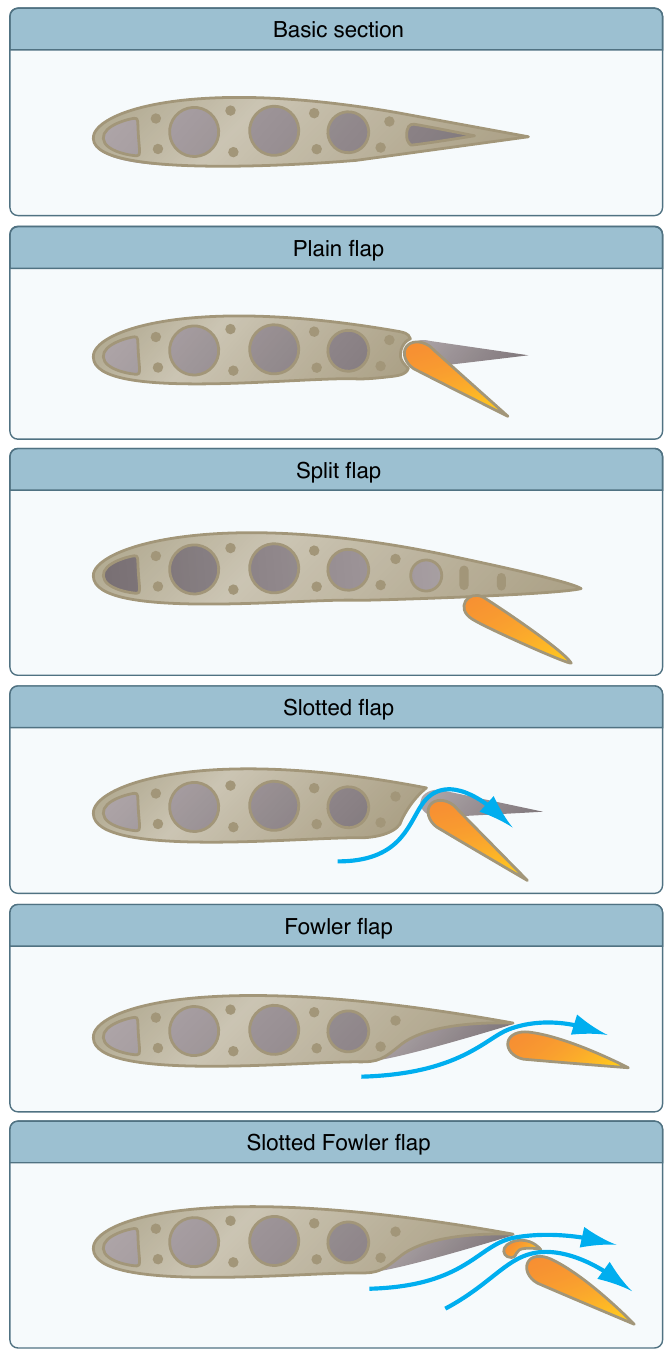
Flaps exist to bend this equation in your favor at low speed. Lowering flaps increases the wing's camber, and with it the coefficient of lift, so the wing can produce the lift you need at a lower airspeed. That reduces the stall speed too, which is what lets you fly a slow, controllable final approach.
Designers have built the idea several ways. The plain flap hinges the trailing edge down; the split flap deflects only the lower surface; the slotted flap (the 172's kind) opens a gap that ducts high-energy air over the flap and delays separation; and the Fowler flap slides aft on tracks, growing the wing's area as well as its camber.
PHAK Ch 6, "Flaps"
How wings are designed
Before the airplane ever reaches you, its designer chose four things about the wing, and each choice shows up in how it flies:
- Camber. Increase the upper camber and the velocity difference between the surfaces grows, and lift with it, up to the point where the curvature starts disturbing the smooth flow.
- Aspect ratio: the wingspan divided by the average chord. At a given angle of attack, a higher-aspect-ratio wing lifts more efficiently, producing more lift for the same drag. Gliders run aspect ratios of 10 to 30; training airplanes sit around 6 to 10.
- Wing area. The wing must carry the whole airplane. Trainer wings produce roughly 14 pounds of lift per square foot, so supporting a 2,450-pound airplane takes about 175 square feet of wing.
- Planform: the wing's shape viewed from above. Elliptical wings are aerodynamically ideal but hard to build, and they stall near the tips first. Rectangular wings stall at the root first, which gives early warning while the ailerons keep working. Most trainers blend a rectangular inner section with tapered outer panels.
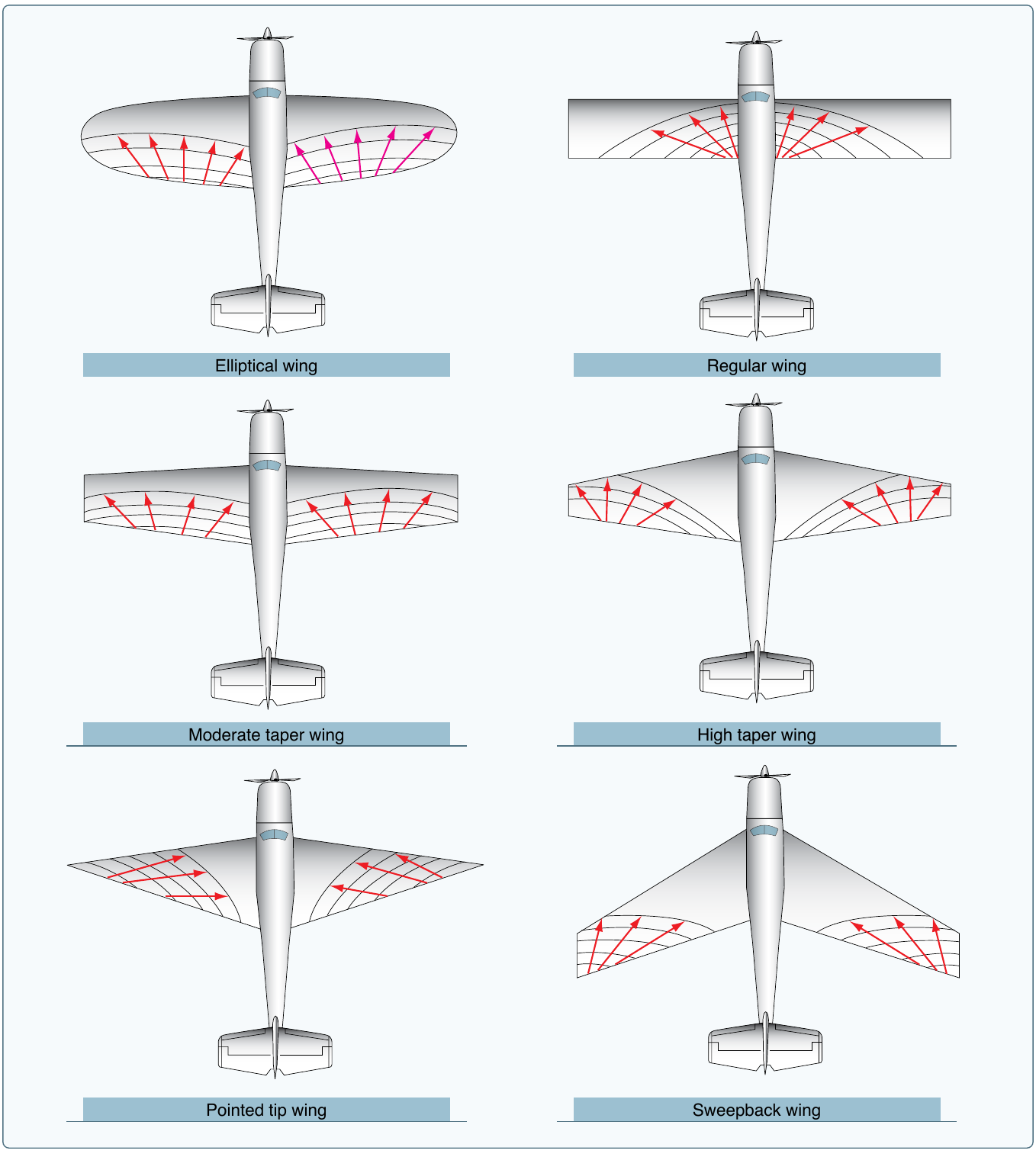
How designers arrange for the root to stall before the tip, using wing twist and stall strips, belongs to the next lesson, where the stall gets its full treatment.
PHAK Ch 5, "Wing Design"
Check your understanding
Answer from memory, without scrolling back up. Recalling it yourself is what makes it stick.
All else equal, what happens to lift if you double your airspeed?
Lift grows with the square of airspeed: at 120 knots the wing makes four times the lift it made at 60. The same math bites in reverse when you get slow. (PHAK Ch 5)
The V in the lift equation is squared, so doubling airspeed roughly quadruples lift. Speed is the most powerful factor you control.
Which statement about a lifting wing is accurate?
The wing hangs in a pressure difference, and most of it is the low pressure on top. That is why upper-surface ice and frost are so dangerous. (PHAK Ch 4)
That is the equal-transit myth, or a piece of it. The real story: faster flow above, lower pressure above, and the air leaves deflected downward.
Besides the pressure difference, what does a lifting wing measurably do?
Downwash. The wing pushes air down; the air pushes the wing up, per Newton's third law. Same lift, second point of view. (PHAK Ch 4)
The measurable flow behind a lifting wing is downwash: air deflected downward, with the equal-and-opposite reaction holding the wing up.
As angle of attack increases, the center of pressure moves where?
Raising the angle of attack shifts the center of pressure forward along the chord; lowering it shifts it aft. The limits of that travel matter to stability. (PHAK Ch 5)
The center of pressure travels: forward as angle of attack rises, aft as it falls. Its movement returns in the stability lesson.
What happens past the critical angle of attack?
The critical angle is where CL peaks at CLmax. Beyond it the airflow separates from the upper surface and lift decreases sharply: the stall. (PHAK Ch 5)
There is no plateau and no slow climb. Past the critical angle the airflow separates and lift drops rapidly; that is the stall.
On a hot day at a high-elevation airport, the same speed and AOA produce what?
Heat and altitude thin the air, and ρ in the lift equation shrinks with it. Expect longer takeoff rolls and weaker climbs. Unit 9 quantifies this.
Thin air is the ρ factor turned down: less density, less lift at the same speed and angle of attack. Hot and high is the combination to respect.
Lowering the flaps does what to the wing?
Flaps increase the wing's camber and with it the coefficient of lift, lowering the stall speed so you can fly a slow, controlled approach. (PHAK Ch 6)
Flaps add curvature rather than remove it: more camber, a higher coefficient of lift, and a lower stall speed for the approach.
Compared to a low-aspect-ratio wing at the same angle of attack, a high-aspect-ratio wing produces what?
Long, narrow wings lift with less drag, which is why gliders run aspect ratios of 10 to 30 against a trainer's 6 to 10. (PHAK Ch 5)
Higher aspect ratio means greater lifting efficiency: more lift for the same drag, which is why gliders use long, narrow wings.
Which two lift factors do you control moment to moment in flight?
Density is set by the day and altitude, and area changes only when you move the flap switch. Your continuous controls over lift are AOA and speed.
Those change slowly or not at all in flight. The two factors in your hands every second are angle of attack and airspeed.
Go deeper (primary source): read the airfoil and lift sections of PHAK Chapter 4, "Principles of Flight", then the "Lift" section of Chapter 5. About twenty minutes, and it walks the same ground with more figures.