Private Pilot · Unit 2 · 30 min
Stalls and Spins
By the end of this lesson you will know:
- why a stall happens at the critical angle of attack, not at a fixed airspeed
- what moves the published stall speed while the critical angle stays fixed
- how to recognize an approaching stall and why recovery starts with reducing the angle of attack
- how washout and stall strips make the wing stall at the root first
- what a spin adds to a stall and why coordinated flight prevents it
- the spin recovery sequence and why the skidding turn to final is dangerous
A stall is an angle, not a speed
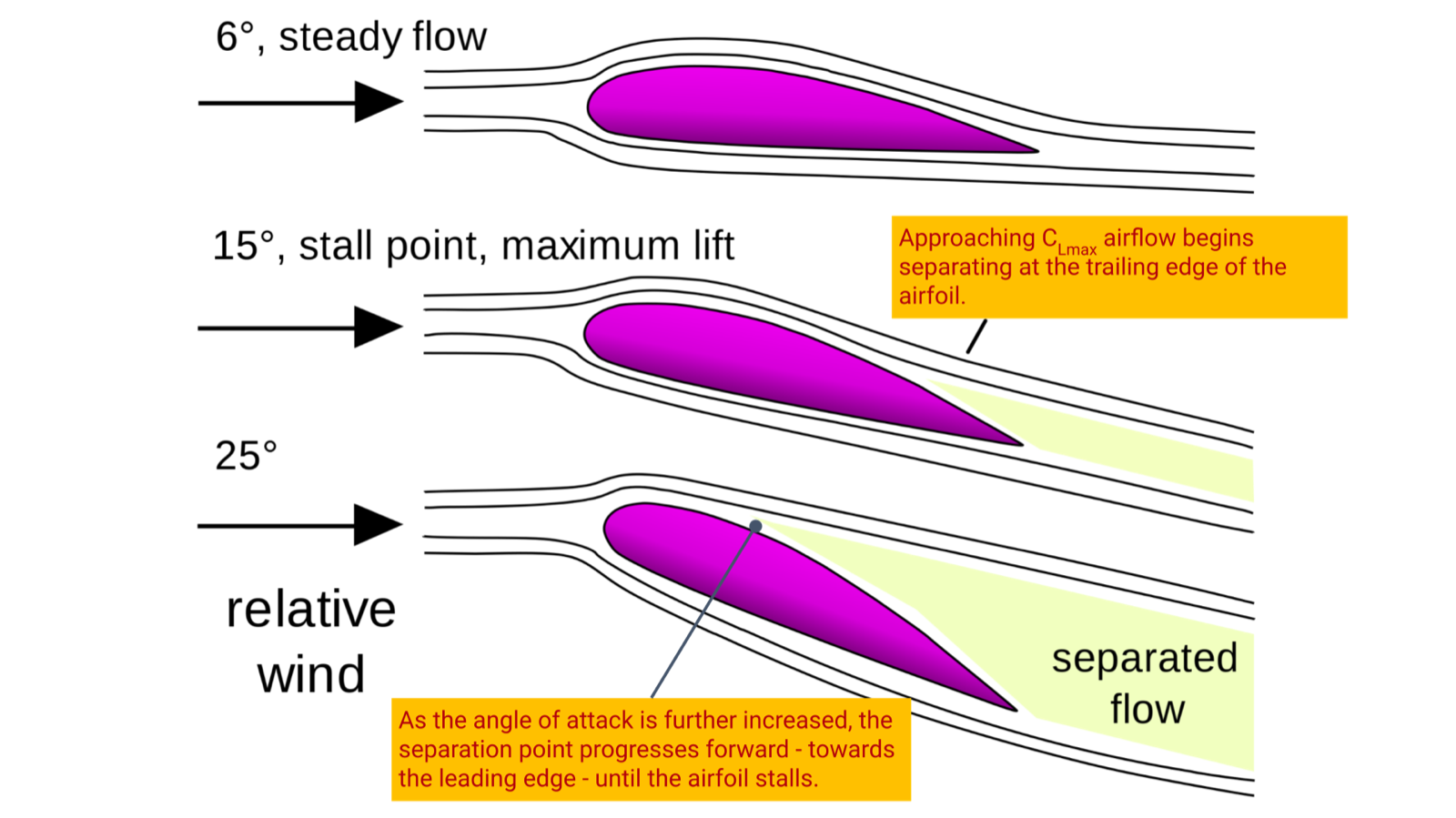
In How a Wing Generates Lift you followed the coefficient of lift up its curve: more angle of attack, more lift, until the curve peaks at CLmax, the airfoil's maximum coefficient of lift. That peak is the critical angle of attack. Push past it and the smooth airflow separates from the upper surface and lift decreases sharply. That loss of lift is the stall.
Here is the fact the knowledge test returns to most often: a wing always stalls at the same critical angle of attack, regardless of airspeed, weight, or the airplane's attitude. Nothing about the stall is fixed to a particular airspeed. If you exceed the critical angle, the wing stalls, and it will do so in a climb, in level flight, in a steep turn, or in a nose-low dive.
How the airflow separates
Watch what the air does as the angle of attack climbs. At a low angle the flow follows the contour of the wing all the way to the trailing edge. As the wing approaches CLmax, the flow can no longer stay attached over the whole upper surface, and a pocket of separated, turbulent air forms at the trailing edge. Raise the angle further and that separation point creeps forward toward the leading edge, the turbulent region grows, and the wing stalls.
The photograph below shows the real thing in a wind tunnel. The smoke lines run straight and orderly into the leading edge, then break into rolling vortices behind the wing. That churning wake is a stalled wing losing its lift, and the same turbulence, striking the tail, is what you feel in the cockpit as buffet.
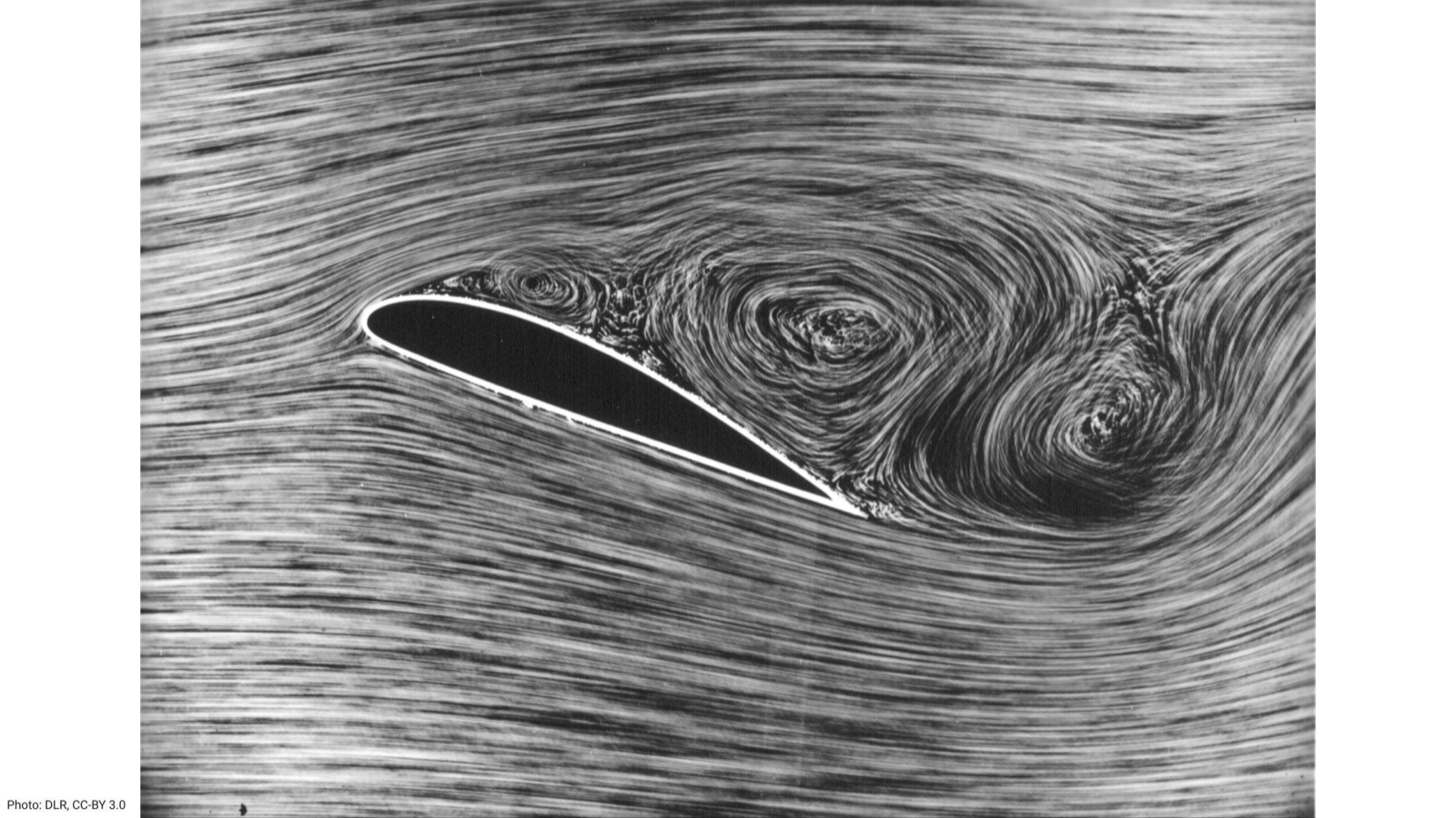
PHAK Ch 5, "Stalls"
Why there is still a stall speed
If the stall is an angle, why does the pilot's operating handbook publish a stall speed? Because in steady, wings-level flight there is exactly one airspeed at which the wing has to reach the critical angle just to make enough lift to hold the airplane up. Slow below it in that condition and the wing cannot make the lift without exceeding the angle, so it stalls. That airspeed is the published stall speed, and it is a useful number precisely because most flying happens near those steady conditions.
But the speed is a consequence, not the cause, and three things move it while the angle stays put:
- Weight. A heavier airplane needs more lift, so the wing reaches the critical angle at a higher speed. Burn off fuel and the stall speed drops a little.
- Load factor. Bank into a turn or pull up abruptly and the wings must support more than the airplane's weight, so they reach the critical angle at a higher airspeed. That is an accelerated stall.
- Configuration. Lowering the flaps adds camber and raises the coefficient of lift, so the wing makes the same lift at a lower speed. That is why the flaps-down stall speed is lower, and why flaps let you fly a slow, controlled approach.
That middle factor is worth pinning down, because it sits behind so many stalls. Load factor is the ratio of the lift the wings are producing to the airplane's weight, and it is usually spoken of in Gs. In steady, wings-level flight the wings carry exactly the airplane's weight, so the load factor is 1G. Maneuver, and it climbs: in a level turn it grows with the bank angle, reaching about 1.15G at 30 degrees and 2G at 60 degrees, where the wings are supporting twice the airplane's weight. A sharp pull on the controls loads the wings the same way.
Here is the connection back to the stall. To carry a higher load factor the wing must make more lift, and it can only do that by flying at a higher angle of attack or a higher speed. So the speed at which it runs out of angle, the stall speed, rises with load factor, specifically by the square root of it. At 2G that square root is about 1.4, so the stall speed is roughly 40 percent higher: an airplane that stalls at 50 knots wings-level will stall near 70 knots in a 60-degree-banked turn. This lesson only asks you to link load factor to stall speed. Its full treatment, including the maneuvering speed and the airplane's structural limits, comes in the lesson on load factor and turns, later in this unit.
PHAK Ch 5, "Stalls"; PHAK Ch 5, "Load Factors"
Recognizing and recovering from a stall
An airplane gives warning before it stalls, and learning those cues is most of stall training:
- The controls go soft and mushy, because slow air moving over the wings and tail makes them less responsive.
- A light aerodynamic buffet shakes the airframe as turbulent air from the wing washes over the tail.
- The stall warning horn or light activates, set to fire a few knots above the actual stall.
- The nose sits high, the airspeed is low and falling, and the sink rate is building.
The recovery is one idea with everything else in support of it: reduce the angle of attack. Lower the nose, or simply release the back pressure, until the wing is flying again. Add power to reduce the altitude you lose, level the wings with coordinated aileron and rudder, and return to normal flight. Power and roll help, but they do not end the stall. Only the reduction in angle of attack does that.
PHAK Ch 5, "Stalls"; Airplane Flying Handbook Ch 4
Designing the stall to be gentle
A well-built wing does not stall all at once. It is designed to stall at the root before the tip, for two reasons that matter to you as the pilot. The ailerons live out near the tips, so keeping the tips flying keeps your roll control working into the stall. And a root that stalls first sends its turbulent wake back over the tail, giving you the buffet as early warning while the wingtips are still doing useful work.
Designers arrange this in two common ways. The first is washout, a built-in twist that sets the wing root at a higher angle of incidence than the tip. Because the root always meets the air at a slightly greater angle, it reaches the critical angle first. The second is the stall strip, a small metal strip on the inboard leading edge that trips the airflow at high angles of attack so the root stalls before the tip does.
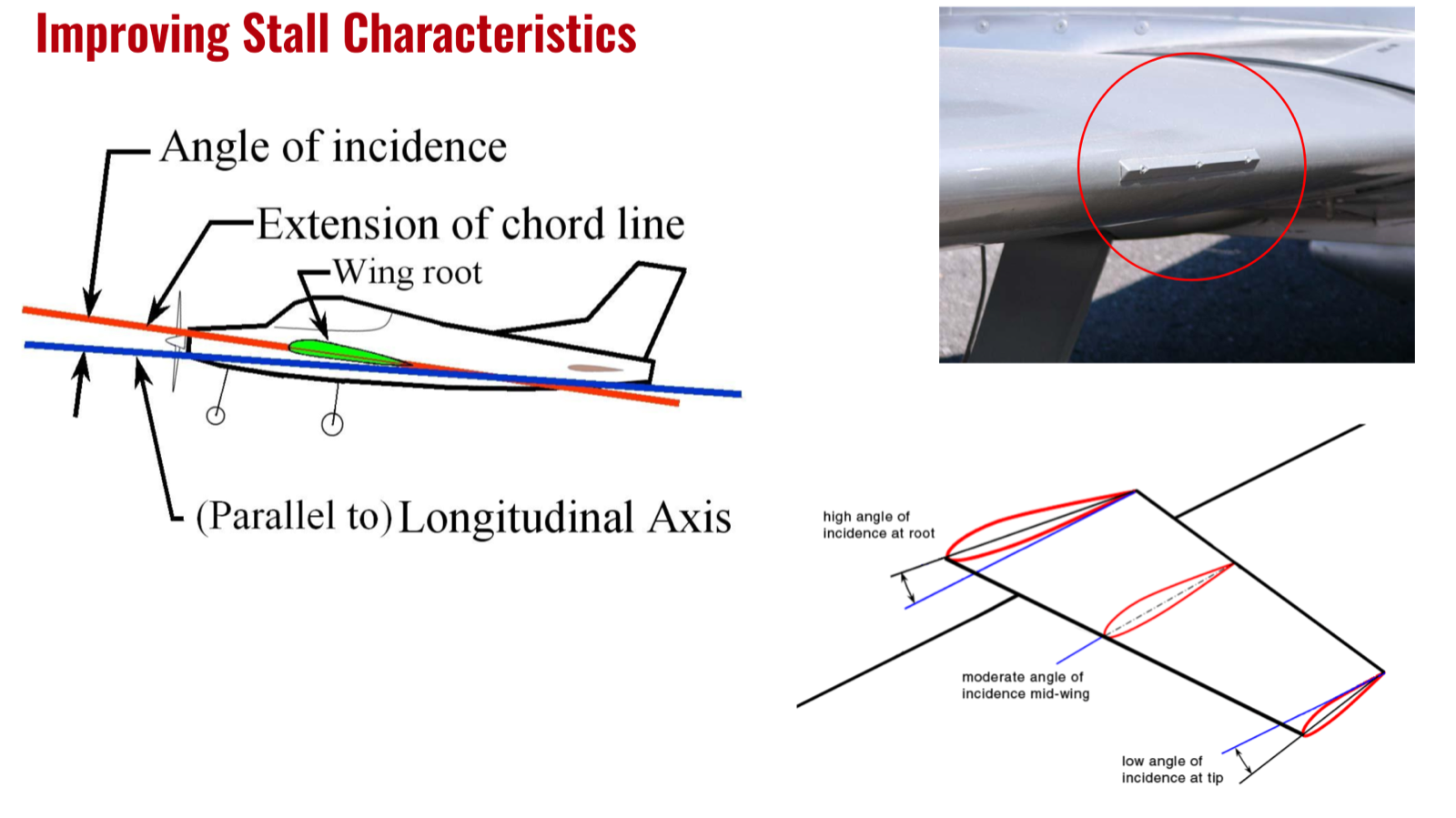
The wing's planform plays a part too. As the lift lesson noted, a rectangular wing tends to stall at the root first on its own, which is one reason so many trainers wear one. Whatever the method, the goal is the same: make the stall progressive and well mannered, with warning and with roll control preserved.
PHAK Ch 5, "Wingtip Vortices" and "Wing Design"
When a stall becomes a spin
A stall by itself, flown straight, just pitches the nose down and recovers. A spin needs a second ingredient: yaw. If the airplane is stalled and also yawing, one wing meets the air at a greater angle of attack than the other and stalls more deeply. The more-stalled wing makes less lift and more drag, so it drops and drags backward. That rolls and yaws the airplane toward the low wing, which deepens its stall further, and the motion feeds itself. That self-sustaining rotation is autorotation, and the resulting corkscrew descent is a spin.
Two things are worth fixing in memory. Both wings are stalled in a spin, one more than the other, which is why you cannot fly out of it on power alone. And a spin cannot happen without a stall, so an airplane kept below the critical angle of attack cannot spin no matter how hard it is yawing.
The phases of a spin
The FAA describes a spin in four phases, and naming them helps you understand what recovery has to undo:
- Entry. You stall the wing while the airplane is yawing, and one wing drops.
- Incipient spin. The rotation has begun but has not yet stabilized. This is the first turn or two, and it is where most inadvertent spins are caught and stopped.
- Developed spin. The rotation rate, airspeed, and vertical descent have settled and hold roughly steady.
- Recovery. The rotation stops and the wing is brought back below the critical angle, flying again.
PHAK Ch 5, "Spins"
Recovering from a spin
The procedure that matters is the one printed in your airplane's Pilot's Operating Handbook (POH). Fly that one. Most light airplanes follow the same general template, sometimes remembered as PARE, and the order is deliberate:
- Power to idle. Power tends to flatten the spin and speed the rotation.
- Ailerons neutral. Aileron against the spin can aggravate it.
- Rudder full, opposite the direction of rotation, to stop the yaw.
- Elevator briskly forward to reduce the angle of attack and break the stall.
Rudder first, then elevator: you stop the rotation and then break the stall. Once the rotation stops, neutralize the rudder and recover smoothly from the resulting dive, watching the airspeed so you do not trade a spin for an overspeed or a secondary stall.
PHAK Ch 5, "Spins"; Airplane Flying Handbook Ch 5
Where stalls and spins actually hurt people
Practice stalls and spins happen high, with room to recover, and they are not what fills accident reports. The accidents happen low and slow, in the traffic pattern, where there is no altitude to spare. The classic scenario is the skidding turn from base to final. A pilot overshoots the extended centerline, and instead of banking more, feeds in bottom rudder to swing the nose around while pulling back to hold the nose up. That is a slow, uncoordinated, high-angle-of-attack turn, and it is a cross-control stall waiting to drop the low wing into a spin, at an altitude far too low to recover.
The defenses are simple and they are all preventive. Keep the ball centered, because coordinated flight is the single best protection against a spin. Respect the angle of attack rather than staring at the airspeed. Do not rush or steepen the turn to final. And when you are maneuvering low, carry a little extra speed. A spin you never enter needs no recovery.
What the private certificate asks of you
For the private pilot certificate you are required to recognize and recover from stalls, both power-on and power-off, and to understand how a spin develops and how it is recovered. You are not required to perform spins themselves; full spin training is required later, to earn a flight instructor certificate. For you the goal is awareness and prevention. Know the warning signs, keep your flying coordinated, and never let a slow, uncoordinated situation build up close to the ground.
FAA-S-ACS-6C, Area VII (Slow Flight and Stalls)
Check your understanding
Answer from memory, without scrolling back up. Recalling it yourself is what makes it stick.
A given wing always stalls at the same what?
The stall is tied to the critical angle of attack, not to a speed. Exceed that angle and the wing stalls in a climb, a dive, or a turn. (PHAK Ch 5)
Speed and attitude both move around the stall. The one thing fixed is the critical angle of attack; reach it and the wing stalls.
Can a wing stall at a high airspeed?
An abrupt pull or a steep turn can drive the wing past the critical angle at high speed. That is an accelerated stall. (PHAK Ch 5)
Exceed the critical angle and the wing stalls at any speed. A hard pull-up at cruise is a fast, sudden stall.
Rolling into a steep level turn does what to stall speed?
The wing must carry more than the airplane's weight in a turn, so it reaches the critical angle sooner. At 60 degrees of bank, stall speed climbs about 40 percent. (PHAK Ch 5)
A turn loads the wing beyond the airplane's weight, so it stalls at a higher speed. This is the accelerated stall.
The first and most important stall recovery action is to?
Lower the nose or relax back pressure to get below the critical angle. Power and roll support the recovery, but only the reduced angle ends the stall. (Airplane Flying Handbook Ch 4)
Power and aileron help, but neither ends a stall. The wing is flying again only when the angle of attack drops below critical.
Why is a wing designed to stall at the root first?
The ailerons sit near the tips, so a root-first stall preserves roll control and sends buffet over the tail as a warning. (PHAK Ch 5)
It is about control, not speed. Stalling the root first keeps the tips and their ailerons flying, so you keep roll authority.
A wing built with washout is?
Washout is a built-in twist that gives the root a higher angle of incidence than the tip, so the root reaches the critical angle first. (PHAK Ch 5)
Washout is twist, not thickness or sweep. The root sits at a higher incidence than the tip and therefore stalls first.
Beyond a stall, what does a spin also require?
A spin is a stall plus yaw. The yaw makes one wing more stalled than the other, and autorotation begins. (PHAK Ch 5)
A spin needs the wing stalled and yawing. Without the stall there is no spin, however hard the airplane yaws.
In a fully developed spin, the wings are?
Both wings are stalled, with the inside wing more deeply stalled, which drives the autorotation. That is why power alone will not fly you out. (PHAK Ch 5)
Both wings are stalled in a spin. The uneven depth of the two stalls is what keeps the rotation going.
For most light airplanes, the rudder input in a spin recovery is?
Opposite rudder stops the yaw, then elevator forward breaks the stall. Fly your own airplane's published procedure. (PHAK Ch 5)
You apply full rudder against the rotation to stop the yaw, then move the elevator forward to break the stall.
The skidding base-to-final turn is deadly mainly because it is?
Bottom rudder and back pressure make it a slow, cross-controlled, high-angle turn low to the ground, where a spin leaves no room to recover. (PHAK Ch 5)
The danger is the opposite of too fast or too high. It is slow, uncoordinated, and low, with no altitude to recover a spin.
Go deeper (primary source): read the "Stalls," "Load Factors," and "Spins" sections of PHAK Chapter 5, then the stall and spin awareness chapters of the Airplane Flying Handbook (FAA-H-8083-3C). Together they walk this same ground with more figures and the maneuver profiles you will fly.