Private Pilot · Unit 2 · 30 min
Stability and Center of Gravity
By the end of this lesson you will know:
- what the center of gravity is and how loading moves it
- the three axes and the motion about each
- the difference between static and dynamic stability
- why the tail carries a downward force and how CG position changes pitch stability
- how dihedral gives lateral stability and the vertical fin gives directional stability
- why an aft CG erodes your stall and spin recovery margin
The center of gravity
Every part of the airplane has weight, and all of it can be treated as acting through a single point: the center of gravity, or CG. It is the airplane's balance point, and one fact makes it the anchor for this whole lesson: a body that is free to rotate always turns about its center of gravity. When the airplane pitches, rolls, or yaws, it pivots around the CG.
The CG is not fixed. It shifts with how you load the airplane: passengers, baggage, and fuel each move it, and burning off fuel moves it again during the flight. Keeping the CG inside the limits the manufacturer sets is one of the pilot's real responsibilities, and the lesson on weight and balance, in a later unit, shows you how to compute it. For now, hold onto the idea that weight acts down through the CG while lift acts up through its own point on the wing, and that the distance between those two points is what gives the airplane its pitch behavior.
PHAK Ch 5, "Aircraft Design Characteristics"
The three axes
Because the airplane pivots about the CG, it helps to name the lines it pivots around. The airplane rotates about three imaginary axes that all pass through the CG at right angles to one another, and the motion about each has a name borrowed from ships:
- The longitudinal axis runs nose to tail. Motion about it is roll.
- The lateral axis runs wingtip to wingtip. Motion about it is pitch.
- The vertical axis runs straight up and down through the CG. Motion about it is yaw.
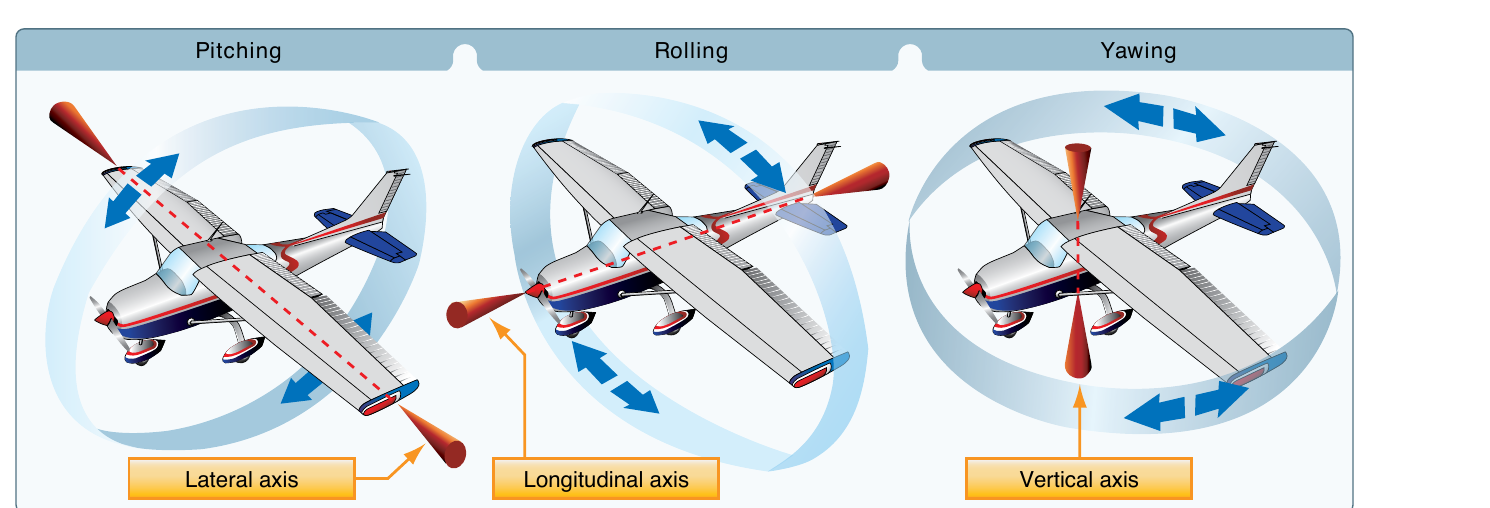
PHAK Ch 5, "Axes of an Aircraft"
What stability means
Stability is the airplane's built-in tendency to return to steady flight after something disturbs it, whether that is a gust or a control input you make and then release. It is mostly a design characteristic, baked into the shape and layout of the airplane rather than something you fly. A stable airplane resists being knocked off its flight path and works its own way back; an unstable one keeps departing from it and demands constant correction. Engineers describe this behavior in two parts, static and dynamic.
Static stability
Static stability is the airplane's initial tendency the instant it is disturbed. There are three possibilities, and the classic picture is a ball on a surface:
- Positive static stability: the airplane tends to return to where it started, like a ball in a valley rolling back to the bottom.
- Neutral static stability: the airplane tends to stay in its new condition, like a ball on a flat surface that just sits wherever you nudge it.
- Negative static stability: the airplane tends to keep moving away, like a ball balanced on a hill that rolls off once disturbed.
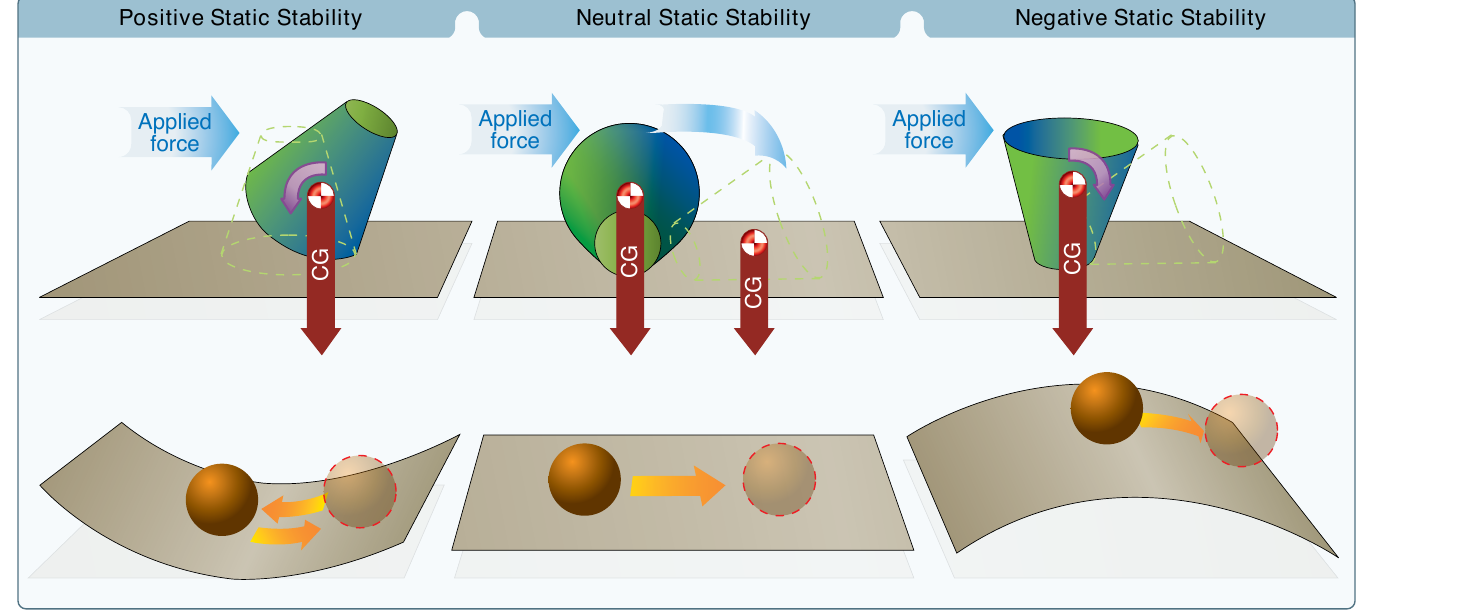
A good training airplane has positive static stability about all its axes. Release the controls after a bump and its first move is back toward the trimmed condition.
Dynamic stability
The initial tendency is only half the description. Dynamic stability describes what happens over time, once the airplane starts oscillating back and forth around its original state. Again there are three cases: with positive dynamic stability the oscillations shrink and die out, with neutral dynamic stability they hold the same size, and with negative dynamic stability they grow larger with each swing.
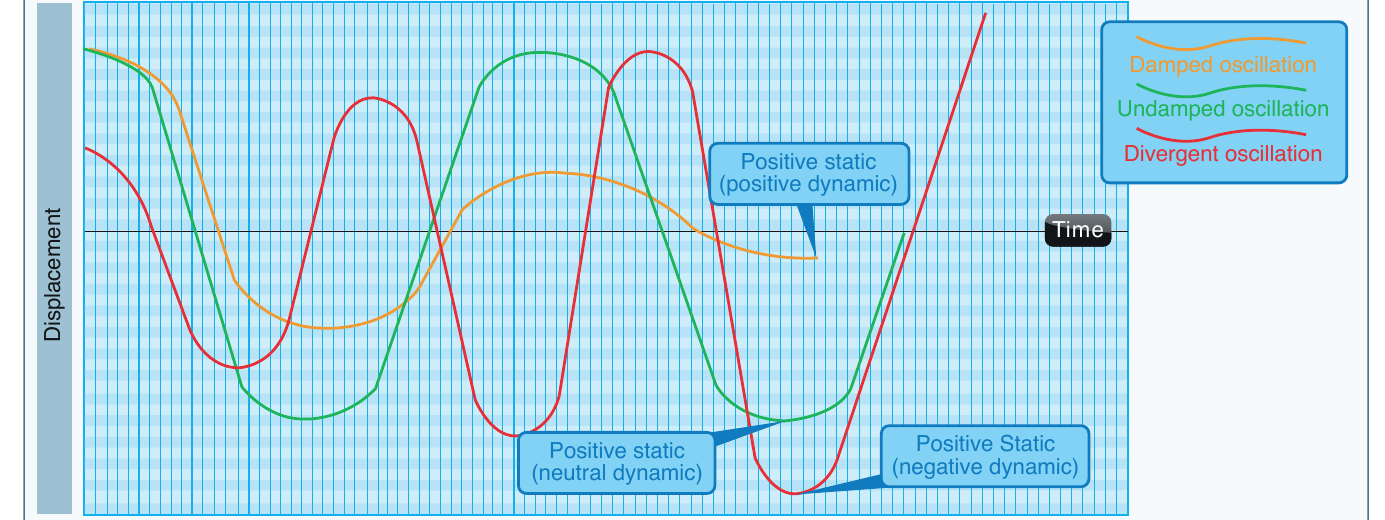
The two properties are separate, and an airplane can be positive in one and negative in the other. An airplane can be statically stable, so its first move is back toward center, yet dynamically unstable, so each swing past center is bigger than the last. What you want in a trainer is positive on both counts: it heads back toward the trimmed condition and its oscillations damp away on their own.
PHAK Ch 5, "Static Stability" and "Dynamic Stability"
The three kinds of stability
Each axis has its own kind of stability. The rest of the lesson takes them one at a time:
- Longitudinal stability is stability in pitch: the nose moving up and down about the lateral axis.
- Lateral stability is stability in roll: one wingtip rising as the other drops, about the longitudinal axis.
- Directional stability is stability in yaw: the nose swinging left and right about the vertical axis.
Longitudinal stability and the tail-down force
Pitch stability, about the lateral axis, is the one designers work hardest on and the one most tied to the center of gravity. Start with a fact from How a Wing Generates Lift: the total lift of the wing acts through the center of lift, the same point the earlier lesson called the center of pressure, and that point moves forward as the angle of attack increases. On its own the wing is therefore unstable in pitch: raise the nose and the lift moves forward, which raises the nose still more.
Most airplanes are built with the wing's center of lift slightly behind the CG. That makes the airplane nose-heavy, and the nose would drop if nothing opposed it. What opposes it is the horizontal stabilizer at the tail, set to carry a small downward force. Picture the line from the CG to the tail as a lever: a strong upward lift at the wing, a heavy weight pulling down at the CG, and a small downward push at the tail that holds the whole thing in balance.
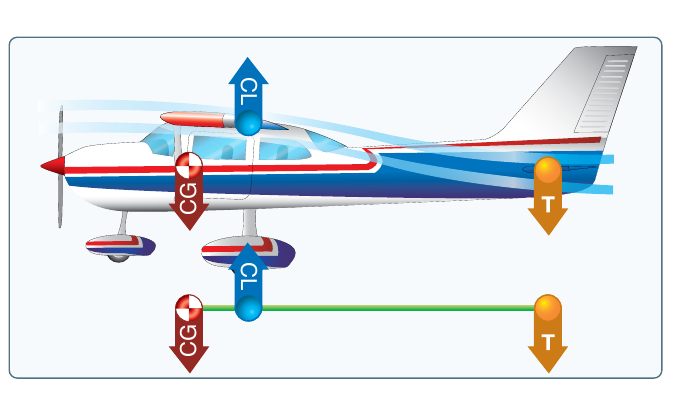
This arrangement is what makes the airplane self-correcting in pitch. The tail-down force comes partly from the downwash off the wing, and it grows and shrinks with airspeed. Speed up and the downwash strengthens, pushing the tail down and the nose up, which slows the airplane again. Slow down and the tail-down force eases, the nose drops, and the airplane picks speed back up. Left alone, a longitudinally stable airplane keeps hunting back toward its trimmed airspeed.
Why the CG position matters so much
Because pitch stability depends on the distance between the CG and the center of lift, where you load the airplane changes how it behaves. This is the part that matters every time you load it.
- A forward CG makes the airplane more stable, but the tail must fly with a larger download to balance the longer lever. The wing then has to support the weight plus that download, so the stall speed goes up, the controls feel heavier, and it takes more elevator to raise the nose. Load it too far forward and you may not be able to raise the nose enough to flare for landing.
- An aft CG shortens the lever and reduces the tail-down force, so the controls feel lighter and the stall speed is a touch lower. But stability drops with it. Load the CG too far aft and the airplane becomes twitchy and, at the extreme, unstable in pitch, and recovery from a stall or spin can become difficult or impossible.
PHAK Ch 5, "Longitudinal Stability (Pitching)"
Lateral stability: keeping the wings level
Lateral stability is stability in roll, about the longitudinal axis: the tendency to return to wings-level after a bump lifts one wing. The main tool designers use is dihedral, the upward angle of the wings when you look at the airplane head-on.
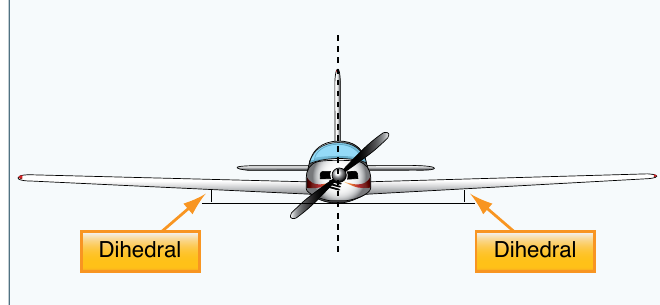
Dihedral works through the sideslip that follows a roll. When a wing drops, the airplane slips slightly toward the low side, so the relative wind now comes partly from that side. The lower wing meets that wind at a higher angle of attack and makes more lift, while the raised wing makes less, and the difference rolls the airplane back toward level. High-wing trainers get extra help from the keel effect: with the wings mounted up high and the weight hanging below, the fuselage swings like a pendulum back to level. Wing sweepback adds lateral stability too, though it matters more on faster airplanes than on trainers.
PHAK Ch 5, "Lateral Stability (Rolling)"
Directional stability: weathervaning into the wind
Directional stability is stability in yaw, about the vertical axis, and it is the easiest of the three to build in. The airplane behaves like a weathervane or an arrow, pointing its nose into the relative wind. The design puts more side area behind the CG than in front of it. The vertical fin does most of the work, helped by the sides of the fuselage aft of the CG.
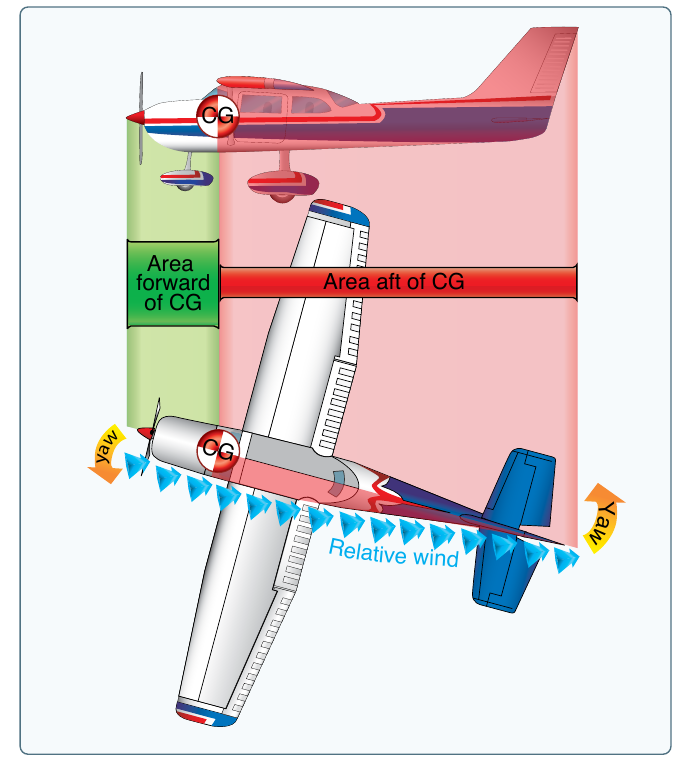
If a gust yaws the nose to one side, the airplane briefly skids, and the relative wind strikes the larger aft area, including the fin. That pressure pushes the tail back into line and swings the nose toward the wind. Like the feathers on an arrow, the farther aft the fin sits and the larger it is, the stronger the effect.
PHAK Ch 5, "Directional Stability (Yawing)"
When roll and yaw interact
Lateral and directional stability do not act in isolation, and the balance between them produces two named behaviors. If directional stability is much stronger than lateral stability, the airplane is prone to spiral instability: a small bank that is left uncorrected slowly tightens into a descending spiral. It develops gradually and is easy to correct once you notice it, but ignored, it can wind up into a spiral dive. If lateral stability is the stronger of the two, the airplane tends toward Dutch roll, a wallowing combination of rolling and yawing. Because Dutch roll is more unpleasant and harder to handle, most airplanes are designed to lean toward mild spiral instability instead.
PHAK Ch 5, "Directional Stability"
Check your understanding
Answer from memory, without scrolling back up. Recalling it yourself is what makes it stick.
The center of gravity is best described as the point where?
The CG is the balance point through which weight acts, and a free body always rotates about it. Loading moves it. (PHAK Ch 5)
That describes a different point. The center of gravity is where the airplane's whole weight is treated as acting, and it is the balance point.
Positive static stability means the initial tendency is to?
Positive static stability is the ball in the valley: disturbed, its first move is back toward where it started. (PHAK Ch 5)
That is neutral or negative. Positive static stability means the first tendency is back toward the original, trimmed condition.
Pitch oscillations that grow larger over time indicate?
Dynamic stability is about the swings over time. Growing swings are negative dynamic stability, even if each first move is toward center. (PHAK Ch 5)
Growing oscillations are the negative case. Positive dynamic stability damps the swings out; neutral holds them the same size.
Longitudinal stability is stability about which axis?
Longitudinal stability is stability in pitch, about the lateral axis: the nose moving up and down. (PHAK Ch 5)
Longitudinal stability is about the lateral axis. It is stability in pitch, the nose moving up and down, not stability in roll.
On most airplanes, the horizontal stabilizer provides?
The center of lift sits behind the CG, so the airplane is nose-heavy and the tail carries a small download to balance the lever. (PHAK Ch 5)
The airplane is built nose-heavy, so the tail carries a downward force. That download is what balances the CG-to-tail lever.
Moving the CG further aft generally makes the airplane?
An aft CG shortens the lever and reduces stability. Too far aft, stall and spin recovery can become difficult or impossible. (PHAK Ch 5)
Aft loading reduces pitch stability. Forward loading is the more stable end; the aft limit protects your recovery margin.
Dihedral is built into a wing to provide?
Dihedral works through sideslip: the lower wing gains angle of attack and lift, rolling the airplane back to level. (PHAK Ch 5)
Dihedral is a roll, or lateral, feature. It rolls the wings back to level after a bump, using the sideslip that follows.
The vertical fin gives the airplane which kind of stability?
The fin puts side area aft of the CG, so a yaw makes the airplane weathervane back into the relative wind. (PHAK Ch 5)
The fin is a yaw, or directional, device. It works like the feathers on an arrow, pointing the nose into the wind.
On most trainers, the wing's center of lift sits where?
The center of lift is set behind the CG, making the airplane nose-heavy so the tail-down force can stabilize it. (PHAK Ch 5)
It is placed behind the CG on purpose. That nose-heavy layout is what the tail-down force balances for pitch stability.
Loading the CG too far forward can make it hard to?
A forward CG demands more tail-down force and more elevator to raise the nose. Too far forward, you may run out of elevator to flare. (PHAK Ch 5)
A forward CG affects pitch control, not roll or the engine. The risk is running out of elevator to raise the nose for landing.
Go deeper (primary source): read the "Aircraft Design Characteristics" and stability sections of PHAK Chapter 5. It carries these same figures, then continues into how stability shapes the airplane's behavior in turns, climbs, and descents.