Private Pilot · Unit 2 · 20 min
The Four Forces of Flight
By the end of this lesson you will know:
- the four forces that act on an airplane and the direction each one acts
- why lift equals weight and thrust equals drag in steady, unaccelerated flight
- how a tilted force resolves into a vertical component and a horizontal component
- why lift is slightly less than weight in a steady climb
- how raising the angle of attack increases lift up to the critical angle
The four forces
In flight, four forces act on the airplane at all times. Each has a direction, and each has an opponent.
- Lift acts upward, perpendicular to the relative wind, the airflow past the wing opposite its flight path. The wing produces it as air flows around it. Its opponent is weight.
- Weight acts downward, from the pull of gravity on the airplane and everything in it: you, fuel, baggage. Its opponent is lift.
- Thrust acts forward, propelling the airplane through the air. It is generated when the engine turns the propeller, and it varies with engine power. How the engine and propeller produce it is the subject of Unit 3. Its opponent is drag.
- Drag acts rearward, parallel to the relative wind. It is the air resisting the airplane's motion, and it is what limits the airplane's speed. Where it comes from is a lesson of its own later in this unit. Its opponent is thrust.
PHAK Ch 5, "Forces Acting on the Aircraft"
One sentence to memorize
"Unaccelerated" means not changing speed or direction. It does not mean slow. "Straight and level" means just what it says: constant direction and constant altitude. Cruising straight ahead at a steady 110 knots? Balanced. Speeding up, slowing down, or turning? Not balanced.
This is Newton's first law at work. With the forces in balance there is no net force, so the airplane keeps its speed and direction until something changes. Flying a maneuver means creating an imbalance on purpose: you add power or raise the nose, the airplane accelerates toward a new speed or path, and then you rebalance the forces to hold it there. Every maneuver in your training is that sequence.
Forces are vectors
Forces are vectors: each one has a magnitude, shown by the length of its arrow, and a direction, shown by the arrow's orientation. Vectors follow three rules:
- Two forces acting on the same object combine into a single resultant whose direction blends the two.
- Run that logic backward and any force can be decomposed into two perpendicular components, one horizontal and one vertical.
- Two forces equal in magnitude but opposite in direction cancel each other, leaving no net force at all.
Here is why this matters to a pilot. Away from straight-and-level flight, in a climb or a glide, the four forces no longer point neatly up, down, forward, and aft. The balance that still holds is in components: in steady flight the sum of the upward-acting components equals the sum of the downward-acting components, and the sum of the forward-acting components equals the sum of the rearward-acting ones. That component balance is what makes sense of the climb and glide pictures below.
PHAK Ch 5, "Forces Acting on the Aircraft"
A common misconception
Students often assume thrust must exceed drag to stay airborne, or that lift must exceed weight in a climb. Neither is true. If thrust exceeded drag in cruise, the airplane would accelerate, and keep accelerating. Balance means steady; imbalance means change.
Here is the one that trips people up on the knowledge test: in a steady climb, lift is slightly less than weight. The flight path tilts upward, so part of the thrust helps hold the airplane up. Climbing comes from excess power, not excess lift.
PHAK Ch 5, "Forces in Climbs"
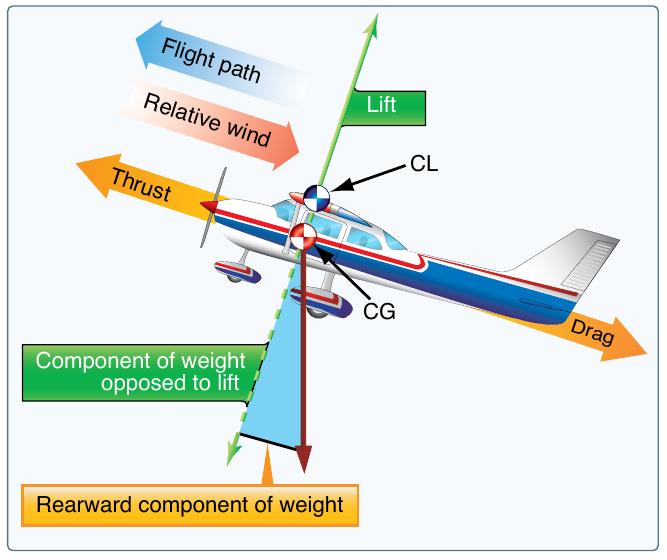
Descents mirror the climb. In a power-off glide there is no thrust at all, yet the airplane keeps flying: the flight path tilts down, and a component of the airplane's own weight now pulls it forward along the path, doing the job thrust used to do. That trade is what makes every glide, and every engine-out drill you will practice, work.
PHAK Ch 5, "Forces in Descents"
Angle of attack: your control over lift
The angle of attack (AOA) is the angle between the wing's chord line (the straight line from its leading edge to its trailing edge) and the relative wind. It is your most direct control over lift. Pull the nose up and AOA increases, so the wing makes more lift at the same speed. This works up to a limit, the critical angle of attack: the angle beyond which the airflow separates from the wing's upper surface and lift decreases rapidly instead of increasing. When the angle of attack exceeds the critical angle of attack, the wings are said to be stalled. The stall gets its own lesson later in this unit. Both the chord line and the relative wind are defined fully in the next lesson, How a Wing Generates Lift.
Lift depends on both speed and angle of attack, which gives you a trade: fly slower and you need more AOA to make the same lift. That is why the nose sits higher in slow flight than in cruise.
PHAK Ch 4, "Angle of Attack"
Check your understanding
Answer from memory, without scrolling back up. Recalling it yourself is what makes it stick.
In steady, level, unaccelerated flight, which statement is true?
Steady and unaccelerated means nothing is changing, so each force is balanced by its opponent: lift with weight, thrust with drag. (PHAK Ch 5)
In steady, unaccelerated flight nothing is changing, so the pairs balance exactly: lift equals weight and thrust equals drag. Any excess would mean acceleration.
The angle of attack is the angle between the wing's chord line and what?
AOA is measured against the relative wind, the airflow opposite your flight path. It is not measured against the horizon.
AOA is measured against the relative wind, not the horizon or the airplane itself. A descending airplane can have a high AOA with its nose below the horizon.
You slow the airplane down but want to hold altitude. What must happen?
Lift depends on both speed and angle of attack. With less speed you need more AOA to keep lift equal to weight.
Slower air over the wing makes less lift, so something must compensate. You raise the angle of attack to keep lift equal to weight.
Drag always acts in which direction?
Drag acts parallel to the relative wind, in the same direction as the oncoming air, directly opposing your motion. (PHAK Ch 5)
Drag always opposes the airplane's motion through the air, so it acts parallel to the relative wind and points rearward.
Stretch question: in a steady climb, how does lift compare to weight?
In a steady climb the flight path tilts up, so part of the thrust helps support the airplane. Lift carries slightly less than the full weight. Climbs come from excess power, not excess lift. (PHAK Ch 5, "Forces in Climbs")
It feels like climbing should take extra lift, but in a steady climb part of the thrust supports the airplane, so lift is slightly less than weight. Climbs come from excess power. (PHAK Ch 5, "Forces in Climbs")
With all four forces in balance, the airplane will do what?
Balanced forces mean no net force, so nothing changes: Newton's first law. Maneuvering is the art of unbalancing the forces on purpose.
Any drift in speed or path would mean the forces were not balanced. With zero net force the airplane simply keeps doing what it is doing.
In a power-off glide, which force does thrust's old job?
With the flight path tilted down, part of the weight vector points forward along the path and keeps the airplane moving. (PHAK Ch 5)
Lift and tail forces act across the flight path, not along it. The forward pull in a glide comes from a component of the airplane's weight.
Go deeper (primary source): read the first section of PHAK Chapter 5, "Aerodynamics of Flight", titled "Forces Acting on the Aircraft." It takes about ten minutes, and knowledge test questions are written from it.