Private Pilot · Unit 4 · 25 min
Currency and Required Documents
By the end of this lesson you will know:
- what the flight review requires, and how its 24-calendar-month clock is counted
- the day and night recent-experience rules for carrying people, and how to regain lapsed currency
- why the current regulation says "persons," not "passengers," and what that changes
- what you must log, who may ask to see your logbook, and whether you must carry it
- which documents you must have in the aircraft to fly as a required pilot
The certificate never expires; your qualification to use it does
The previous lesson ended with this fact: a pilot certificate, once issued under Title 14 of the Code of Federal Regulations (14 CFR), section 61.19, is valid indefinitely. It has no renewal date. What does expire is your legal qualification to exercise it. That qualification is a set of recurring items, each on its own clock. This lesson covers four of them:
- the flight review;
- recent flight experience before you carry other people;
- a current medical or BasicMed;
- the documents you must have in the aircraft.
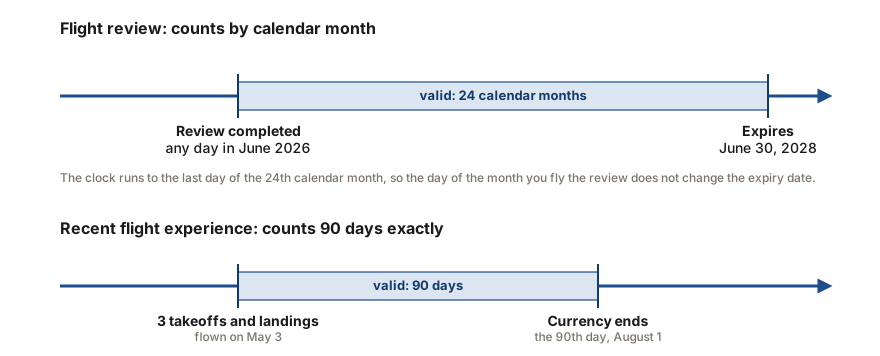
Two of these clocks count time in different units, and confusing them is a common error. A calendar month runs to the last day of the month, so a requirement met on any day of a month stays valid through that month's end in the target year. A day count is exact: it runs from the date of the flight to a date a fixed number of days later. The flight review uses calendar months. Recent flight experience uses days. Keep the two units separate; each rule in this lesson counts in one or the other.
14 CFR 61.19
The flight review
To act as pilot in command (PIC) of any aircraft, you must have completed a flight review within the preceding 24 calendar months (14 CFR 61.56). The review has a fixed minimum size. It is at least one hour of ground training and at least one hour of flight training with an authorized instructor. The ground hour is a review of the current general operating and flight rules of 14 CFR Part 91. The flight hour covers the maneuvers and procedures the instructor judges necessary for you to show that you can exercise your certificate safely.
A flight review is training, not a test. There is no pass or fail score. The instructor either endorses your logbook when the review is complete or keeps training you until it is. When the review is satisfactory, the instructor makes a signed and dated logbook entry certifying that you completed it (14 CFR 61.56). That endorsement is what makes you current.
There are two other ways of maintaining your status without a flight review (14 CFR 61.56). They are:
- Passing a practical test or a proficiency check for a certificate, rating, or operating privilege. The checkride that adds your instrument rating, for example, resets the 24-calendar-month clock.
- Completing a phase of the WINGS pilot proficiency program, run by the Federal Aviation Administration (FAA).
One group of pilots is exempt from the flight review altogether (14 CFR 61.56). A student pilot in training who holds a current solo endorsement does not need one.
14 CFR 61.56
Recent flight experience by day
A current flight review lets you act as pilot in command. Carrying another person aboard takes a second, shorter clock: recent flight experience (14 CFR 61.57(a)). In the preceding 90 days you must have made at least three takeoffs and three landings. You must have been the sole manipulator of the controls for them. They must have been in an aircraft of the same category and class, and the same type when a type rating is required (type ratings apply to large and turbojet airplanes, not to trainers). If the airplane you will fly has a tailwheel, the takeoffs and landings must have been made to a full stop in an airplane with a tailwheel.
If your 90 days lapse, you are not grounded, but 14 CFR 61.57(a) narrows how you get current again. There are two ways to fly the three takeoffs and landings that restore your currency. They are:
- Alone, by day, carrying no one and nothing beyond what the flight itself needs.
- With a flight instructor as the only other person aboard.
What you may not do is bring along another rated pilot to keep you company while you get current, because carrying that person is exactly what a non-current pilot is barred from doing (14 CFR 61.57(a)).
These landing requirements are legal minimums, not a measure of skill. Three landings in the last 90 days makes you legal to carry a friend. It does not by itself mean you are sharp. Currency is a floor set by regulation. Proficiency is the real standard, and you reach it by flying more often than the minimum and by practicing the maneuvers that have gone rusty.
14 CFR 61.57(a)
Recent flight experience at night
Night carries its own recent-experience rule on top of the day rule (14 CFR 61.57(b)). To carry another person during the period beginning one hour after sunset and ending one hour before sunrise, you must have made at least three takeoffs and three landings to a full stop, inside that same window, within the preceding 90 days. Day landings never count toward it. Touch-and-go landings do not count either, because the rule requires full stops. The night takeoffs and landings must, again, be as sole manipulator and in the same category, class, and type where a type rating applies.
The word night means three different spans of time, depending on which rule is asking. Keeping them separate is the point of the timeline below.
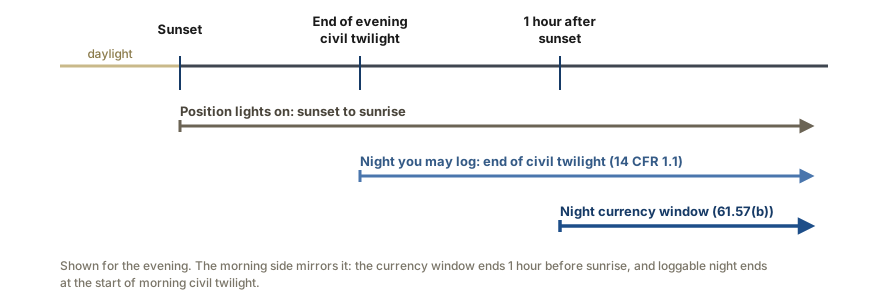
- Position lights must be on from sunset to sunrise (14 CFR 91.209). That span is the widest of the three. Its details are covered later in this unit in the lesson on operating rules for every flight.
- Loggable night, the flight time you may record as night in your logbook, runs from the end of evening civil twilight to the beginning of morning civil twilight. This is the definition in 14 CFR 1.1. Civil twilight ends roughly half an hour after sunset, so this window opens after the position-light span.
- Night currency to carry persons uses the narrowest window (14 CFR 61.57(b)): the period beginning one hour after sunset and ending one hour before sunrise. Only takeoffs and landings inside that window count toward carrying people after dark.
The three windows nest inside one another. The full-stop landings you need for night currency happen in the narrowest of the three. Fly them one hour after sunset or later and they count.
14 CFR 61.57(b); 14 CFR 1.1
The logbook
Your logbook holds the record that establishes currency: the flight review endorsement, the takeoffs and landings that prove recent experience, and the training that qualified you in the first place. A widespread belief is that you must log every flight. You do not. The regulation (14 CFR 61.51) requires you to record only the training and aeronautical experience you use to meet a requirement:
- a certificate;
- a rating;
- the flight review;
- recent flight experience.
Beyond that, logging is your own choice. Most pilots log everything anyway, because a complete record is useful, but the law asks only for the flights that prove something.
Each required entry records a fixed set of facts (14 CFR 61.51(b)):
- the date;
- the total flight time;
- the departure and arrival points;
- the type and identification of the aircraft;
- the kind of pilot experience, such as solo or pilot-in-command time;
- the conditions of flight, such as day, night, or instrument.
As a private pilot you may log pilot-in-command time in two situations (14 CFR 61.51(e)):
- when you are the sole manipulator of the controls of an aircraft for which you are rated;
- when you are the sole occupant of the aircraft.
Under 14 CFR 61.51(i), you must present your logbook for inspection on a reasonable request from:
- the Administrator of the FAA;
- an authorized representative of the National Transportation Safety Board;
- any federal, state, or local law enforcement officer.
You need not carry it with you to do so, and for most flights you should leave it somewhere safe rather than risk losing it in the airplane. There is one exception a student pilot must remember: on a solo cross-country flight, a student pilot must carry both the logbook and the student pilot certificate (14 CFR 61.51(i)(2)), because the endorsements inside them are what authorize the flight.
14 CFR 61.51
Documents that must be with you
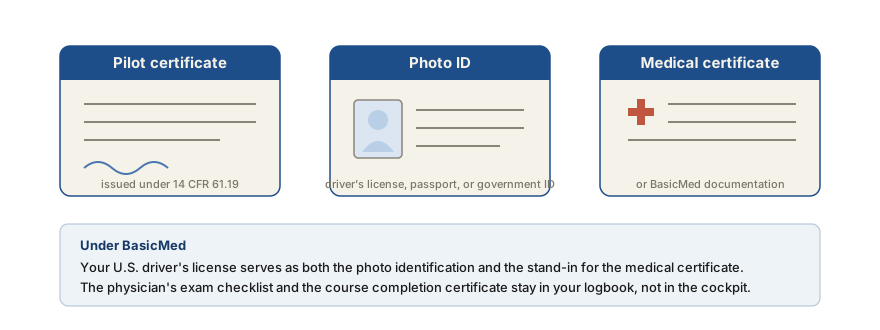
When you fly as a required pilot flight crewmember, the regulation's term for a pilot the aircraft or the operation needs (in a single-pilot trainer, the pilot flying), three documents must be in your physical possession or readily accessible in the aircraft (14 CFR 61.3):
- your pilot certificate;
- a government-issued photo identification, such as a driver's license, a passport, or a government identification card;
- your medical certificate or, if you fly under BasicMed, the U.S. driver's license that BasicMed requires you to hold.
Under BasicMed your driver's license serves as the photo identification and stands in for the medical certificate (14 CFR 61.3). The physician's examination checklist and the course completion certificate stay in your logbook, not in the cockpit (14 CFR 68.3).
You must present all of them on request (14 CFR 61.3(l)). The list of who may ask is one item longer than the list for your logbook:
- the Administrator of the FAA;
- an authorized representative of the National Transportation Safety Board;
- any federal, state, or local law enforcement officer;
- an authorized representative of the Transportation Security Administration.
These are the pilot's documents. The aircraft carries its own required paperwork, including its airworthiness certificate, its registration, its operating limitations, and its weight-and-balance data (14 CFR 91.203, 91.9). Those belong to the airplane, not to you, and the lesson on airworthiness and maintenance, later in this unit, takes them up in full. Do not confuse the two sets. A ramp check, an FAA inspector's on-the-spot review of pilot and aircraft paperwork, tests both.
14 CFR 61.3
The currency stack: am I legal today?
Assembled, the recurring clocks answer one preflight question: may I make this flight today? Read the table top to bottom before any flight that will carry another person or continue past one hour after sunset.
| Requirement | Clock | Needed to |
|---|---|---|
| Pilot certificate | Never expires | Hold the privilege at all |
| Flight review | Preceding 24 calendar months | Act as pilot in command |
| Day recent experience | Preceding 90 days | Carry another person by day |
| Night recent experience | Preceding 90 days, full stop, night window | Carry another person in the night window |
| Medical or BasicMed | By class and age, or the BasicMed intervals | Act as a required pilot |
The last row is the upkeep the previous lesson taught in full. Its durations, and the way a third-class medical runs 60 or 24 calendar months by your age at the exam (14 CFR 61.23), are set out in the medical certificate section of that lesson. This lesson adds the rows above it. Together they are your self-check before the airplane moves.
14 CFR 61.56, 61.57, 61.3
Check your understanding
Answer from memory, without scrolling back up. Recalling it yourself is what makes it stick.
What is the minimum content of a flight review?
A flight review is at least one hour of ground training on current Part 91 rules and at least one hour of flight training. (14 CFR 61.56)
The minimum is one hour of ground and one hour of flight (14 CFR 61.56). The ground hour reviews current Part 91 rules; the flight hour covers maneuvers at the instructor's discretion.
A flight review flown June 15, 2026, stays valid through which date?
The clock runs to the last day of the 24th calendar month, so a June 2026 review lasts through June 30, 2028, not the exact day. (14 CFR 61.56)
Calendar months run to a month's end (14 CFR 61.56). A June 2026 review is valid through June 30, 2028, whatever day of June you flew it.
Which accomplishment counts in place of a flight review?
Completing a phase of the FAA's WINGS program substitutes for a flight review, as does a checkride for a certificate or rating. (14 CFR 61.56)
A WINGS phase substitutes for the flight review (14 CFR 61.56). A seminar alone and a renewed ID card do not. A new-rating checkride also counts.
Day currency to carry another person requires what?
You need three takeoffs and three landings in the preceding 90 days, as sole manipulator, in the same category and class. (14 CFR 61.57)
The window is 90 days, not 60 or 30 (14 CFR 61.57). Three takeoffs and landings as sole manipulator, in the same category and class, keep you current.
How may a pilot whose 90 days have lapsed regain currency?
A non-current pilot may not carry persons, so the regaining flight is solo or with a flight instructor as the only other occupant. (14 CFR 61.57)
Carrying anyone is what a non-current pilot cannot do (14 CFR 61.57). The three takeoffs and landings are flown solo or with only a flight instructor aboard.
Which takeoffs and landings must be made to a full stop?
Night currency landings and tailwheel landings must be full stop. Day landings in a nosewheel airplane may be touch-and-go. (14 CFR 61.57)
Full stops are required at night and for tailwheel airplanes (14 CFR 61.57). Day landings in a nosewheel airplane can be touch-and-go and still count.
Night currency to carry persons counts landings inside which window?
Night currency uses the narrowest window: one hour after sunset to one hour before sunrise. Lights and logging use wider windows. (14 CFR 61.57)
Currency counts from one hour after sunset to one hour before sunrise (14 CFR 61.57). The lights window and the logging window are both wider than that.
When are you required to log flight time?
The rule requires logging only the training and experience used to meet a requirement. Logging every flight is a habit, not a rule. (14 CFR 61.51)
You must log only what proves a certificate, rating, review, or currency requirement (14 CFR 61.51). Ownership and time of day do not create a logging duty.
Which set of documents must be aboard to fly as a required pilot?
You need your pilot certificate, a government photo ID, and your medical certificate or BasicMed documentation in the aircraft. (14 CFR 61.3)
The set is certificate, photo ID, and medical or BasicMed (14 CFR 61.3). The logbook need not be carried, and the aircraft's own papers are separate.
Go deeper (primary source): read 14 CFR 61.56 and 14 CFR 61.57 in full, then the FAA's Advisory Circular 61-98 on flight reviews and the FAASafety.gov WINGS program page. Note how 61.57 now reads "persons" where older guides say "passengers."