Private Pilot · Unit 4 · 30 min
Airworthiness and Maintenance
By the end of this lesson you will know:
- what makes an aircraft airworthy, and who determines it before each flight
- which documents the aircraft itself must carry, using the ARROW memory aid
- the recurring inspections an aircraft needs and how each interval is counted
- what preventive maintenance you may perform and record as a pilot who owns the aircraft
- how an airworthiness directive binds the owner, and what a special flight permit allows
- the steps that let you fly with a non-required item inoperative
What airworthy means
An aircraft is airworthy when it meets two conditions at the same time:
- it conforms to its type certificate, the design the Federal Aviation Administration (FAA) approved, as that design has since been changed by any approved alteration;
- it is in condition for safe operation.
An aircraft that matches its approved design on paper but has a cracked exhaust or a flat strut is not airworthy, and an aircraft in fine mechanical condition that carries an unapproved modification is not airworthy either.
Two people share the responsibility for airworthiness. The owner or operator must keep the aircraft in an airworthy condition, correct defects, and see that the required inspections are done (14 CFR 91.403). Before each flight, the pilot in command (PIC) must determine that the aircraft is airworthy, and must discontinue the flight if unairworthy conditions appear in the air (14 CFR 91.7). When you rent, you are the PIC, so this determination is yours even though you do not own the airplane and did not perform its maintenance.
14 CFR 91.7, 91.403; PHAK Ch 9, "Aircraft Maintenance"
The airplane's paperwork: ARROW
The previous lesson listed the three documents you carry as a pilot: your certificate, a photo identification, and your medical or BasicMed. The airplane carries its own set, required aboard by 14 CFR 91.203 and 91.9. The memory aid is ARROW:
- A is the airworthiness certificate. It is displayed in the aircraft where crew and passengers can read it (14 CFR 91.203(b)), and it is valid indefinitely as long as the required maintenance is performed and the aircraft stays registered (14 CFR 21.181).
- R is the certificate of aircraft registration. Every aircraft must be registered with the FAA before it flies (14 CFR 47.3), and the registration is renewed every seven years (14 CFR 47.40). Older study material says three years; the interval became seven years in 2023.
- R is the radio station license. It is required only for flights outside the United States, issued by the Federal Communications Commission, not the FAA.
- O is the operating limitations. These reach you through the flight manual, the instrument markings, and the placards, covered in the next section.
- W is the weight-and-balance data current for this aircraft. How you use it to compute a loading belongs to the performance and weight-and-balance unit later in the course; here the requirement is only that the data is aboard.
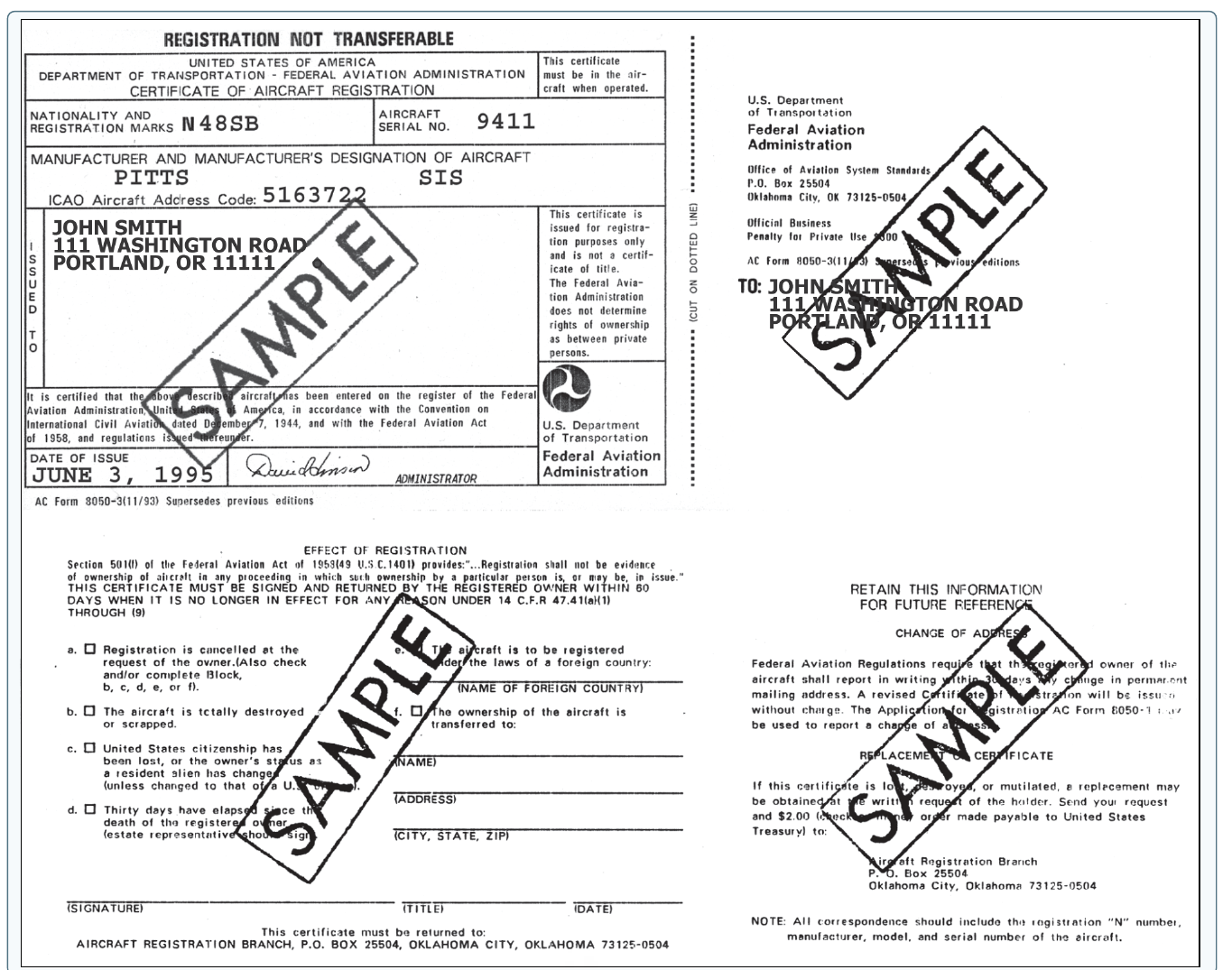
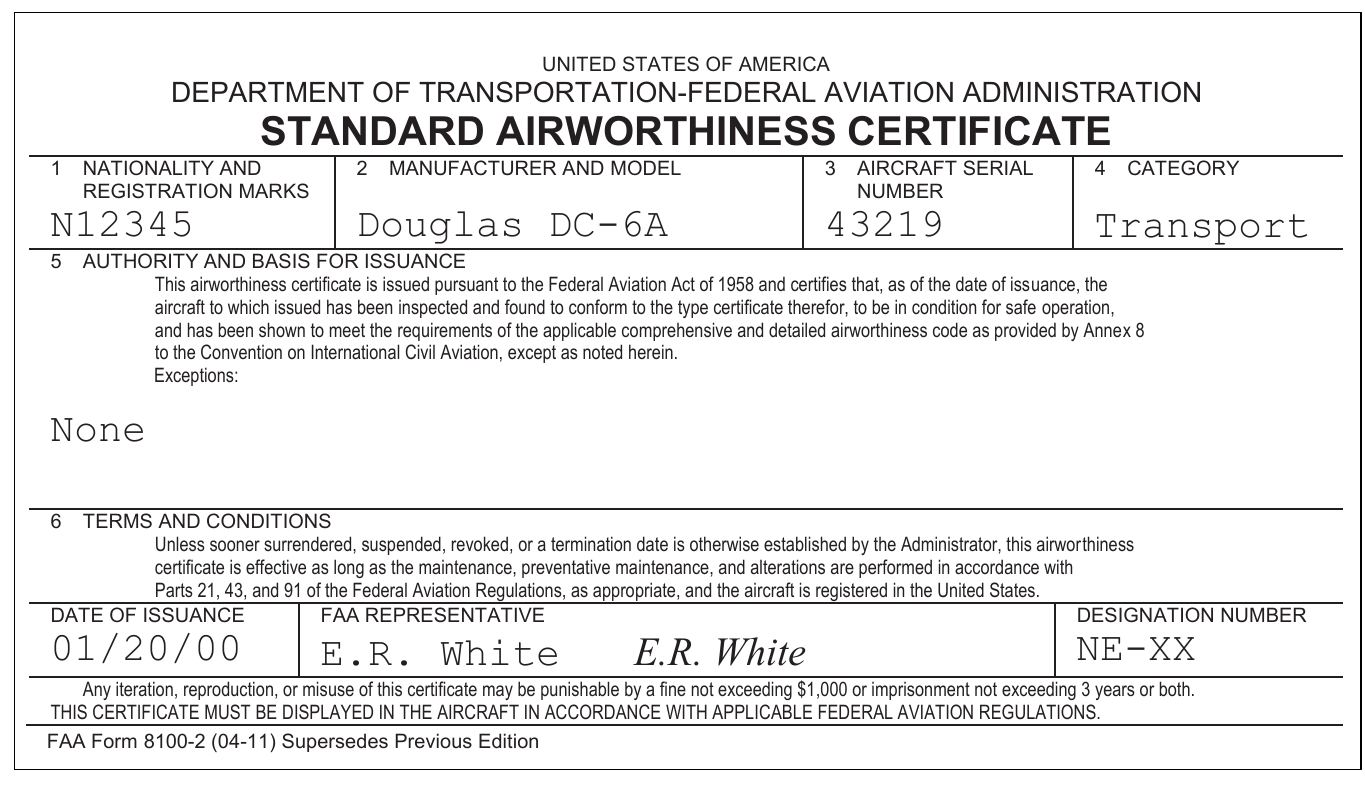
14 CFR 91.203, 91.9; PHAK Ch 9, "Aircraft Documents"
The airplane's own category
An earlier lesson in this unit noted that the words category and class mean one thing on your pilot certificate and another thing for the airplane. On your certificate, a category is a broad grouping such as airplane or rotorcraft. For the airplane itself, a category is an airworthiness grouping that sets structural limits. A standard airworthiness certificate names one of these categories (14 CFR 21.175), and the common ones for training aircraft are:
- Normal, which permits ordinary flight and limits the aircraft to a load factor no greater than 3.8 times the force of gravity, with no aerobatic maneuvers;
- Utility, which permits limited acrobatic maneuvers such as spins, when approved, and turns beyond 60 degrees of bank, with a load factor limit of 4.4 times the force of gravity, usually only at a reduced weight;
- Acrobatic, which permits aerobatic flight with a load factor limit of 6.0 times the force of gravity.
The same airframe can hold more than one of these categories at once. Many trainers are certificated in both normal and utility, and which one applies on a given flight depends on how the airplane is loaded. A placard in the cockpit states the category in force, as the figure later in this lesson shows. Special airworthiness certificates, such as experimental and light-sport, exist for aircraft outside the standard categories.
14 CFR 21.175; PHAK Ch 9, "Airworthiness Certificate"
Where operating limitations live
The operating limitations bind you from three places at once, and a limit stated in any one of them is binding (14 CFR 91.9).
The first is the Pilot's Operating Handbook (POH), the manufacturer's handbook for a specific aircraft, which contains the FAA-approved Airplane Flight Manual information for that airplane. Its Limitations section lists the certificated airspeed limits, the weight and loading limits, the approved maneuvers, and the powerplant limits.
The second is the instrument markings. The pitot-static lesson explained that the colored arcs on the airspeed indicator place several certificated speed limits where the needle passes them: the flap operating range, the normal operating range, the caution range, and the never-exceed red line.
The third is the placard. A placard is a required cockpit marking that states an operating limitation or names an inoperative item. A placard often sits at the control it governs, so you do not have to open the handbook to find the limit in flight.
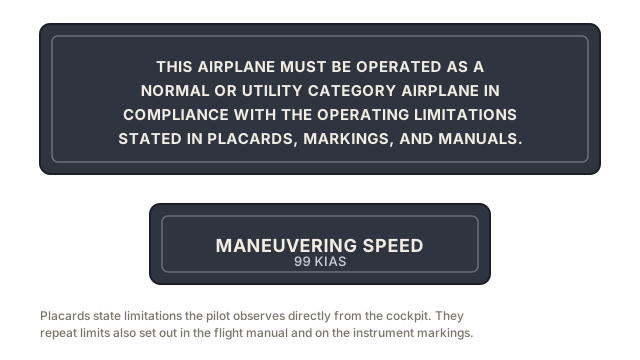
14 CFR 91.9; PHAK Ch 9, "Airplane Flight Manual"
The required inspections
An airworthy aircraft must be inspected at set intervals, and each interval is counted in its own unit. A calendar month runs to the last day of that month in the target year. Hours in service count actual operating time, not the calendar.
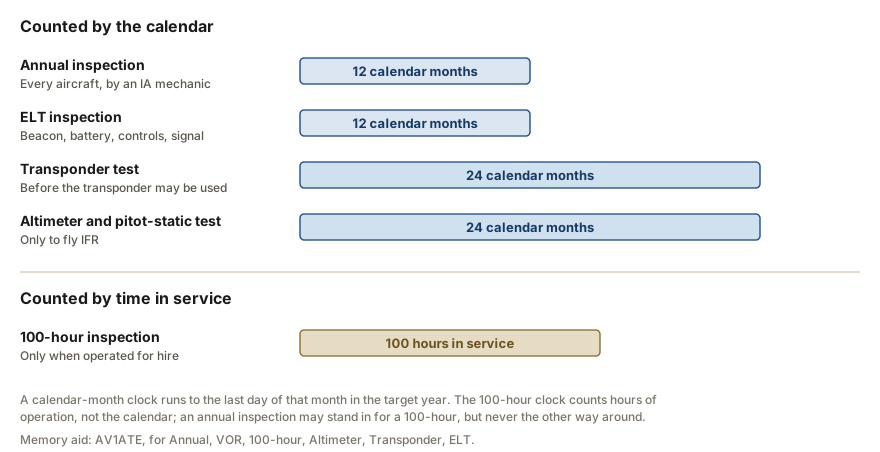
- The annual inspection is required for every aircraft within the preceding 12 calendar months (14 CFR 91.409(a)). It must be signed off by a mechanic who holds an inspection authorization (IA). No aircraft may fly if the annual is overdue, whatever kind of flying is planned.
- The 100-hour inspection is required only when the aircraft carries persons for hire, or when it is used to give flight instruction for hire and the person giving the instruction provides the aircraft (14 CFR 91.409(b)). It falls within each 100 hours of time in service. An annual inspection may stand in for a 100-hour, but a 100-hour may never stand in for an annual. The 100-hour limit may be exceeded by up to 10 hours, and only to reach a place where the inspection can be done; any hours flown over 100 count against the next 100-hour interval.
- A transponder may not be used unless it has been tested within the preceding 24 calendar months (14 CFR 91.413). The requirement applies wherever the transponder is operated.
- The emergency locator transmitter (ELT) must be inspected within the preceding 12 calendar months for proper installation, battery condition, control operation, and a sufficient signal (14 CFR 91.207). Its battery must be replaced when the transmitter has been in use for more than one cumulative hour, or when half of the battery's useful life has expired, whichever comes first.
- The altimeter and pitot-static system must be tested within the preceding 24 calendar months (14 CFR 91.411). This one matters only for flight under instrument flight rules; the instrument rating covers it in full.
A common memory aid strings these together as AV1ATE:
| Letter | Inspection | Clock | Applies to |
|---|---|---|---|
| A | Annual | 12 calendar months | Every aircraft |
| V | VOR check | 30 days | Instrument flight only, covered with the instrument rating |
| 1 | 100-hour | Each 100 hours in service | For-hire operations |
| A | Altimeter and pitot-static | 24 calendar months | Instrument flight only |
| T | Transponder | 24 calendar months | Before the transponder may be used |
| E | ELT | 12 calendar months | Every aircraft |
14 CFR 91.409, 91.411, 91.413, 91.207; PHAK Ch 9, "Aircraft Inspections"
Who may work on the airplane
Maintenance is the work of certificated people. A certificated airframe and powerplant (A&P) mechanic performs and approves maintenance and returns the aircraft to service (14 CFR 43.3, 43.7). An A&P mechanic who additionally holds an inspection authorization is the one who signs off an annual inspection (14 CFR 65.95). As a pilot you are not a mechanic, with one bounded exception.
That exception is preventive maintenance: the simple, minor tasks listed in Part 43, Appendix A, paragraph (c), that a certificated pilot who owns or operates the aircraft may perform (14 CFR 43.3(g)). The paragraph holds 31 items, and every one is limited to work that does not involve complex assembly operations. Several of the 31 apply only to balloons or to special aircraft categories. The tasks that are applicable to a light training airplane are:
- Landing gear
- Removing, installing, and repairing tires.
- Replacing elastic shock cords.
- Servicing shock struts with oil, air, or both.
- Servicing wheel bearings.
- Replacing wheels and skis where no weight and balance computation is involved.
- Engine and fuel
- Replacing or cleaning spark plugs and setting the gap.
- Cleaning or replacing fuel and oil strainers or filter elements, the item under which the routine oil and filter change is done.
- Replacing any hose connection except a hydraulic connection.
- Replacing prefabricated fuel lines.
- Replenishing hydraulic fluid in the reservoir.
- Removing, checking, and replacing magnetic chip detectors.
- Airframe, cabin, and fairings
- Lubrication that needs no disassembly beyond removing nonstructural items such as cover plates and cowlings.
- Replacing any cowling that does not require removing the propeller or disconnecting flight controls.
- Making small simple repairs to fairings and nonstructural cover plates that do not change the contour.
- Replacing side windows that do not interfere with the structure or an operating system.
- Replacing safety belts, and seats or seat parts with approved parts.
- Repairing upholstery and decorative furnishings.
- Refinishing decorative coating on surfaces other than balanced control surfaces.
- Applying preservative or protective material where no primary structure or operating system is disassembled.
- Replacing defective safety wiring or cotter keys.
- Replacing or adjusting nonstructural standard fasteners.
- Electrical and lights
- Servicing and replacing batteries.
- Replacing bulbs, reflectors, and lenses of the position and landing lights.
- Troubleshooting and repairing broken circuits in the landing light wiring.
- Avionics
- Removing and replacing a self-contained, panel-mounted navigation or communication unit that uses tray-mounted connectors, with an operational check before the unit is used; autopilots, transponders, and DME are excluded.
Student and recreational pilots are not authorized, and a sport pilot may perform it only on a light-sport aircraft they own or operate (14 CFR 43.3(g), 43.7(f)). When you perform preventive maintenance, you must make an entry in the aircraft's maintenance record (14 CFR 43.9). The entry must state:
- a description of the work done;
- the date it was completed;
- your name, signature, certificate number, and the kind of certificate you hold.
Anything beyond the Appendix A list, and any major repair or major alteration, is for certificated maintenance personnel. Repairs and alterations are classified as major or minor, and a major one is documented on FAA Form 337 (14 CFR Part 43 Appendix B) and returned to service by a mechanic holding an inspection authorization or by a certificated repair station (14 CFR 65.95).
14 CFR 43.3, 43.7, Part 43 Appendix A; PHAK Ch 9, "Preventive Maintenance"
Airworthiness directives
When the FAA finds an unsafe condition that is likely to exist in other aircraft of the same design, it issues an airworthiness directive (AD) under 14 CFR Part 39. It orders the correction of an unsafe condition in a specific design of aircraft, engine, propeller, or appliance, and compliance is mandatory unless the FAA grants a specific exemption. ADs come in two forms:
- those of an emergency nature, requiring compliance before further flight;
- those of a less urgent nature, requiring compliance within a stated time or number of hours.
Some ADs are one-time actions and some recur, such as an inspection required every 50 hours. Ensuring that every applicable AD has been complied with is the owner or operator's responsibility (14 CFR 91.403), and the compliance record is part of the maintenance records (14 CFR 91.417). There is no allowance to overfly the limit in a recurring AD unless the AD itself provides one. The Special Airworthiness Information Bulletin, by contrast, is advisory: it alerts owners to a concern but does not compel action.
14 CFR Part 39, 91.417; PHAK Ch 9, "Airworthiness Directives"
Required equipment and flying with something broken
Under 14 CFR 91.213, every installed instrument and item of equipment must be operative before each departure. 14 CFR 91.205 lists the minimum equipment for day visual flight and the additional equipment for night. The day list carries the instruments and equipment the aircraft needs to be flown safely by reference to the ground and its own gauges; the night list adds position lights, an anti-collision light, an adequate electrical source, and a spare set of fuses. The operating rule for exactly when the position lights must be switched on belongs to the operating-rules lesson later in this unit.
When an item that is not required fails, 14 CFR 91.213(d) lets you defer it and fly, provided you work through its steps. First determine whether the item is required, by 14 CFR 91.205, by the aircraft's type design or equipment list, or by an AD. If it is required, it must be repaired before flight. If it is not required, and you determine the aircraft is safe to fly without it, you may defer it. The inoperative item is then deactivated or removed and placarded INOPERATIVE. When the deactivation or removal involves maintenance, and removal always does, certificated maintenance personnel must do the work and record it in the maintenance record.
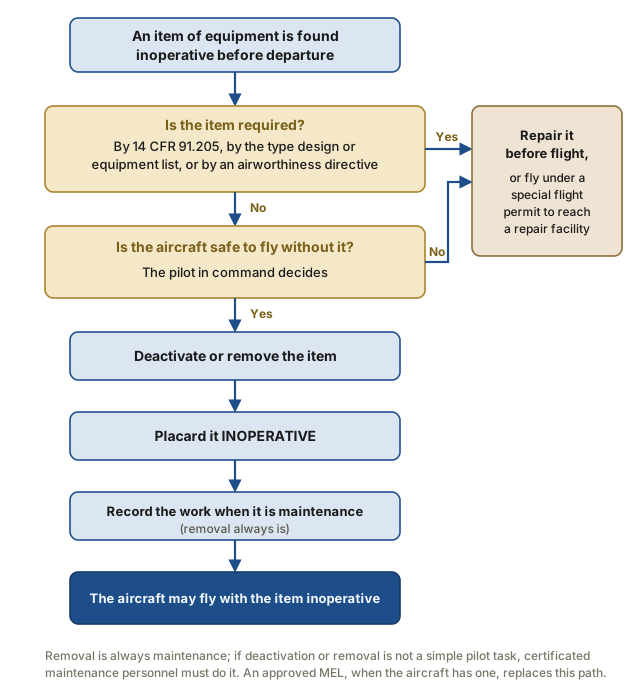
Larger and more complex operations use a different tool, the minimum equipment list (MEL): an FAA-approved list, specific to one aircraft, that authorizes flight with certain equipment inoperative under stated conditions (14 CFR 91.213(a)). Once the FAA issues an operator an MEL, using it becomes mandatory for that aircraft, and it replaces the 91.213(d) path. A related term you will hear is the Kinds of Operation Equipment List (KOEL), a table in some flight manuals stating which equipment each kind of operation, such as day visual or night instrument flight, requires.
14 CFR 91.205, 91.213; PHAK Ch 9, "Operations With Inoperative Equipment"
Special flight permits
Sometimes an aircraft is safe to fly but does not currently meet all airworthiness requirements, for example when its annual inspection has lapsed or a required item has failed and no parts are on hand. A special flight permit, often called a ferry permit, authorizes a specific flight in that condition (14 CFR 21.197). It is a special airworthiness certificate issued by the Flight Standards District Office (FSDO) or a designated airworthiness representative, and it typically allows the aircraft to be flown to a place where the repair or inspection can be done. The permit carries operating limitations for the flight, and any AD that is due must still be complied with before the airplane is flown.
14 CFR 21.197, 91.213; PHAK Ch 9, "Special Flight Permits"
The airworthiness question in two checks
Everything in this lesson answers one question you ask before you fly: is this aircraft legal and safe to take up today? The answer is two checks, and both are the pilot in command's to make.
- The paper check. Are the ARROW documents aboard? Are the required inspections current, above all the annual, and any AD complied with? If an item is inoperative, has it been handled under 91.213(d) or the MEL, deactivated or removed and placarded?
- The condition check. On the walk-around, is the aircraft in condition for safe operation, with no defect that makes it unairworthy?
The owner or operator keeps the airplane airworthy over its life. You, in the left seat, confirm on the day that it still is. An aircraft can be mechanically sound and still be unairworthy for a missing inspection, and it can be legal on paper and still be unsafe for a defect you find on preflight. Both checks must pass.
Check your understanding
Answer from memory, without scrolling back up. Recalling it yourself is what makes it stick.
Before each flight, who determines that the aircraft is airworthy?
The PIC determines airworthiness before each flight under 14 CFR 91.7. The owner or operator is responsible for maintaining the aircraft under 91.403. (PHAK Ch 9)
The owner or operator maintains the aircraft, but the pilot in command makes the airworthiness determination before each flight under 14 CFR 91.7.
Which set of documents must be aboard the aircraft itself?
ARROW: airworthiness certificate, registration, radio station license for international flights, operating limitations, and weight-and-balance data. (PHAK Ch 9)
Certificate, photo ID, and medical are the pilot's own documents. The aircraft carries the ARROW set, including its airworthiness certificate and registration.
The airworthiness certificate stays valid for how long?
A standard airworthiness certificate has no expiry. It stays in effect as long as the aircraft is maintained per 14 CFR Parts 21, 43, and 91 and stays registered. (PHAK Ch 9)
The certificate does not expire on a calendar. It remains effective indefinitely while the required maintenance is done and the aircraft is registered.
A 100-hour inspection is required only when the aircraft is?
The 100-hour applies to aircraft carried for hire or used for flight instruction for hire (14 CFR 91.409(b)). An annual may substitute for it, but a 100-hour never substitutes for an annual. (PHAK Ch 9)
Night, airspace, and ownership do not trigger it. The 100-hour is required when the aircraft is operated for hire or for flight instruction for hire.
The 10-hour allowance for overflying a 100-hour inspection?
The limit may be exceeded by up to 10 hours only to reach a place for the inspection, and the excess is subtracted from the next 100 hours (14 CFR 91.409(b)). (PHAK Ch 9)
The overflight does not extend or reset anything. Any hours flown past 100 count against the next 100-hour interval.
An ELT battery must be replaced after how much use?
Replace the battery after more than one cumulative hour of transmitter use, or when 50 percent of its useful life has expired, whichever is first (14 CFR 91.207). (PHAK Ch 9)
The thresholds are one cumulative hour of use or 50 percent of useful life. The ELT itself is inspected every 12 calendar months.
After a private pilot-owner changes the engine oil, the rules require?
Oil changes are preventive maintenance under Part 43 Appendix A. The pilot must record the work, date, name, signature, and certificate number (14 CFR 43.9). (PHAK Ch 9)
Preventive maintenance needs no mechanic sign-off or new certificate. It needs a maintenance-record entry with the work, date, and your certificate details.
An airworthiness directive is best described as?
An AD under Part 39 is regulatory and compliance is mandatory. Ensuring every applicable AD is complied with is the owner or operator's responsibility. (PHAK Ch 9)
Advisory bulletins and maker's notes are not binding. An AD is a rule that must be complied with, and the owner or operator ensures it is done.
Before flying with a non-required item inoperative, you must?
Under 14 CFR 91.213(d), a deferred non-required item is deactivated or removed and placarded INOPERATIVE. When the work is maintenance, it is recorded in the maintenance record. (PHAK Ch 9)
Your logbook and a special permit are not the mechanism. The item is deactivated or removed and placarded inoperative, with a record entry when maintenance is involved.
A special flight permit allows an aircraft to?
A special flight permit, issued by the FSDO, authorizes a specific flight of an aircraft that is safe but not currently airworthy, typically to reach a repair facility (14 CFR 21.197). (PHAK Ch 9)
It does not waive inspections or allow passenger service. It authorizes a specific flight of a safe but non-airworthy aircraft, usually to a repair facility.
Go deeper (primary source): read the "Aircraft Documents," "Aircraft Maintenance," and "Operations With Inoperative Equipment" sections of PHAK Chapter 9, then 14 CFR 91.213 and 14 CFR 91.7 in full. The next lesson in this unit takes up the operating rules of flight.