Private Pilot · Unit 4 · 25 min
Certificates, Privileges, and Medicals
By the end of this lesson you will know:
- where the rules live: which numbered parts of the federal aviation regulations govern pilots and medicals
- how pilot certificates rank, and what a private pilot may and may not do for money
- what category, class, and rating mean on a pilot certificate
- which airplanes need a one-time training endorsement, and why an endorsement is not a certificate
- the three classes of medical certificate, how long each lasts, and how BasicMed replaces a third-class medical
- the sequence of regulatory gates from student pilot to the practical test
The rules have an address
Nearly everything a pilot may do, and everything an airplane must be, is written down in one title of federal law: Title 14 of the Code of Federal Regulations (14 CFR), administered by the Federal Aviation Administration (FAA). Within it, rules are grouped into numbered parts, and each part is split into numbered sections. When your instructor cites "61.113," the number before the period is the part and the number after it is the section. You will come to read these citations the way you read a page number.
A handful of parts carry almost everything in this unit. You do not need to memorize the whole title. You do need to know which part answers which question.
| Part | What it governs |
|---|---|
| 14 CFR Part 61 | Certification of pilots, flight instructors, and ground instructors |
| 14 CFR Part 67 | Medical standards and the classes of medical certificate |
| 14 CFR Part 68 | Flying certain small aircraft without a medical, under BasicMed |
| 14 CFR Part 91 | General operating and flight rules for civil aircraft |
| 49 CFR Part 830 | Reporting of aircraft accidents and certain incidents (the National Transportation Safety Board's rule) |
This lesson lives inside Parts 61, 67, and 68: who may fly, and the medical standards that let them. The last row is the exception to the pattern, because accident reporting belongs to that board and sits in Title 49, not Title 14. Parts 91 and 830 each get their own lesson later in this unit.
PHAK Ch 1, "Introduction to Flying" (regulatory basis, Figure 1-12)
The certificate ladder
Pilot certificates rank by the privileges they grant. From fewest to most, the rungs are sport pilot, recreational pilot, private pilot, commercial pilot, and airline transport pilot (14 CFR 61.5). Each higher certificate demands more training and experience, and each grants privileges the one below it lacks.
The private pilot certificate is the standard first goal, and the one this course prepares you for. It lets you carry passengers and fly for your own purposes, by day or night, in most airspace, in a wide range of aircraft. The one thing it does not let you do is fly for pay (14 CFR 61.113), a limit the next section spells out.
Two lighter certificates sit below it. The sport pilot certificate takes the fewest hours and, for many pilots, allows a valid driver's license in place of a medical certificate (14 CFR 61.23(c)). In exchange it limits you to one passenger, to smaller and simpler aircraft that meet the sport pilot limits of 14 CFR 61.316, and to tighter operating limits than a private pilot holds, including on night flight, altitude, and visibility (14 CFR 61.315). The recreational pilot certificate sits between sport and private, with fewer required hours than the private certificate but tighter limits on distance from home, airspace, and the aircraft you may fly (14 CFR 61.101). Above the private certificate, the commercial pilot certificate allows flying for compensation or hire (14 CFR 61.133), and the airline transport pilot certificate is the highest grade, required to captain an airliner (14 CFR 121.436).
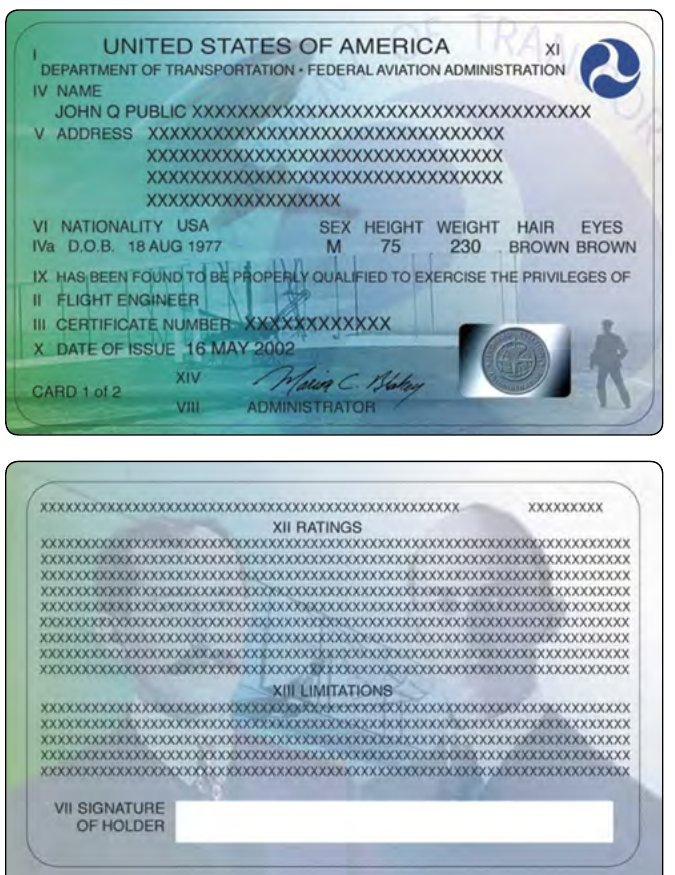
PHAK Ch 1, "Pilot Certifications" through "Airline Transport Pilot"
Category, class, and rating
An airman certificate is not a blanket permission to fly anything. It states exactly what you are qualified for, using three terms that stack from broad to narrow (14 CFR 61.5). A category is the broad grouping of aircraft, such as airplane, rotorcraft, glider, and lighter-than-air. A class is a subdivision within a category, such as single-engine land, single-engine sea, multiengine land, or multiengine sea. A rating is an entry that sets the conditions or added privileges under which the certificate may be exercised, such as an instrument rating for flight in cloud.
So a typical new private pilot holds a private pilot certificate with an airplane category rating and a single-engine land class rating. To add seaplanes or a second engine, you train for and add the new class. To fly in instrument conditions, you earn the instrument rating.
14 CFR 61.5; PHAK Ch 1, "Pilot Certifications"
What a private pilot may and may not do
The private pilot certificate has one defining limit. As pilot in command (PIC), the pilot with final authority and responsibility for a flight, you may not fly for compensation or hire, and you may not carry passengers or property for compensation or hire (14 CFR 61.113). The certificate draws its line at who pays: if money changes hands for the flying itself, you have crossed into work that requires a commercial certificate. The two columns below sort the everyday cases.
| You may | You may not |
|---|---|
| Carry passengers and property for your own purposes | Carry passengers or property for compensation or hire |
| Fly by day or by night in most classes of airspace | Act as pilot in command for compensation or hire |
| Share a flight's operating expenses with your passengers | Pay less than your equal pro-rata share of those expenses |
| Fly on a trip that is incidental to your business or job | Take payment for the flying itself on such a trip |
| Fly a charitable or community event within the regulation's conditions | Sell rides to people who are simply seeking transportation |
The last three rows of the left column are exceptions to the compensation ban, and they are heavily tested. Learn them as a set.
- Pro-rata cost sharing. You may share the operating expenses of a flight with your passengers, but you must pay at least your equal share (14 CFR 61.113(c)). The expenses you may split are limited to fuel, oil, airport expenditures, and aircraft rental. You cannot come out ahead. FAA legal interpretations add a common-purpose test: you and your passengers must each have your own reason for making the trip, so cost sharing cannot become a way of selling rides.
- Flight incidental to a business. You may fly in connection with a business or employment when the flight is only incidental to that business, and when it carries no passengers or property for compensation or hire (14 CFR 61.113(b)). The flying cannot be what you are paid for.
- Charitable flights. You may act as pilot in command of a charitable, nonprofit, or community-event flight, subject to the specific conditions the regulation lists (14 CFR 61.113(d)).
14 CFR 61.113
Endorsements: training, not new certificates
Some airplanes require training beyond the private certificate before you may act as pilot in command of them (14 CFR 61.31). That training is recorded not as a new certificate but as an endorsement: a signed and dated entry your flight instructor makes in your logbook. Four kinds of airplane call for one:
- High-performance: an airplane with an engine of more than 200 horsepower.
- Complex: an airplane with retractable landing gear, flaps, and a controllable-pitch propeller.
- Tailwheel: an airplane with the small wheel under the tail rather than the nose.
- High-altitude: a pressurized airplane with a service ceiling or maximum operating altitude above 25,000 feet.
Each is a one-time endorsement. Once your logbook shows it, no repeat is required to keep flying that kind of airplane. An endorsement is not a rating, so it never appears on the plastic certificate; it lives in your logbook. The tailwheel endorsement is one you have already met: the lesson on the airplane's landing gear noted that a taildragger requires specific training and a logbook endorsement, and this is the regulation behind that note.
14 CFR 61.31
Medical certificates
To exercise most pilot privileges you also need a medical certificate: the FAA document attesting that you meet the physical standards of Part 67. You earn one by passing an examination given by an aviation medical examiner (AME), a physician the FAA designates to perform flight physicals. There are three classes, matched to the level of privilege (14 CFR 61.23(a)):
- First class is required for airline transport pilot privileges.
- Second class is required for commercial pilot privileges.
- Third class is required for private, recreational, and student pilot privileges.
The class you need depends on what you are doing, not on what you hold. How long a certificate lasts depends on your age on the date of the examination, and on the privileges you are exercising with it (14 CFR 61.23(d)).
| Class | Privileges it covers | Under 40 at exam | Age 40 or older |
|---|---|---|---|
| Third | Student, recreational, private | 60 calendar months | 24 calendar months |
| Second | Commercial | 12 calendar months | 12 calendar months |
| First | Airline transport pilot | 12 calendar months | 6 calendar months |
The number to fix in memory is the third-class one: 60 calendar months if you were under 40 at the exam, 24 calendar months if you were 40 or older. A calendar-month count runs to the end of the month: a third-class exam on July 10, 2026, for a pilot under 40, is valid through July 31, 2031. Because the table keys off the operation you are conducting, a higher-class certificate that has lapsed for its own privileges still serves the lower ones. A first-class medical that is past its 6 or 12 months for airline privileges keeps covering private-pilot flying out to the 60-month or 24-month mark.
If a medical condition would otherwise disqualify you, the FAA can still clear you through a special issuance, an authorization granted case by case after review (14 CFR 67.401).
PHAK Ch 17, "Obtaining a Medical Certificate"; 14 CFR 61.23(d)
BasicMed
There is a second way to meet the medical requirement for private flying: BasicMed, created by Part 68. Under it you fly on a valid U.S. driver's license instead of a medical certificate from an examiner, provided you satisfy an eligibility gate and keep up two recurring items.
The eligibility gate is that you must have held an FAA medical certificate, issued under Part 67, at any point after July 14, 2006 (14 CFR 61.23(c)(3)); a special-issuance medical counts, and it may since have expired. A pilot who has never held one cannot use BasicMed. Neither can a pilot whose most recent medical application was denied, or whose most recent medical certificate was suspended or revoked, until the FAA resolves it. Once eligible, you keep BasicMed current with two things:
- a comprehensive medical examination by a state-licensed physician, using the FAA's checklist, once every 48 calendar months;
- an online medical education course, once every 24 calendar months.
BasicMed comes with defined operating limits (14 CFR 61.113(i)). The flight must stay at or below 18,000 feet above mean sea level and at an indicated airspeed of 250 knots or less, and it must stay within the United States unless the country in which the flight is conducted authorizes it. The aircraft must be authorized to carry no more than 7 occupants and have a maximum takeoff weight of no more than 12,500 pounds, with no more than 6 passengers on board. Congress raised these aircraft limits in 2024 from the earlier ceiling of 6,000 pounds and six occupants.
14 CFR 61.113(i); 14 CFR Part 68
The student pilot and the path to the certificate
Before the private certificate comes the student pilot certificate, and the road between them is a sequence of gates in Part 61. The timeline below lays out that order; the paragraphs after it take the gates in order.
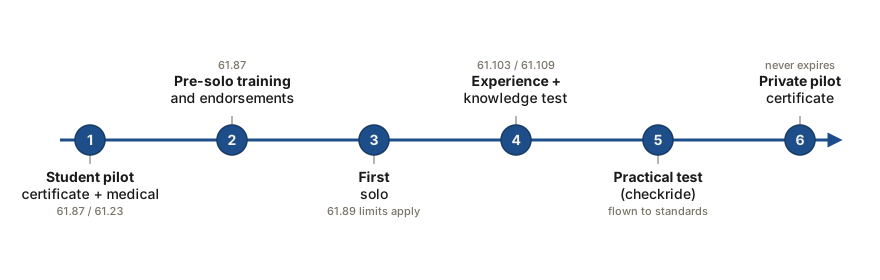
The student pilot certificate is issued once and never expires (14 CFR 61.19). By itself it carries no privileges; every flight you make on it is authorized by an instructor's endorsement. Before your first solo flight, the flight in which you are the sole occupant of the aircraft, your instructor gives you ground and flight training, has you pass a pre-solo written test, and endorses your logbook for solo flight in a specific make and model (14 CFR 61.87). A student pilot works under strict limitations (14 CFR 61.89). The one to remember is that a student pilot may not carry passengers.
To be eligible for the private certificate you must be at least 17 years old and able to read, speak, write, and understand English (14 CFR 61.103). You must also log the minimum aeronautical experience (14 CFR 61.109), the headline of which is at least 40 hours of flight time, including dual instruction, solo time, and required cross-country flights such as a long solo cross-country. Few students finish in exactly 40 hours; the national average runs higher, and the number is a floor, not a target.
Two tests close out the path. The knowledge test is the FAA's computer-based written exam, and this course is built to prepare you for it. The practical test, the checkride, is the flight test for the certificate. An FAA inspector or, far more often, a designated pilot examiner conducts it. The test follows the Airman Certification Standards (FAA-S-ACS-6C), the document that lists exactly what you must know and be able to do.
You can reach that checkride by two routes. Training under Part 61 follows a syllabus your instructor directs and adapts to you. Training at a Part 141 school follows an FAA-approved course, which sometimes allows the certificate at slightly fewer hours. Either way, a certificated flight instructor conducts your training and signs the endorsements that let you solo and, in time, take the practical test.
14 CFR 61.87, 61.89, 61.103, 61.109; PHAK Ch 1, "Becoming a Pilot"
The certificate does not expire, but its privileges have upkeep
Once issued, a pilot certificate is valid indefinitely (14 CFR 61.19). It has no renewal date, unlike a driver's license. What does need tending is your ability to use it: a flight review on a recurring schedule (14 CFR 61.56), recent flight experience before you carry other people (14 CFR 61.57), a current medical or BasicMed, and the documents you must have with you (14 CFR 61.3). Those rules are the subject of the next lesson, on currency and required documents.
14 CFR 61.19
Check your understanding
Answer from memory, without scrolling back up. Recalling it yourself is what makes it stick.
On a pilot certificate, what is "single-engine land"?
Category is the broad grouping (airplane); class subdivides it (single-engine land). Airplane is the category, single-engine land the class. (14 CFR 61.5)
Category is broad, class is narrow. Airplane is the category; single-engine land is the class within it. A rating states conditions such as instrument flight. (14 CFR 61.5)
Part 61 governs pilot certification. Which part governs general flight rules?
Part 61 covers certification of pilots; Part 91 holds the general operating and flight rules. Part 67 is medical standards and Part 68 is BasicMed. (14 CFR)
Part 91 holds the general operating and flight rules. Part 67 is medical standards; Part 68 is BasicMed. Part 61 certifies pilots.
In pro-rata cost sharing, how much of the expenses must the pilot pay?
The pilot must pay at least a pro-rata (equal) share of fuel, oil, airport expenditures, and rental. You cannot profit from the flight. (14 CFR 61.113)
Cost sharing lets you split fuel, oil, airport, and rental costs, but you must pay at least your equal share. Paying less would be flying for hire. (14 CFR 61.113)
A third-class medical is valid for how long, under 40 and at 40 or older?
A third-class medical lasts 60 calendar months if you were under 40 at the exam and 24 calendar months if you were 40 or older. (14 CFR 61.23)
The younger pilot gets the longer period: 60 calendar months under 40, and 24 calendar months at 40 and over. The 48-month figure is the BasicMed physician exam. (14 CFR 61.23)
Under BasicMed, how often are the physician exam and the medical course?
BasicMed needs a physician's comprehensive exam every 48 calendar months and an online medical education course every 24 calendar months. (14 CFR 61.23(c)(3))
The physician exam is the longer interval at 48 months; the online course is the shorter one at 24 months. The two are easy to swap, so anchor them. (14 CFR 61.23(c)(3))
Which passenger rule applies to a student pilot flying without an instructor?
A student pilot may not carry passengers. A solo flight means the student is the sole occupant of the aircraft. (14 CFR 61.89)
Carrying passengers is off-limits for a student pilot. Solo means sole occupant, and no endorsement changes that rule. (14 CFR 61.89)
What are the minimum age and language requirements for a private pilot?
A private pilot applicant must be at least 17 years old and able to read, speak, write, and understand English. (14 CFR 61.103)
The minimum age is 17, and the applicant must read, speak, write, and understand English. Sixteen is the age to solo, not to earn the certificate. (14 CFR 61.103)
What is the minimum total flight time for the private certificate under Part 61?
Part 61 sets a minimum of 40 hours, including dual, solo, and cross-country time. Most students need more; the number is a floor. (14 CFR 61.109)
The Part 61 minimum is 40 hours. Thirty-five is the Part 141 figure for some approved courses, and 20 is far below any private minimum. (14 CFR 61.109)
A high-performance airplane is defined by which feature?
High-performance means an engine of more than 200 horsepower. Retractable gear with flaps and a controllable-pitch propeller describes a complex airplane. (14 CFR 61.31)
High-performance is about power: more than 200 horsepower. The gear and propeller features define a complex airplane instead. (14 CFR 61.31)
When does a private pilot certificate expire?
The certificate itself does not expire. Using it requires a current flight review, recent experience, and a valid medical or BasicMed. (14 CFR 61.19)
The certificate never expires; only the ability to use it has upkeep, such as the flight review. The next lesson covers that upkeep in full. (14 CFR 61.19)
Go deeper (primary source): read 14 CFR Part 61, sections 61.113 (private pilot privileges), 61.31 (additional training required), 61.103 and 61.109 (eligibility and experience), and 61.23 (medical certificate durations). For BasicMed, read 14 CFR Part 68 and the FAA's BasicMed page.