Private Pilot · Unit 4 · 20 min
Accidents and Incidents: NTSB 830
By the end of this lesson you will know:
- why accident reporting is an NTSB rule in Title 49 rather than an FAA rule in Title 14
- how 49 CFR 830 defines an aircraft accident, an incident, serious injury, and substantial damage
- which occurrences require immediate notification to the nearest NTSB office
- the deadlines for the written accident report and the overdue-aircraft report
- how the NASA Aviation Safety Reporting System differs from a mandatory NTSB report
The earlier lessons in this unit covered who may fly, what keeps a certificate and an aircraft current, and the operating rules for the flight itself. This lesson covers what the regulations require after something goes wrong: when you must notify the government, how fast, and in what form. These duties come from 49 CFR Part 830, a rule of the National Transportation Safety Board, not the FAA.
The board and where its rule lives
The National Transportation Safety Board (NTSB) is an independent federal board charged with investigating accidents across the transportation system, including civil aviation. Because it is independent of the FAA, its rules sit in Title 49 of the Code of Federal Regulations, the transportation title, rather than in Title 14, where the FAA's aviation rules live.
Part 830 applies to the notification and reporting of aircraft accidents and certain incidents, and to the preservation of wreckage, mail, cargo, and records (49 CFR 830.1). The duties it creates fall on the operator of the aircraft, which the rule defines as any person who causes or authorizes the operation of an aircraft, such as the owner, lessee, or bailee (49 CFR 830.2). For the flights you will make as a student and a private pilot, you are that operator.
49 CFR 830.1; PHAK Ch 1, "The Regulatory System"
Accident or incident: the definitions
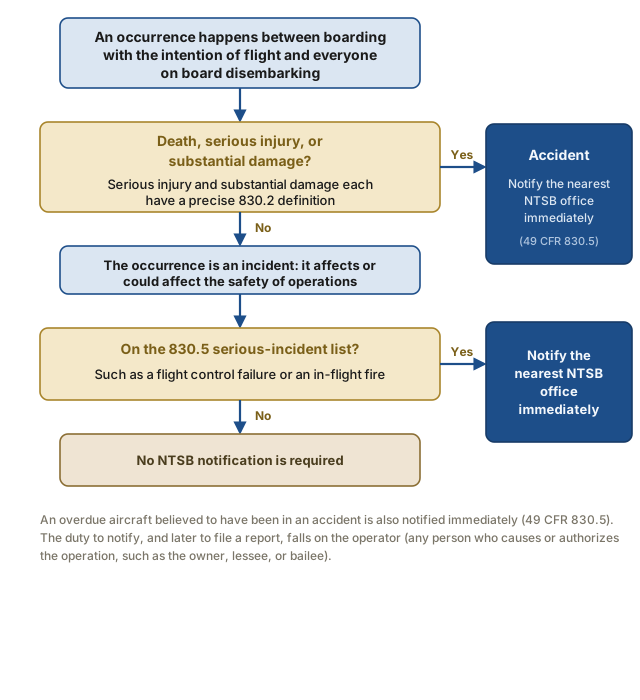
Part 830 turns on two defined terms. An aircraft accident is an occurrence associated with the operation of an aircraft that takes place between the time any person boards the aircraft with the intention of flight and the time all such persons have disembarked, and in which any person suffers death or serious injury, or the aircraft receives substantial damage (49 CFR 830.2). Two conditions must both hold: the occurrence falls inside the boarding-to-disembarking window, and it produces a death, a serious injury, or substantial damage to the aircraft.
An incident is an occurrence other than an accident, associated with the operation of an aircraft, that affects or could affect the safety of operations (49 CFR 830.2). Most incidents require no notification at all. A short list of serious incidents in 49 CFR 830.5 does require immediate notification.
49 CFR 830.2
Serious injury and substantial damage
Two of the accident triggers are themselves defined terms. A serious injury is any injury that meets one of these criteria (49 CFR 830.2):
- requires hospitalization for more than 48 hours, beginning within 7 days of the injury;
- fractures any bone, except simple fractures of fingers, toes, or the nose;
- causes severe hemorrhage or nerve, muscle, or tendon damage;
- involves any internal organ;
- involves second- or third-degree burns, or any burns affecting more than 5 percent of the body surface.
A fatal injury, by contrast, is defined by time: an injury that results in death within 30 days of the accident (49 CFR 830.2). A death from injuries after that 30-day window does not convert the occurrence into a fatal accident under the rule.
Substantial damage is damage or failure that adversely affects the structural strength, performance, or flight characteristics of the aircraft, and that would normally require major repair or replacement of the affected component (49 CFR 830.2). The rule then lists damage that does not count:
| Damage that does not count as substantial (49 CFR 830.2) |
|---|
| Engine failure or damage limited to one engine |
| Bent fairings or cowling |
| Dented skin |
| Small punctures in the skin |
| Ground damage to propeller blades |
| Damage to landing gear, wheels, tires, flaps, engine accessories, brakes, or wingtips |
49 CFR 830.2
Immediate notification
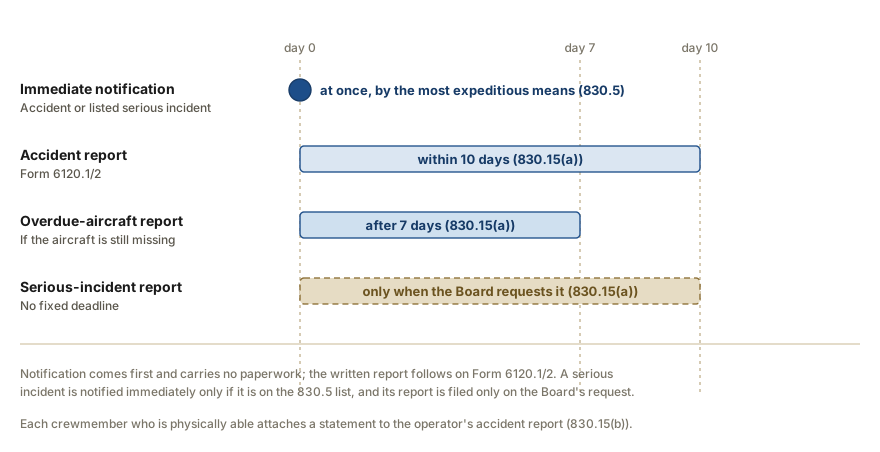
The operator must notify the nearest NTSB office immediately, and by the most expeditious means available, after an aircraft accident, after any of a listed set of serious incidents, or when an aircraft is overdue and is believed to have been in an accident (49 CFR 830.5). Immediately means by telephone or another prompt means, not by mail, and it precedes any written report.
The listed serious incidents that a light single-engine airplane can experience are these (49 CFR 830.5):
- a flight control system malfunction or failure;
- a required flight crewmember becoming unable to perform normal flight duties because of injury or illness;
- an in-flight fire;
- an in-flight collision between aircraft;
- damage to property other than the aircraft estimated to exceed $25,000 for repair, or fair market value if the loss is total, whichever is less;
- release of all or part of a propeller blade from the aircraft, except a release caused solely by ground contact.
The list in 49 CFR 830.5 continues with items you are unlikely to encounter in primary training, such as turbine engine failures that release debris, a complete loss of information from more than half of an aircraft's electronic cockpit displays, and certain air carrier runway events.
When you do notify, the notification must contain (49 CFR 830.6):
- the aircraft's type, nationality, and registration marks;
- the name of the owner and of the operator;
- the name of the pilot in command;
- the date and time of the accident;
- the last point of departure and the point of intended landing;
- the position of the aircraft relative to an easily defined geographical point;
- the number aboard, the number killed, and the number seriously injured;
- the nature of the accident, the weather, and the extent of damage, so far as is known;
- a description of any explosives, radioactive materials, or other dangerous articles aboard.
49 CFR 830.5, 830.6; AIM 7-7-2, "Aircraft Accident and Incident Reporting"
Preserving the wreckage
Until the NTSB takes custody of the wreckage, the operator must preserve it, together with any cargo and mail aboard and all records pertaining to the operation and maintenance of the aircraft and its airmen, and must protect the wreckage from further damage (49 CFR 830.10). Nothing may be disturbed or moved except when necessary for one of three purposes (49 CFR 830.10(b)):
- to remove persons who are injured or trapped;
- to protect the wreckage from further damage;
- to protect the public from injury.
When wreckage is moved for one of those reasons, sketches, notes, and photographs record the original positions and conditions first, so that the investigation is not deprived of the evidence (49 CFR 830.10(c)).
49 CFR 830.10
Filing the report
The immediate notification and the written report are separate duties. The operator files a written report of an aircraft accident on NTSB Form 6120.1/2 within 10 days of the accident (49 CFR 830.15(a)). If an aircraft was overdue and is still missing, the report is due after the aircraft has been missing for 7 days. A report on one of the listed serious incidents is filed only when an authorized representative of the Board requests it. Each crewmember who is physically able attaches a statement setting out the facts, conditions, and circumstances as they saw them (49 CFR 830.15(b)).
These NTSB reports are separate from the report to the FAA that the operating-rules lesson described, in which a pilot in command who deviates from a rule to meet an in-flight emergency sends the FAA Administrator a written account of the deviation on request (14 CFR 91.3(c)). Neither substitutes for the other.
49 CFR 830.15; AIM 7-7-2
The NASA report is a different program
The Aviation Safety Reporting System (ASRS) is a confidential program in which pilots and controllers report safety events and hazards. It is run by NASA, not the FAA, so that the agency that enforces the regulations does not hold the reports. The FAA will not use an ASRS report, or information derived from it, in an enforcement action, except information concerning accidents or criminal offenses (14 CFR 91.25). A timely filed report can also waive a penalty for an inadvertent, non-deliberate violation, under conditions the FAA states in AC 00-46F.
An NTSB notification is a legal duty triggered by an accident or a listed serious incident. A NASA report is a voluntary contribution to safety data that carries the 14 CFR 91.25 protection. Filing with NASA does not discharge the duty to notify the NTSB, and notifying the NTSB does not file anything with NASA.
14 CFR 91.25; AIM 7-7-1, "Aviation Safety Reporting Program"; AC 00-46F
Check your understanding
Answer from memory, without scrolling back up. Recalling it yourself is what makes it stick.
An aircraft accident under NTSB 830 must occur between?
The window runs from the time any person boards with the intention of flight until all such persons have disembarked (49 CFR 830.2). Engine start and takeoff clearance do not define it.
The window is boarding with the intention of flight until everyone has disembarked, not engine start or takeoff clearance (49 CFR 830.2).
Which injury counts as a serious injury under 830.2?
Any bone fracture is a serious injury except a simple fracture of a finger, toe, or nose (49 CFR 830.2). A forearm fracture qualifies; a bruise does not.
Simple finger, toe, and nose fractures are excepted, and a bruise is not listed. Any other bone fracture, such as a forearm, is a serious injury (49 CFR 830.2).
Which of these is NOT substantial damage under 830.2?
Ground damage to propeller blades is on the list of excluded damage (49 CFR 830.2). A bent firewall or a cracked spar is structural and does count.
A bent firewall and a cracked spar are structural damage. Ground damage to propeller blades is specifically excluded (49 CFR 830.2).
Which occurrence requires immediate notification to the NTSB?
A flight control system malfunction or failure is on the immediate-notification list (49 CFR 830.5). A dented cowling and a damaged tire are excluded damage.
A dented cowling and a flat-spotted tire are excluded from substantial damage. A flight control malfunction is a listed serious incident (49 CFR 830.5).
Damage to property other than the aircraft requires notification when it exceeds?
Property damage estimated to exceed $25,000 for repair, or fair market value if the loss is total, requires immediate notification (49 CFR 830.5).
The threshold is $25,000, not $10,000 or $50,000, measured by repair cost or fair market value (49 CFR 830.5).
After an accident, the written report to the NTSB is due within?
The written accident report is due within 10 days on NTSB Form 6120.1/2 (49 CFR 830.15(a)). The phone call is the separate immediate notification.
The report is due within 10 days on Form 6120.1/2, not in 24 hours and not on an FAA form (49 CFR 830.15(a)).
An overdue aircraft that is still missing generates a report after?
If a missing aircraft is still not found, the report is due after it has been missing for 7 days (49 CFR 830.15(a)).
The overdue-aircraft report is due after 7 days of the aircraft being missing, not 3 or 14 (49 CFR 830.15(a)).
A report on a listed serious incident is filed?
A serious-incident report is filed only when an authorized representative of the Board requests it, unlike the 10-day accident report (49 CFR 830.15(a)).
Only an accident carries the 10-day report deadline. A serious incident is reported only on the Board's request (49 CFR 830.15(a)).
Before the NTSB takes custody, wreckage may be moved to?
Wreckage may be disturbed only to remove injured or trapped persons, protect it from further damage, or protect the public (49 CFR 830.10(b)).
Clearing the runway or moving the aircraft home is not permitted. The exceptions are removing injured persons and protecting the wreckage or public (49 CFR 830.10(b)).
The FAA will not use a filed NASA ASRS report for enforcement except for?
The 14 CFR 91.25 protection excludes accidents and criminal offenses.
The exceptions in 14 CFR 91.25 are accidents and criminal offenses, not repeated violations or lapses in medical or currency status.
Go deeper (primary source): read 49 CFR 830.2 and 49 CFR 830.5 in full, then skim all of 49 CFR Part 830; it runs only a few pages. That completes the Regulations unit. Unit 5 opens with the airspace system and the visual flight rules weather minimums that go with it.